
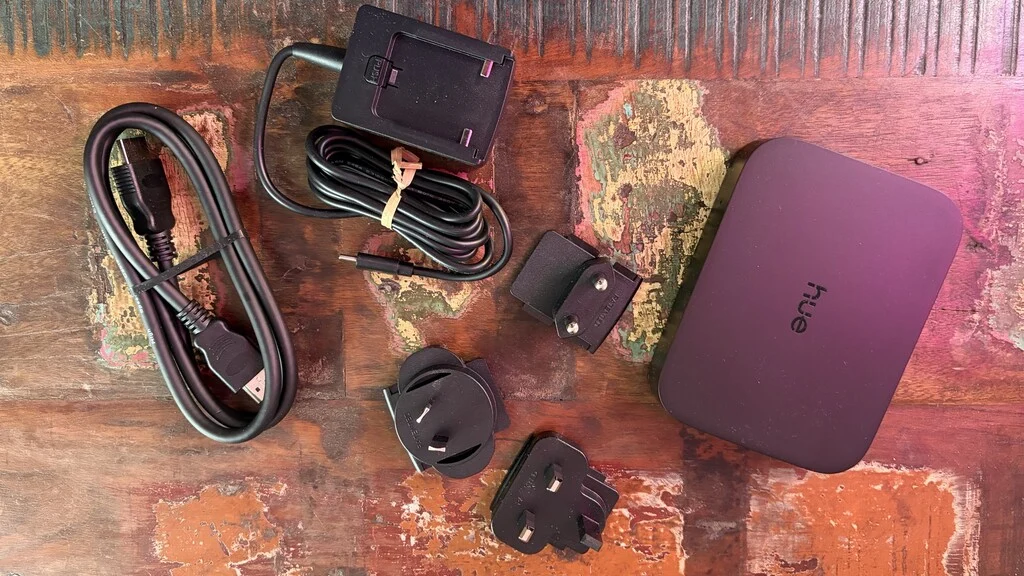
Signify, the company behind the Philips Hue smart lighting system, has unveiled the Philips Hue Play HDMI Sync Box 4K, a new iteration designed to democratize the immersive experience of screen-synced lighting. Launched in September 2026 at the IFA consumer electronics trade show, this latest offering aims to provide a more accessible entry point into Hue’s signature ambient lighting, significantly undercutting the price of its high-specification predecessor. While it foregoes some of the advanced features found in the flagship model, the Sync Box 4K prioritizes delivering the core movie-night enhancement that has captivated consumers.
The Philips Hue HDMI Sync Box has evolved since its initial debut in 2019. The original model offered 4K resolution at a 60Hz refresh rate, a capability that remained standard until the 2024 upgrade. This flagship, still current at the time of this review, introduced HDMI 2.1 support, enabling 4K at 120Hz and even up to 8K resolutions. However, this premium performance came with a substantial price tag, positioning it as a high-end accessory for enthusiasts. The new Sync Box 4K directly addresses this cost barrier, launching at less than half the price of the 8K model, signaling a strategic shift by Signify to broaden the appeal of its entertainment lighting solutions.

Strategic Positioning and Feature Set
The Sync Box 4K’s feature set is deliberately curated for a specific audience: those whose primary goal is to elevate their home entertainment experience, particularly movie nights, rather than to achieve the absolute cutting edge of gaming performance. This focus is evident in the decision to simplify the hardware, most notably by reducing the number of HDMI inputs from four in previous models to a single port. This simplification is a key differentiator and a significant factor in the device’s more accessible price point.
While the original 4K Sync Box already supported resolutions common for streaming and cinematic content, the new model maintains this capability. The reduction in HDMI inputs means the device is less of a comprehensive HDMI switcher, a feature that was beneficial for users with multiple connected devices. However, for a user base that primarily connects a single primary streaming device – such as an Apple TV, a dedicated streaming stick, or a cable box – to their television, this reduction is unlikely to be a significant drawback. The emphasis shifts from managing multiple inputs to providing a focused, immersive lighting experience.
The "8K" branding on the more expensive model, while attention-grabbing, is less functionally significant for the average consumer than the underlying HDMI 2.1 features it enables. The new Sync Box 4K adheres to HDMI 2.0 specifications, supporting 4K resolution at 60Hz and 1440p at 120Hz. For the vast majority of movie and TV streaming, which typically operates at frame rates of 24, 25, 30, or 60 frames per second, this is more than adequate. The absence of 4K at 120Hz is a direct concession for gamers who utilize compatible consoles and displays for high-refresh-rate gaming. For these users, the 8K Sync Box remains the superior, albeit more costly, option.

Competitive Landscape and Ecosystem Advantage
The market for TV backlighting and screen-syncing technology is not without its alternatives. Companies like Govee and AiDot offer their own solutions, often at competitive price points. However, Philips Hue leverages its established brand recognition and a deeply integrated smart lighting ecosystem. For existing Hue users, the Sync Box 4K presents an appealing and more affordable pathway to extend their current smart lighting setup into their primary viewing area.
Signify also introduced the Philips Hue Play Screen Sync at IFA, a system that employs a camera to capture on-screen colors and replicate them with ambient lighting. This camera-based approach offers the advantage of working with native smart TV apps and broadcast channels, areas where HDMI-connected devices cannot traditionally integrate. However, the inherent trade-off is the need for a camera to be positioned on or near the television, a design choice that many consumers may find intrusive. The HDMI Sync Box, by contrast, operates by intercepting the video signal, thus avoiding the need for external visual monitoring of the screen.
Design and Installation: A Compact and Streamlined Approach
A notable improvement in the new Sync Box 4K is its physical design. Significantly smaller than its predecessors, measuring 117 x 87 x 23mm, it adopts a more discreet profile, resembling a compact media player rather than a bulky AV component. This reduced size makes it easier to integrate seamlessly into existing entertainment setups, minimizing visual clutter. The unit is powered via a USB-C adapter, which is included in the package, along with an HDMI cable. Users also have the flexibility to utilize their own compatible USB-C power supplies.

Installation is designed to be straightforward, contingent on a basic understanding of how the device functions. The Sync Box acts as an intermediary, positioned between the HDMI source and the television. It intercepts the video signal, processes the color information, and transmits it to the connected Hue lights. Unlike camera-based systems, its operation is entirely independent of the visual content displayed on the screen itself.
The primary limitation encountered during installation, as with the previous models, is the reduced number of HDMI inputs. With only a single HDMI port, users must make a choice about which device to connect. This contrasts with the four inputs offered by both the original 4K and the 8K Sync Boxes, which allowed for seamless switching between multiple sources like gaming consoles, streaming boxes, and cable receivers. For users with more complex AV setups, the need to manually switch cables or employ an external HDMI switcher may be a consideration. However, for those whose viewing habits are predominantly managed by a single primary streaming device, this simplification aligns with the product’s cost-saving objective.
To achieve the full immersive effect, users will naturally require compatible Philips Hue lights. The Hue Play light bars are a popular choice for placement around the television, while a Hue Gradient Lightstrip can create a more continuous and expansive wash of color behind the screen. The reviewer utilized a Hue Gradient lightstrip on the TV and a Gradient Light Tube on an AV unit for their testing. The system also supports standard Hue white and color ambiance bulbs and fixtures, offering flexibility beyond the dedicated "Play" range. A Hue Bridge is essential for integrating multiple lights into a synchronized entertainment area.

The setup process is managed through the familiar Philips Hue app, a departure from the standalone Hue Sync app that was required for earlier models. The Sync Box is added to the app in a manner similar to adding any other Hue light, bulb, or sensor. Creating an "entertainment area" involves mapping the physical placement of lights in relation to the television within an interactive on-screen diagram. Users specify whether each light is positioned at floor level, alongside the TV, or overhead. The app then guides users through identifying individual lights and verifies the arrangement by synchronizing them with on-screen colors. Minor adjustments can be made if the initial results are not optimal. While this setup process is slightly more involved than simply plugging in a light strip, it is generally intuitive and manageable.
An interesting development is the inclusion of limited Bluetooth connectivity for compatible Hue lights, such as certain Gradient lightstrips and the OmniGlow range. This allows for initial setup with a single light without the necessity of a Hue Bridge. However, this Bluetooth-only configuration does not support the addition of a second light. While this offers a low-barrier entry point for users to sample screen-synced lighting, the reviewer still strongly recommends investing in a Hue Bridge for those who intend to expand their setup over time, as it unlocks the full potential of the Hue ecosystem, including multi-light synchronization and advanced features. It’s also worth noting that while multiple Sync Boxes can be deployed in a home, they cannot share an entertainment area or synchronize separate sources concurrently.
Performance: Immersive Lighting Without Compromise
The core performance of the Philips Hue Play HDMI Sync Box 4K, particularly in its intended use cases, is demonstrably strong. Testing with the same Hue lights and content at 4K/60Hz revealed no discernible difference in the lighting experience compared to the more expensive 8K model. The system effectively captures the colors from the HDMI signal and translates them into ambient lighting that dynamically shifts with on-screen action. The responsiveness is impressive, with minimal perceptible lag as colors, brightness, and scene changes on the television are mirrored by the Hue lights.

The immersive quality is particularly striking with content that features vibrant and dynamic color palettes, such as animated films and action-packed blockbusters. The reviewer noted that watching Marvel movies with family members was significantly enhanced, with the lighting extending the perceived action beyond the confines of the television screen. Explosions, expansive landscapes, and dramatic visual shifts were convincingly replicated by the surrounding lights, creating a more engaging and atmospheric viewing experience.
However, the intensity of the lighting effect is a crucial factor. While maximum brightness and intensity can produce a spectacular and immersive result during intense action sequences, it can also become distracting during more subdued scenes or less visually dynamic films. For content like the film "Train Dreams," the reviewer found that overly aggressive lighting could detract from the on-screen narrative. A more nuanced approach, with brightness set around 60% and intensity at a lower level, provided a subtler, more natural integration of light with the picture. This setting proved particularly effective for nature documentaries, where the shifting colors added atmosphere without overwhelming the visual content.
For users seeking a more dramatic effect, increasing the brightness and intensity to their maximum settings can indeed create a powerful and involving experience, especially with visually rich films.

The performance with standard television programming, however, is less ideal. The constant shifts in color during news broadcasts or commercials can be jarring, even with reduced settings. The reviewer concluded that the screen-syncing feature is best reserved for movies, select TV shows, and gaming, rather than being left active for all-day viewing.
Ultimately, the cost savings of the Sync Box 4K do not appear to come at the expense of the core functionality. Provided users operate within the device’s specified video capabilities, the lighting synchronization performs comparably to its higher-priced counterparts.
Broader Implications and Future Outlook
The introduction of the Philips Hue Play HDMI Sync Box 4K signifies a strategic move by Signify to capture a larger segment of the smart home market. By offering a more affordable gateway to immersive entertainment lighting, the company is likely to attract new users to the Hue ecosystem. This approach acknowledges that while high-end specifications appeal to a niche, accessibility is key to mass adoption.

The decision to focus on HDMI 2.0 capabilities and a single HDMI input, while limiting for some, directly addresses the needs and budgets of a broader consumer base. This allows existing Hue users to enhance their home entertainment without the significant investment previously required. It also positions Philips Hue favorably against competitors that may offer similar visual effects but lack the robust ecosystem and established brand loyalty of Philips Hue.
The continued development of the Hue app, integrating sync functionality seamlessly, further streamlines the user experience. The option for limited Bluetooth connectivity also provides a low-friction entry point for those hesitant to commit to the full Hue Bridge setup.
The implications for the home entertainment market are clear: immersive lighting is becoming an increasingly sought-after feature, and manufacturers are responding by offering tiered solutions. The Sync Box 4K demonstrates that effective and engaging ambient lighting does not necessarily require the most cutting-edge video specifications.

Final Verdict
The Philips Hue Play HDMI Sync Box 4K successfully democratizes Philips Hue’s signature screen-synchronized lighting experience. It offers a compact, user-friendly, and highly effective solution for enhancing movie nights and gaming sessions. Its performance with 4K/60Hz content is on par with the more premium 8K model, making the trade-offs in terms of HDMI inputs and high-refresh-rate gaming support easily justifiable for many users.
The primary limitations are the single HDMI input, which necessitates external switching for multi-device setups, and the absence of 4K at 120Hz support, a feature critical for hardcore gamers. Furthermore, the cost of the Sync Box 4K is only one part of the equation; the investment in compatible Hue lights and potentially a Hue Bridge will contribute to the overall expenditure.
However, for existing Philips Hue owners looking to elevate their entertainment without the flagship price tag, the Sync Box 4K represents an excellent value proposition. It delivers the core immersive experience that defines Hue’s screen sync technology, making it an accessible and compelling option for a wider audience. This device firmly establishes itself as an entry-level yet highly capable solution for bringing on-screen action to life with synchronized lighting.

