
The global corporate landscape is currently navigating a significant disconnect between the aggressive integration of artificial intelligence and the actual requirements of the end-user. While senior leadership teams across various industries have operated under the assumption that a "digital gold rush" of AI features would be met with universal enthusiasm, market data and user experience research suggest a growing resistance. This phenomenon, characterized by low adoption rates and high delivery costs, indicates that the current trajectory of AI development may be misaligned with the fundamental needs of the workforce and the consumer public.
The Emerging Adoption Gap and Economic Reality
Since the public release of large language models in late 2022, companies have pivoted billions of dollars in capital expenditure toward AI development. However, recent studies, including those by IBM and MindStudio, highlight a widening "adoption gap." By 2026, it is projected that many organizations will struggle to justify the high cost of AI delivery due to poor retention rates. The financial risk is twofold: the direct cost of infrastructure and specialized talent, and the indirect cost of reputational damage when AI features fail to perform reliably.
The primary driver of this gap is the industry’s tendency to treat AI as a standalone value proposition rather than a supportive tool. In many corporate environments, AI features are implemented as "bolt-ons"—separate interfaces or disconnected workflows that require employees to deviate from their established routines. Instead of streamlining operations, these tools often introduce a new layer of fragmentation, forcing users to hop between traditional systems and new AI platforms.
The Productivity Paradox: When Automation Intensifies Labor
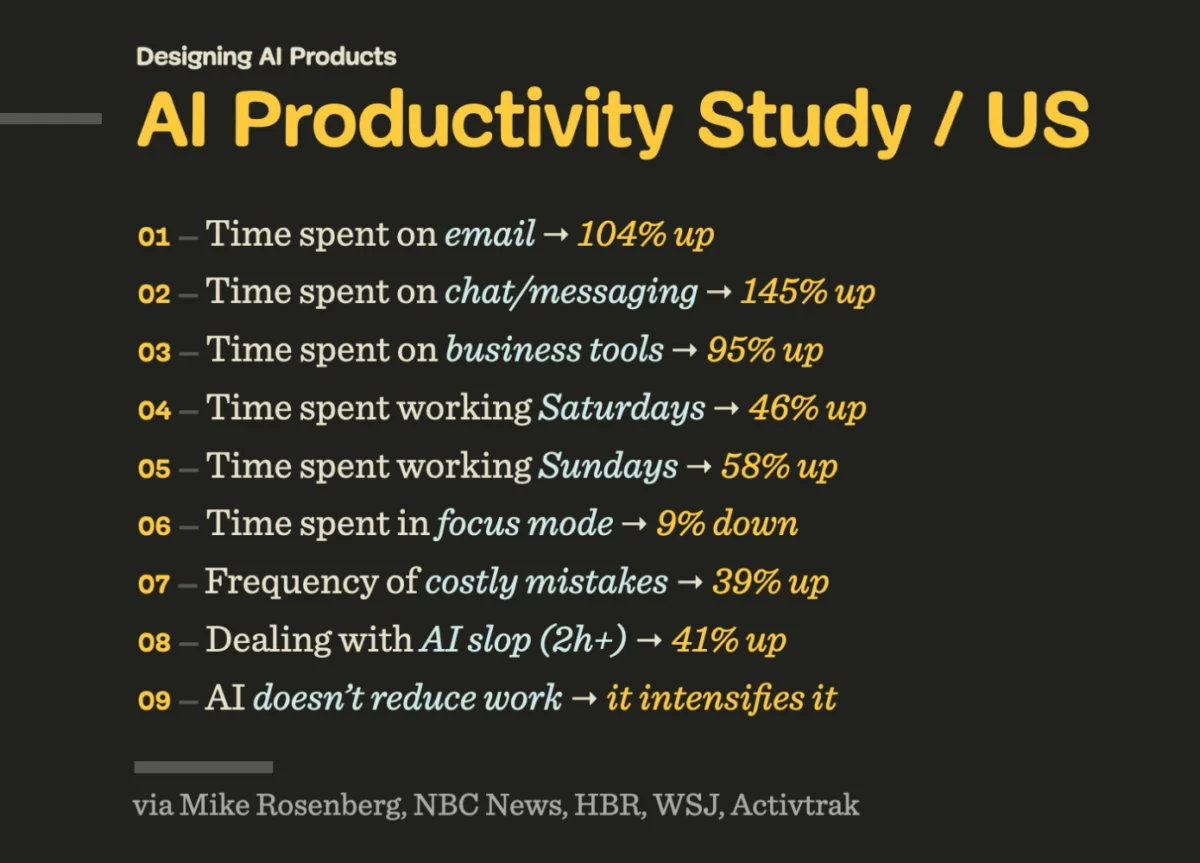
One of the most pervasive myths in the current technological era is that AI inherently reduces workload. On the contrary, emerging data from Activtrak, NBC News, and the Harvard Business Review suggest that AI integration has, in many cases, intensified the workday. Findings indicate that time spent on email has increased by 104% in some sectors, while business tool management has risen by 95%. Perhaps most tellingly, the frequency of work on weekends has seen a sharp uptick, with Saturday work increasing by 46% and Sunday work by 58%.
This "productivity paradox" is largely attributed to the hidden labor required to manage AI outputs. While an AI can generate a 500-word response in seconds, the human responsibility to fact-check, edit, and verify for "hallucinations"—the tendency of models to present false information as fact—remains high. Research from the Nielsen Norman Group (NN/g) suggests that AI chatbots can actually discourage thorough error-checking, leading to a 39% increase in costly mistakes. Users find themselves in a position of "cleaning up" after a swarm of AI agents, a task that is often viewed as more tedious and less rewarding than performing the original work from scratch.

Chronology of the AI Integration Wave
The current state of AI skepticism can be traced through a specific timeline of technological overreach:
- Late 2022 – Early 2023: The Novelty Phase. Following the launch of ChatGPT, organizations rushed to announce "AI-powered" versions of existing products. The market responded with high stock valuations based on potential rather than utility.
- Mid 2023 – Early 2024: The Implementation Phase. Companies began embedding generative AI into everyday software, from word processors to project management tools. During this period, the "bolt-on" approach became the industry standard.
- Mid 2024 – Present: The Disillusionment Phase. Users began reporting "AI fatigue." The realization that AI is neither predictable nor reliable in high-stakes environments led to a plateau in active daily usage for many enterprise AI features.
As of late 2024, the focus has shifted from "can we build it" to "should we build it," as organizations grapple with technical debt and the realization that AI cannot magically fix years of accumulated organizational dysfunction or broken internal cultures.
Labor Vulnerability and the Human Element
The psychological impact of AI integration cannot be overstated. A significant portion of the workforce views AI not as a partner, but as an uninvited intruder that threatens job security. A study by the Brookings Institution and the Washington Post categorized jobs based on their exposure to AI automation. While software developers and public relations specialists are among the most exposed, professions requiring physical presence and high-stakes human empathy, such as firefighters and healthcare providers, remain the least vulnerable.

However, even in highly exposed fields, there is a distinct human preference for "taste" and "intuition"—qualities that current AI models cannot replicate. Users do not generally desire AI-narrated children’s books, AI-generated art museums, or AI-driven romantic partners. The resistance to these applications stems from a fundamental human desire to engage with the consciousness and effort of other human beings. When technology attempts to automate the creative or emotional core of a task, it often strips away the sense of achievement and reward that makes the work meaningful.
Official Responses and Expert Analysis
Industry leaders and UX designers are beginning to call for a "human-centric" pivot. Bo Young Lee, a prominent voice in organizational strategy, recently articulated the sentiment of many workers: "I want AI to do all the physical and mental labor that taxes me so I can read books written by humans and go to art galleries to engage with art made by humans. I want AI that makes my life easier rather than forces me to change myself."
Vitaly Friedman, a noted UX expert and founder of Smashing Magazine, argues that the most successful AI tools are not "AI-first," but "AI-second." This philosophy advocates for subtle, ambient technology that takes a supportive role in the background. Instead of demanding a conversational interface for every task, "AI-second" design focuses on automating the mundane, predictable, and repetitive tasks that users find no pleasure in performing.

Implications for Future Product Development
For AI to move past its current adoption plateau, developers and senior leaders must reconcile with several hard truths regarding user experience and value delivery:
- Integration over Innovation: AI must be deeply integrated into existing mental models. If a user has spent a decade perfecting a specific workflow, an AI tool that requires them to abandon that workflow will likely be rejected, regardless of its theoretical efficiency.
- Reliability as a Requirement: In the software world, users compare features with features. If a traditional automation tool works 100% of the time and an AI tool works 85% of the time, the user will invariably choose the former for critical tasks. Reliability is the only path to trust.
- The Search for Utility: Organizations must identify "high-pain, low-reward" tasks for AI intervention. Automating the creative "soul" of a project creates resentment; automating the filing, data entry, and scheduling creates gratitude.
- Economic Sustainability: The high energy and compute costs of generative AI mean that "frivolous" AI features are not only annoying to users but also economically unsustainable for the provider.
Conclusion: A Return to Human-Centricity
The data suggests that the "more is better" approach to AI is failing. People do not want more AI in their lives; they want more time for the things that AI cannot do. The future of the technology lies in its ability to become invisible—to function as a quiet infrastructure that handles the "boring stuff," thereby freeing human beings to engage in thinking, laughing, and connecting.
As the industry matures, the companies that succeed will be those that stop marketing AI as a miracle cure and start treating it as a standard utility. By focusing on predictability, accessibility, and genuine utility, the tech industry can bridge the gap between corporate ambition and the reality of the human experience. The goal of technology has always been to augment human capability, not to replace the human spirit. In the coming years, the most valuable "feature" a company can offer may not be an AI agent at all, but the gift of time and the preservation of human-to-human connection.

