
The modern digital storefront is increasingly shaped by two powerful forces: the authentic voice of content creators and the intelligent algorithms of AI shopping assistants. Yet, a growing disconnect between these two realms is costing brands valuable conversions and eroding marketing ROI. The problem lies in a fundamental linguistic divide: creators speak human, contextual language, while many brand product catalogs remain mired in technical jargon and insufficient detail.
Consider a recent viral sensation: A creator passionately showcases a compact carry-on, extolling its virtues: “I’ve dragged this through six airports; it fits every overhead bin, and the front pocket actually holds my laptop.” The comments section explodes with eager buying questions. While some viewers immediately tap the creator’s direct link, a significant portion turns to AI shopping assistants like ChatGPT or Gemini, querying for “the suitcase with a laptop pocket that fits overhead bins.” This second group often encounters a frustrating dead end. The brand’s official catalog, in stark contrast, describes the item as a "22-inch polycarbonate spinner," omits any mention of the crucial laptop compartment, and lists the popular "beige" color as "stone." The creator masterfully ignited preference and demand, but the brand’s product data failed to carry that preference into the next crucial stage of the shopper’s journey.
The Dual Ascent of Creator Commerce and Conversational AI
The rise of creator commerce has fundamentally reshaped how consumers discover and engage with products. Valued at over $100 billion and projected to grow substantially, the creator economy thrives on authenticity, relatability, and contextual storytelling. Influencers on platforms like TikTok, Instagram, and YouTube provide real-world demonstrations, answer nuanced questions, and build trust that traditional advertising often struggles to achieve. They explain why a pan is easy to clean after eggs, how a jacket layers over a thick sweater, or that a desk lamp avoids glare during video calls – details that resonate deeply with potential buyers. This human-centric approach transforms abstract product features into tangible benefits.
Simultaneously, conversational AI has emerged as a powerful new interface for online shopping. Tools like ChatGPT and Google Gemini are increasingly being utilized as personal shopping assistants, capable of processing natural language queries and offering product recommendations. These AI platforms aim to streamline the discovery process, moving beyond keyword-based searches to understand complex, multi-attribute requests. A shopper no longer just searches for "women’s footwear"; they ask for "white sneakers that won’t look too sporty with a dress, come in wide sizes, and can arrive before a weekend trip." The efficacy of these AI assistants hinges entirely on the quality, richness, and human-readability of the underlying product data they access.
The collision of these two trends creates both immense opportunity and a significant challenge. Creators generate a new lexicon of product description, rooted in user experience. AI assistants are poised to interpret and act on this natural language. However, if the brand’s product information systems – the catalogs, feeds, and product pages – do not align with this human-centric language, the entire conversion funnel breaks down.
The Linguistic Divide: Creator Narratives vs. Catalog Specifications
The core issue is a semantic chasm between the language of influence and the language of inventory. Creators sell through context, utility, and emotion. They understand the "why" behind a purchase. For instance, a skincare creator might describe a moisturizer as "the perfect lightweight option for people who hate heavy creams and want something that sits beautifully under makeup." This addresses texture, finish, and application context – critical human concerns.
In contrast, traditional product catalogs, often managed by Product Information Management (PIM) systems, tend to speak in technical specifications: category names, dimensions, internal SKU labels, ingredients lists, and marketing copy approved at product launch. The moisturizer’s product page might list "barrier-supporting hydration" and a full ingredient breakdown, but completely omit any mention of its texture, absorption time, or compatibility with makeup. While technically accurate, this information fails to connect with the human questions sparked by the creator.
This disconnect is not accidental; it stems from different objectives and legacy systems. Product catalogs were historically designed for internal inventory management, technical specifications, and broad keyword matching for search engines. They were not built to capture the nuanced, experiential language that drives modern consumer preference or to feed intelligent AI systems that mimic human conversation. The result is a system optimized for data entry and categorization, rather than for seamless customer understanding and AI interpretation.
Quantifying the Lost Opportunity: Conversion Fallout and Eroded Trust
The consequences of this linguistic misalignment are tangible and costly. When a shopper, inspired by a creator, cannot find the product using their natural language queries via an AI assistant or even on a brand’s website, several negative outcomes ensue:
- Lost Conversions: The primary impact is a direct loss of sales. The creator has done the hard work of creating preference and demand, but the inability to easily locate or identify the product translates directly into abandoned carts and missed purchases. Industry analyses often suggest that poor product information can lead to significant drops in conversion rates, with some estimates putting it as high as 20-30% for complex products.
- Eroded Marketing ROI: Brands invest substantial resources in creator campaigns. If the generated demand cannot be efficiently channeled into purchases due to inadequate product data, a significant portion of that marketing spend is wasted. The effectiveness of an influencer campaign isn’t just about reach and engagement, but also about the brand’s readiness to convert that interest into revenue.
- Customer Frustration and Brand Damage: Shoppers today expect frictionless experiences. The frustration of searching for a "beige suitcase with a laptop pocket" and only finding a "stone 22-inch polycarbonate spinner" erodes trust and negatively impacts brand perception. This often leads to increased customer support inquiries, further straining resources.
- AI Assistant Underperformance: If AI shopping assistants cannot accurately match natural language queries to product data, they may suggest irrelevant items or, worse, recommend competitors’ products that do have better-structured information. This undermines the brand’s visibility in a rapidly growing discovery channel. OpenAI’s merchant page explicitly invites brands to share product data for inclusion in ChatGPT’s shopping experiences, underscoring the critical need for comprehensive and accurate feeds. Similarly, Google’s Product structured data guidelines emphasize that rich, detailed data makes products eligible for enhanced search results, including price, availability, and reviews.
The "freshness problem" further exacerbates these issues. A creator’s recommendation can circulate for months, long after a campaign’s official end. If product details like price, stock availability, or specific features aren’t dynamically updated and accurately reflected across all channels, the enduring demand generated by the creator can lead to disappointment and lost sales due to outdated information.
Bridging the Divide: Strategies for Data Harmonization
To thrive in the creator- and AI-driven commerce landscape, brands must implement robust strategies for data harmonization, ensuring product information is accurate, rich, and semantically aligned with how customers speak.
- Integrated Product Data Systems: The foundation is a connected product-data and storefront system. This means integrating PIM systems with e-commerce platforms, Digital Asset Management (DAM) tools, and external channel listings (marketplaces, social commerce platforms, AI feeds). Such integration ensures that descriptions, attributes, availability, and pricing are consistently updated across all touchpoints.
- Capturing Creator Insights Systematically: Brands need a formal process to capture and integrate the "human language" from creator campaigns:
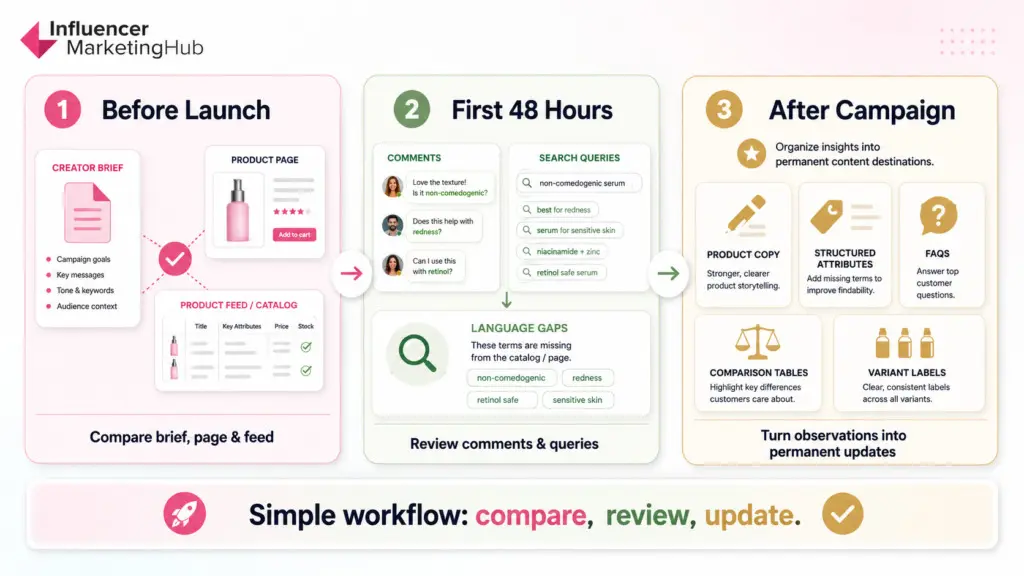
- Pre-Campaign Alignment: Before launch, marketing and e-commerce teams must compare the creator brief’s talking points with existing product page copy and data feeds. This proactive step identifies immediate gaps.
- Real-time Monitoring: During the initial 48-72 hours of a campaign, teams should actively monitor comments, social media mentions, and internal site search queries. Look for repeated questions, unexpected use cases, common comparisons, objections, and specific creator wording that reveals how shoppers genuinely perceive and categorize the product. For instance, if a creator highlights that a tote "stands upright" or a microphone "works seamlessly with an iPhone," and these become recurring themes in comments, these details are crucial.
- Post-Campaign Integration: After a campaign, a dedicated review process should determine which insights belong in permanent product copy, structured attributes, FAQs, comparison tables, or variant labels. This ensures valuable, context-rich information isn’t lost.
- Rich, Granular, and Contextual Data: Beyond the basics (accurate name, images, price, stock, variants, shipping), product data must be enriched with useful specificity. This includes:
- Experiential Attributes: "Doesn’t glare during video calls" (desk lamp), "ear cups don’t press against glasses" (headphones), "functional pockets" (dress).
- Usage Context: "Good for sensitive skin," "travel-friendly," "quick-drying."
- Semantic Equivalents: Mapping "stone" to "beige," "compact" to "fits overhead," or "barrier-supporting" to "lightweight."
- Compatibility Details: Explicitly stating device compatibility for electronics.
- Unique Selling Propositions: What makes this item stand out, as highlighted by creators.
- Robust Structured Data Implementation: Adhering to standards like Google’s Product structured data and Google Merchant Center’s product data specification is non-negotiable. These structured formats allow search engines and AI assistants to parse product information accurately, enhancing visibility and matching capabilities. Brands should also actively explore opportunities to feed product data directly to AI platforms like ChatGPT, as outlined in their merchant programs.
- Dynamic and Real-time Data Management: Given the speed of social commerce and AI interactions, product data must be dynamic. Real-time updates for prices, stock levels, and promotions across all channels prevent customer dissatisfaction and ensures AI assistants provide current information. The article correctly notes that OpenAI’s shopping results may reflect third-party data and not always the lowest price, underscoring the brand’s responsibility to provide accurate, up-to-date information directly.
Industry Perspectives and the Path Forward
E-commerce strategists and brand managers increasingly recognize the urgency of this data transformation. "The days of static, keyword-stuffed product descriptions are over," states Dr. Anya Sharma, a leading e-commerce analyst. "Consumers are looking for context and utility, and AI is learning to understand those nuances. Brands that fail to bridge the semantic gap between their creators and their catalogs will simply become invisible in the evolving digital landscape."
This shift requires significant organizational alignment. Marketing, e-commerce, merchandising, and IT teams must collaborate closely, moving beyond traditional departmental silos. The "campaign brief" must reach beyond creative execution and reporting; it needs to inform and update the "catalog brief."
Measuring the success of this integration also demands new metrics. While direct attribution (tracked links, discount codes) remains important, brands must also track:
- Branded Search Lift: Increases in searches for product names or creator-used phrases.
- AI/Conversational Search Referrals: Traffic originating from AI shopping assistants.
- Product Data Correction Rate: How often staff must fix product titles, prices, images, or compatibility details after a campaign begins. A high rate indicates poor preparation.
- Customer Support Insights: A reduction in product-related queries post-campaign (e.g., "Is this the one from the video?", "Does it fit my device?"). These tickets are invaluable clues about missing information in the catalog.
The Influencer Marketing Hub’s 2026 benchmark report highlights operational issues like measurement design, quality controls, and AI-enabled scaling as critical for influencer marketing success. This context reinforces that weak sales after creator exposure may not signify a creative failure, but rather a deficiency in the underlying commerce infrastructure.
Conclusion: The Imperative for Semantic Alignment
Creators have become invaluable sources of product language, capturing the real questions buyers ask before, during, and after a purchase. AI shopping systems offer an unprecedented opportunity to scale this demand, but only if the product remains recognizable and accurately described across all digital interfaces. The brands that will truly thrive are not necessarily those that publish the most content, but those that master the art of connecting authentic customer language to accurate, current, and richly detailed product information. This requires a concerted, cross-functional effort to harmonize the human insights of creators with the structured demands of product catalogs.
The time for brands to audit their product data is now. Pick one product from a recent creator campaign and rigorously compare the words used in the post, the comments it generated, the official product page, and the underlying catalog fields. The discrepancies revealed will be a powerful indicator of the path forward towards a truly unified, human-centric, and AI-ready commerce experience.

