
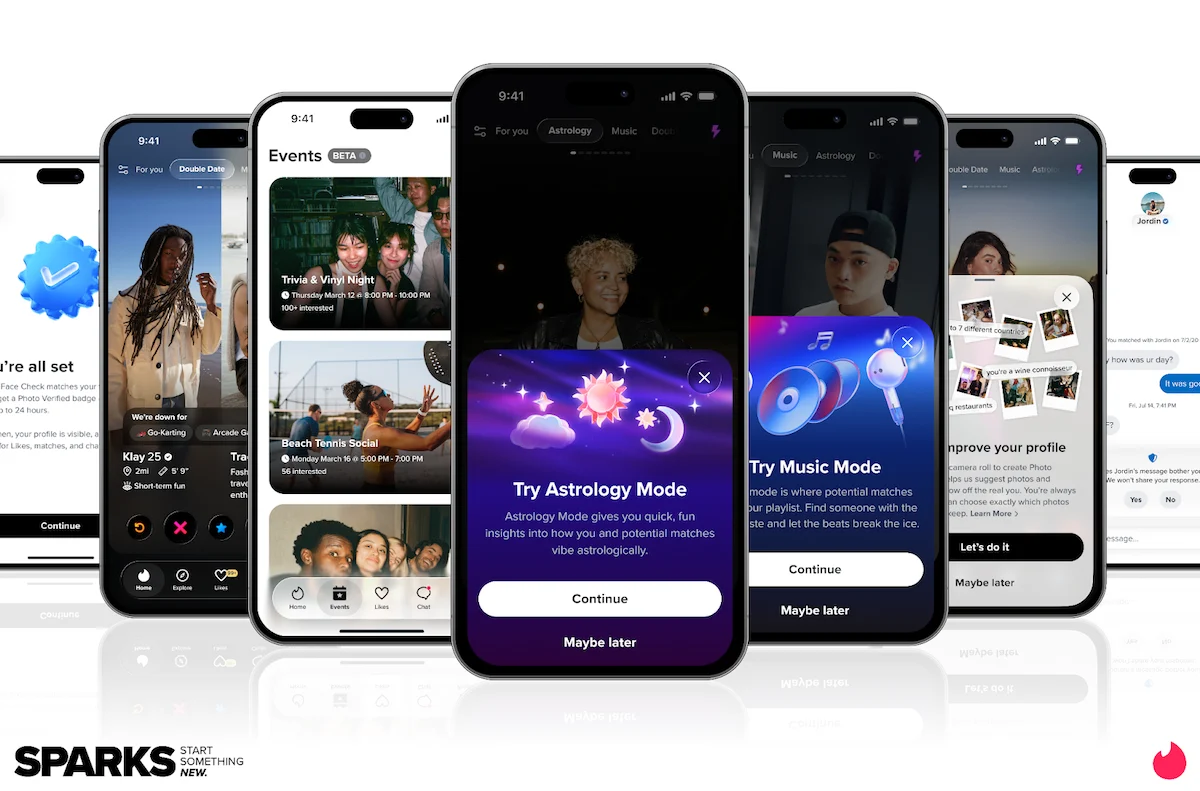
Tinder, the global leader in online dating, held its inaugural product keynote on Thursday, unveiling an ambitious and multi-faceted slate of updates designed to fundamentally reinvigorate its core product, bolster user safety, and harness the cutting-edge capabilities of artificial intelligence. This significant strategic pivot follows Match Group’s substantial $60 million investment in product development, a move initially announced last August, signaling the parent company’s concerted effort to re-engage its expansive user base and, critically, win over the elusive and discerning Gen Z demographic.
The comprehensive array of new features and enhancements represents a strategic response to evolving user preferences and intense market competition. Central to these updates are innovative functionalities aimed at facilitating real-world connections, including a dedicated "Events" tab for discovering curated in-person gatherings and a novel virtual speed dating experience currently undergoing pilot testing in Los Angeles. Concurrently, Tinder is integrating a series of advanced AI enhancements designed to refine its matching algorithm for greater personalization and significantly augment its user safety protocols. This dual focus on bridging the digital-to-physical gap and leveraging sophisticated technology underscores a pivotal shift in Tinder’s operational philosophy, moving beyond its foundational swiping mechanic to cultivate a more holistic and secure dating ecosystem.
The Strategic Imperative: Re-engaging a Shifting User Base
Tinder’s aggressive overhaul arrives at a critical juncture for Match Group, its parent company. While the dating app conglomerate reported a positive financial outcome for Q4 2025, with revenues reaching $878 million, it has concurrently faced a challenging period marked by several consecutive quarters of declining paying subscribers. This trend has placed considerable pressure on the company to innovate and adapt, not only to retain its existing user base but also to attract new generations of daters who exhibit distinct preferences and expectations. The $60 million investment underscored a clear commitment from Match Group to inject new life into its flagship product and restore investor confidence amidst a cautious market outlook that acknowledges changing user behaviors and heightened competitive intensity from both traditional rivals and emerging social platforms.
Industry analysis suggests that Gen Z, a demographic increasingly influential in shaping digital trends, is exhibiting a noticeable shift away from the traditional, often superficial, endless-swiping model that once defined online dating. This cohort, having grown up immersed in digital interactions, now expresses a strong appetite for more authentic, spontaneous, and real-world encounters. Data from recent market surveys indicates a growing preference among young adults for meeting potential partners through shared activities, social events, or even serendipitous encounters, rather than solely relying on profile-based algorithmic matching. This trend aligns with a broader cultural movement towards "IRL" (in-real-life) engagement, where digital tools are leveraged not as ends in themselves, but as facilitators for genuine human connection offline.

Pioneering In-Real-Life Connections: The "Events" Tab
One of the most anticipated and notable features introduced at the keynote is the new "Events" tab, which is set to enter beta testing for users in Los Angeles starting in late May or early June. This functionality marks Tinder’s most direct foray yet into the realm of organized offline interaction. The "Events" tab will allow users to discover and browse a curated selection of local happenings, ranging from niche social gatherings like speakeasy nights and pottery classes to more dynamic activities such as bowling leagues and raves. The explicit goal is to provide a seamless bridge for users to connect with potential matches in person, moving beyond the screen into shared experiences.
Hillary Paine, Senior Vice President of Product at Tinder, articulated the strategic vision behind this initiative in an interview with TechCrunch, stating, "We’re really trying to tap into meeting younger users at the places where they’re already hanging out. You can go to an event with your friend and have a good time, or you could meet somebody new. Instead of asking users to choose between their dating life and their social life, we’re trying to blend these things together and create a more social community first experience." This statement highlights Tinder’s ambition to reposition itself not merely as a dating app, but as a social discovery platform that integrates dating seamlessly into users’ existing social lives.
The "Events" tab is a direct acknowledgment of Gen Z’s burgeoning desire for real-world encounters over what is often described as "swipe fatigue"—the burnout associated with endless, often unfulfilling, swiping through profiles. This demographic is increasingly seeking authentic offline experiences or unconventional methods to meet potential partners. This shift is not unique to Tinder; other innovative apps like Breeze, 222, Timeleft, and Thursday have already begun to successfully tap into this in-real-life (IRL) trend, demonstrating a viable market for platforms that facilitate face-to-face interactions. Tinder’s entry into this space, backed by its massive user base, could significantly accelerate the mainstream adoption of event-based dating.
A particularly intriguing aspect of the "Events" tab is the post-event feature: profiles of attendees will be made available on the app, allowing users to "like" and swipe through individuals they may have encountered. This innovative approach evokes the nostalgic charm of "Missed Connections" ads, providing a second chance for users who might have lacked the courage to approach someone in person or simply missed the opportunity during the event. This mechanism mitigates the pressure of immediate interaction while still leveraging the serendipity of shared physical space, offering a thoughtful blend of digital convenience and real-world connection.
The Resurgence of Speed Dating: A Virtual "Vibe Check"
Parallel to its IRL initiatives, Tinder is also embracing the resurgence of speed dating, albeit with a modern, virtual twist. The company revealed it is piloting a video speed dating experience in Los Angeles, allowing users to join scheduled three-minute video chats with potential matches. This feature is strategically designed as a "vibe check," enabling individuals to quickly break the ice, gauge chemistry, and assess compatibility before committing to a more significant in-person meeting. Users will have the option to extend promising conversations beyond the initial three minutes, and a verified profile photo will be a prerequisite for participation, enhancing accountability and security.

The reintroduction of video-based interactions, however, comes with its own set of challenges and historical context for Tinder. During the peak of the COVID-19 pandemic, the platform launched a "Face-to-Face" video chat feature, which was subsequently discontinued due to declining interest. Many daters, after an initial surge in virtual communication during lockdowns, appear to have experienced "video chat fatigue." This raises questions about the long-term success of Tinder’s new speed dating experiment, especially given its relatively late entry into a space where other platforms have already explored and, in some cases, scaled back similar offerings. Tinder’s success will hinge on its ability to make this experience feel fresh, efficient, and genuinely valuable, perhaps by integrating it more tightly with its broader personalization efforts.
The AI Imperative: Enhanced Matching and Unprecedented Safety
Artificial intelligence was a dominant theme at Tinder’s keynote, underscoring its pivotal role in the platform’s future. Tinder is significantly deepening its investment in AI, starting with the widespread rollout of its "Chemistry" feature. This sophisticated system utilizes AI to learn about users through a series of questions and, with their explicit permission, by analyzing their camera rolls. The objective is to curate a more personalized and relevant set of daily matches, thereby combating "swipe fatigue" and improving the overall quality of connections. "Chemistry," having undergone successful initial testing in Australia and New Zealand, is now being rolled out across the U.S. and Canada. Tinder envisions "Chemistry" evolving from a standalone feature into a foundational element that shapes the entire user experience, making it profoundly more personalized and intuitive.
Further enhancing personalization, Tinder introduced a new "Learning Mode" designed to accelerate the platform’s understanding of user preferences. This AI-driven system aims to present more relevant matches significantly earlier in the user journey. Traditionally, Tinder required multiple swiping sessions to gather sufficient data signals for effective personalization. With "Learning Mode," the system can begin to understand a user’s inclinations and desires from their very first session. Paine emphasized the transformative potential, stating, "We’re hoping that this is something that makes Tinder really feel like it understands you from the very first time you use it, or if you’re returning to Tinder after some time away, it feels like it gets me, and I don’t have to spend a lot of time telling Tinder what I’m looking for again." This promises a more efficient and less frustrating onboarding or re-engagement experience, crucial for retaining users in a competitive market.
Beyond personalization, AI is being heavily leveraged to fortify Tinder’s safety infrastructure. The "Does This Bother You?" feature, designed to prompt users about potentially harmful messages, has been upgraded with large language models (LLMs) to enhance its detection capabilities for offensive or disrespectful content. This advanced AI can now more accurately identify and even auto-blur inappropriate messages, creating a safer communication environment. Similarly, the "Are You Sure?" prompts, which encourage users to reconsider sending potentially harmful messages, are being fine-tuned with greater precision to identify and flag interactions that could be perceived as disrespectful or abusive. These AI-driven safety enhancements are crucial for building trust and ensuring a positive user experience, particularly among Gen Z daters who prioritize online safety and respect.
A Fresh Aesthetic and Expanded Experiential Modes
Beyond the functional updates, Tinder is also rolling out a sleek visual redesign aimed at modernizing its interface and enhancing user engagement. The aesthetic overhaul includes edge-to-edge profile photos, a subtle blur effect for background elements, and a refined "Liquid Glass" aesthetic for the iconic Like and Nope bar, creating a more sophisticated and immersive visual experience.

Accompanying the visual refresh are several new "Modes" designed to enrich user profiles and facilitate more nuanced connections based on shared interests:
- Music Mode: This feature will allow users to seamlessly integrate up to 20 Spotify songs that auto-populate their profile, offering a dynamic and authentic glimpse into their musical tastes and potentially serving as a powerful conversation starter.
- Astrology Mode: Tapping into a growing interest in astrological compatibility, this mode will enable users to add their birth details to unlock and display their Sun, Moon, and Rising signs, allowing for a quick check of astrological compatibility with potential matches.
These new modes follow the recent launches of "Double Date Mode," designed for users seeking to find other couples for group outings, and "College Mode," which tailors the experience for university students, further demonstrating Tinder’s commitment to providing diverse and tailored dating experiences.
Broader Impact and Future Implications
The extensive suite of announcements from Tinder signals a pivotal and comprehensive shift in its strategic approach. For Match Group, these innovations are not merely incremental updates but represent a significant investment in securing its market leadership and reversing recent trends in subscriber decline. The company’s Q4 2025 earnings report, while showing robust revenue of $878 million, simultaneously highlighted the pressing need to address the challenge of declining paying subscribers. This dynamic places immense pressure on Tinder to demonstrate the efficacy of these new features in driving user acquisition, engagement, and ultimately, monetization.
The focus on IRL events and enhanced personalization through AI positions Tinder to directly compete with both established dating apps and newer social platforms that have successfully captured the attention of younger demographics. By blending dating with social discovery and community building, Tinder aims to transcend its reputation as solely a hookup app and foster a more meaningful, long-term connection with its users. The emphasis on safety, driven by advanced AI, is also a crucial component of this strategy, addressing a persistent concern for online daters and aiming to differentiate Tinder as a trustworthy platform.
While the success of these changes remains to be seen, particularly in an increasingly saturated and competitive market, one aspect is undeniably clear: Tinder is making a profound and significant commitment to the future of dating. The era of solely relying on simplistic swiping mechanics appears to be drawing to a close. Instead, Tinder is adapting proactively, leveraging technology and insights into user psychology to create a more dynamic, personalized, and socially integrated experience that aligns with the evolving desires of its global user base, especially the influential Gen Z daters who are shaping the future of digital interaction. This bold reinvention could very well set a new standard for how dating apps operate in the coming years.

