
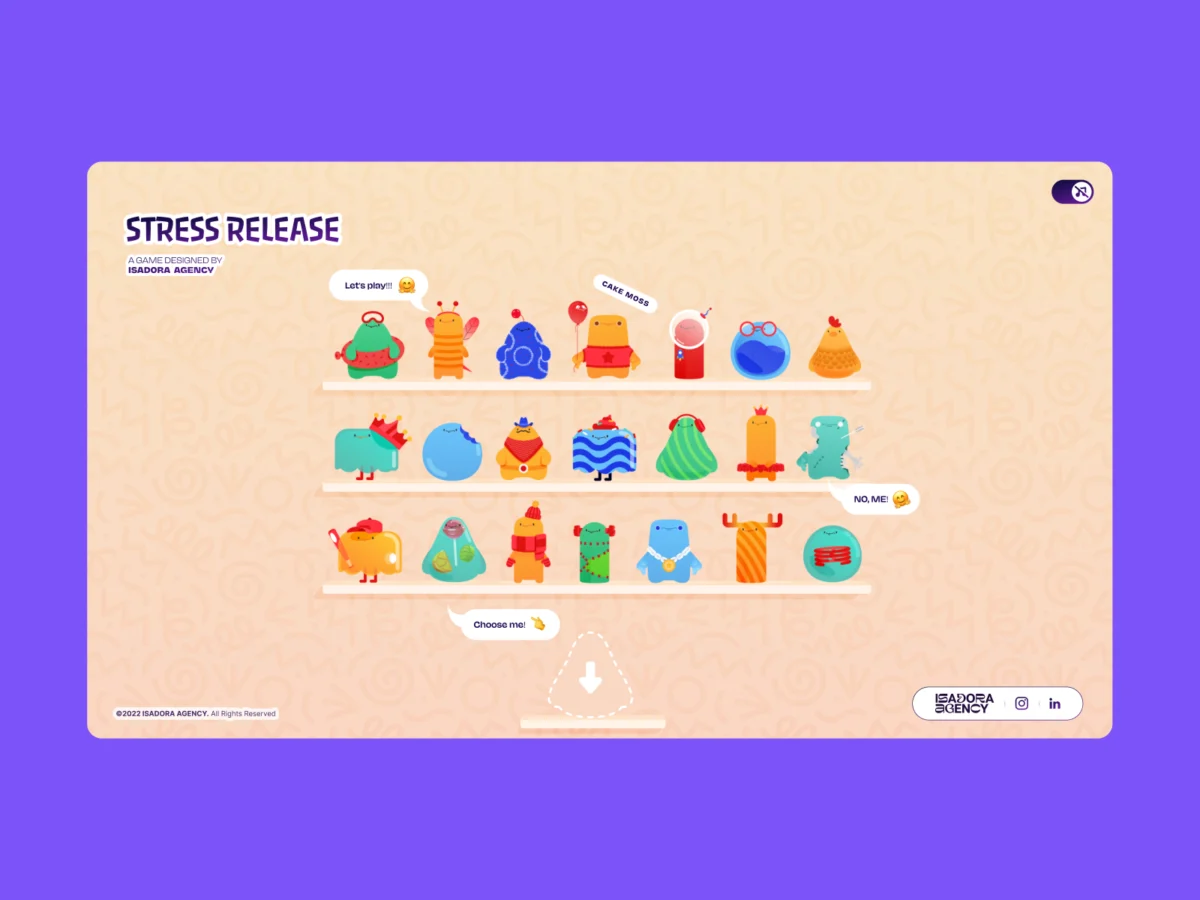
In an era where web interfaces are increasingly judged by their responsiveness and "feel," the technical architecture behind interactive experiences is undergoing a significant shift. Traditionally, front-end developers and UX engineers tasked with creating bouncy, tactile, or destructive digital environments have defaulted to physics engines. Frameworks such as Matter.js, Cannon.js, or complex WebGL-based solutions have long been the industry standard for simulating realistic motion. However, a recent development project by Isadora Agency, titled "Stress Release," has challenged this convention by eschewing algorithmic physics in favor of "intentional motion" driven by Lottie animations and DOM-based mathematics.
The project, led by Alexey Kopytin, aimed to create a digital stress-relief tool where users could interact with animated characters through squeezing, stretching, and distorting UI elements. While the initial instinct was to utilize a physics engine to handle these interactions, the development team discovered a fundamental conflict between the unpredictability of physics simulations and the specific artistic vision of their designers. By moving away from standardized physics libraries, the team was able to maintain absolute deterministic control over every frame of animation, ensuring that the user’s tactile experience remained exactly as the animators intended.
The Evolution of the Project: From Simulation to Intentionality
The development of Stress Release followed a non-linear path that reflects a broader conversation in the web development community regarding the trade-offs between "plausible motion" and "designed motion." Plausible motion refers to the behavior generated by physics engines—objects that bounce, fall, and collide based on gravity and friction variables. While realistic, this motion is often unpredictable and can sometimes result in visual artifacts or behaviors that feel "off" to a user expecting a specific narrative or aesthetic result.
Isadora Agency’s chronology began with a prototyping phase that utilized standard physics libraries. During this stage, the team realized that the characters, designed to have distinct personalities and specific "squishy" reactions, were behaving like generic rubber balls. The physics engine was overwriting the carefully crafted keyframes of the animators. By mid-development, the team pivoted to a programmatic state-control architecture. This allowed them to use Lottie—a mobile library that parses Adobe After Effects animations exported as JSON—to trigger specific, frame-accurate sequences based on user input. This transition marked a shift from letting the engine "decide" the motion to allowing the code to "trigger" the motion.
Technical Architecture: Radial Mapping and the Pythagorean Theorem
The core of the Stress Release experience lies in its hit detection and feedback loop. Rather than using complex collision boxes or raycasting—standard techniques in 3D and physics-based environments—the team utilized a simplified mathematical approach centered on the DOM. By treating the character as a coordinate space and measuring the distance of a click from the center point, the developers created a "concentric zone" scoring system.

When a user clicks on a character, the application captures the page coordinates and translates them into the character’s local coordinate space. Using the Pythagorean theorem ($a^2 + b^2 = c^2$), the system calculates the straight-line distance from the center. This single value then serves as the primary driver for three distinct functions: the numerical score awarded to the player, the intensity of the visual feedback, and the spatial positioning of "explosion" animations.
This radial input mapping ensures that the interaction feels tactile and accurate. For example, a click closer to the center (the "bullseye") triggers a higher score and a more intense animation segment, while a click near the edge triggers a lighter reaction. Because the explosion animations are repositioned to the exact coordinates of the click using CSS margins, the visual result is a seamless alignment between user action and digital reaction. This method bypasses the need for the heavy overhead of a physics engine while providing a more precise "hit" sensation.
The Role of Lottie and Segmented Animation States
A critical component of the project’s success was the use of Lottie’s native API to control animation segments. In a traditional physics-based game, an object might "squish" based on the force of an impact. In Stress Release, the "squish" is a series of pre-rendered, high-quality vector animations.

Each character in the game possesses a library of defined frame ranges:
- Idle States: Looping frames (e.g., frames 0-40) that play when no interaction is occurring.
- Reaction Segments: Specific sequences for light, medium, and heavy interactions (e.g., frames 41-160).
- End States: Climax animations for "mega-squeezes" or character resets.
By programmatically jumping to these segments, the developers ensured that the animation curves—the specific timing and easing designed by the artists—remained intact. This deterministic approach means that every user, regardless of their device’s processing power, sees the same high-quality motion. The code acts as a conductor, halting current segments and forcing immediate jumps to new frames based on the "play order" defined in the application’s state machine.
Performance Data and Mobile Optimization Strategies
One of the primary arguments for moving away from WebGL or heavy physics libraries is performance, particularly on mobile devices. Physics engines require constant CPU cycles to calculate the positions of objects in every frame. In contrast, the DOM-based math used in Stress Release is computationally inexpensive. However, the use of Lottie introduces its own set of challenges, primarily related to file size and rendering quality.

To maintain a fluid experience across 21 different character animations, Isadora Agency implemented several optimization layers. On the "character shelf" screen, where multiple animations play simultaneously, the team reduced the Lottie rendering quality to 50% and slowed the playback speed to 60%. This significantly reduced the number of interpolation calculations required by the browser.
Conversely, when a user selects a single character to play with, the application shifts resources to that specific animation, increasing the quality to 100%. By managing resources in this way, the team achieved a stable 60 frames per second (FPS) on most modern mobile browsers—a feat that would have been significantly more difficult to guarantee with a full physics simulation running in the background. Furthermore, by using CSS variables to handle responsive resizing, the team ensured that the SVG-based animations scaled naturally across different screen aspect ratios without the need to recalculate collision vectors.
Industry Implications: The Rise of Deterministic UX
The success of the Stress Release project highlights a growing trend in high-end digital agency work: the prioritization of art direction over emergent simulation. While physics engines remain essential for sandbox games and complex 3D environments, the "intentional motion" approach is proving superior for branded experiences, gamified UIs, and micro-interactions.

Industry analysts suggest that this shift is driven by the need for brand consistency. In a branded digital experience, the way a character moves is as much a part of the brand identity as the logo or the color palette. Allowing an algorithm to dictate that motion introduces a level of brand risk that many high-stakes projects cannot afford. By using Lottie and programmatic state controls, agencies can deliver a "hand-crafted" feel that resonates more deeply with users.
Furthermore, this architecture offers significant benefits for accessibility and maintenance. DOM-based elements are inherently more "readable" by browser tools than objects rendered inside a WebGL canvas. Handling interactions through native event listeners (clicks and taps) ensures that the experience remains compatible with standard web conventions, making it easier to update and debug over time.
Conclusion and Broader Impact
The methodology detailed by Alexey Kopytin and the Isadora Agency team serves as a blueprint for developers looking to build "tactile" web experiences without the technical debt of a physics engine. By mapping Lottie’s native timeline capabilities to the DOM and using basic geometry for hit detection, developers can bridge the gap between complex motion design and performant web code.

As web technologies continue to evolve, the distinction between "website" and "application" continues to blur. Tools like Lottie have democratized high-end animation, allowing front-end developers to implement sequences that were previously the exclusive domain of film and video game studios. The key takeaway from the Stress Release project is that the most sophisticated solution is not always the most effective. By stripping away the complexity of a physics engine and returning to the fundamentals of math and intentional design, the team created a more satisfying, responsive, and visually stunning experience.
This approach is likely to influence future UX patterns in sectors ranging from e-commerce—where tactile feedback can simulate the feel of a product—to digital wellness, where the predictability of motion can contribute to a sense of calm and control. As the digital landscape becomes more crowded, the ability to deliver bespoke, intentional motion will remain a significant competitive advantage for agencies and brands alike.

