
The European Union has formalized a definitive timeline and set of technical requirements for the labeling of artificial intelligence, signaling a transition from theoretical regulation to enforceable digital standards. While initial industry reactions were characterized by concerns regarding "drastic measures" and "sweeping fines," the clarified guidelines reveal a targeted framework designed to ensure user transparency without stifling innovation. Central to this regulatory shift is the mandate that by August 2, 2026, any company providing or deploying AI systems within the European Union must clearly label content that has been artificially generated or manipulated. This requirement extends beyond European borders, applying to any global entity whose AI-generated output is utilized by citizens within the EU’s internal market.
The Foundations of the Transparency Mandate
The legal core of these requirements is found in Article 50 of the EU AI Act, which categorizes transparency obligations based on the nature of the AI’s output and its potential impact on the public. The primary objective is to empower users to distinguish between human-authored and machine-generated content, thereby mitigating the risks of misinformation, fraud, and the unintentional erosion of trust in digital media.
According to Article 50(4), the disclosure obligation is mandatory for three specific categories of AI output. First, it applies to "deepfakes"—images, audio, or video files that have been manipulated to resemble real persons, objects, or events in a way that could mislead a reasonable person. Second, it covers AI-generated text that is published with the intent to inform the public on matters of public interest, such as politics, health, safety, or the environment. Third, it encompasses any generative AI system that produces content resembling human-authored work, regardless of the medium.
The responsibility for compliance is shared between "providers"—the organizations that develop and bring AI systems to market—and "deployers"—the entities that utilize these systems in a professional or commercial capacity. This dual-layered responsibility ensures that a company cannot bypass transparency rules simply by licensing a third-party tool; the obligation remains with the entity presenting the content to the end-user.
A Chronological Path to Enforcement
The implementation of the EU AI Act follows a phased approach, allowing organizations to align their technical infrastructure with legal requirements. The Act officially entered into force on August 1, 2024, following years of legislative debate that began with the European Commission’s initial proposal in April 2021.

The timeline for transparency is specific:
- August 2024: The Act entered into force, initiating the grace period for most provisions.
- February 2025: Prohibitions on "unacceptable risk" AI systems (such as social scoring or certain biometric categorizations) take effect.
- August 2025: Obligations for General-Purpose AI (GPAI) models, including transparency and documentation requirements for model providers, become enforceable.
- August 2026: The specific labeling requirements for AI-generated content (Article 50) become legally binding for all companies serving EU citizens.
- August 2027: High-risk AI systems, which are subject to the most stringent technical and safety assessments, must achieve full compliance.
This structured rollout provides a two-year window for designers, developers, and legal teams to integrate "Transparency by Design" into their product lifecycles.
Defining the Threshold of Human Intervention
One of the most complex aspects of the new guidelines is the distinction between "AI-assisted" and "AI-generated" content. The European Commission has provided clarity on where the disclosure obligation begins, focusing on the concept of "substantive" editorial control.

Content does not require an AI label if it has undergone significant human review and editing, where a named person or entity takes editorial responsibility for the final output. For instance, if an AI generates a draft article but a human editor rewrites sections, verifies facts, and approves the final version, it is considered human-authored for the purposes of the Act. Conversely, a human simply "skimming" an AI-generated text before publication does not constitute substantive intervention.
Minor assistive edits are generally exempt from labeling. These include:
- Grammar and spell-checking.
- Formatting and layout adjustments.
- Basic photo editing such as cropping or color correction.
- AI-powered translations (provided they are verified for accuracy).
However, substantive AI interventions always require disclosure. This includes AI-generated summaries of complex documents, composite imagery where elements are added or removed via generative fill, and realistic AI-generated photos or posters used in marketing that resemble real-world objects or locations. In these instances, the intentionality of the automation triggers the legal requirement for a label.

Beyond the Sparkle: The Evolution of AI Design Patterns
For years, the "sparkle" icon (✨) has served as the industry-standard shorthand for AI-powered features. However, the EU guidelines suggest that this icon alone is insufficient for legal compliance. Research from organizations such as the Nielsen Norman Group indicates that the sparkle is often too ambiguous; users frequently interpret it as a "new feature" or "magic enhancement" symbol rather than a clear indicator of machine-generated content.
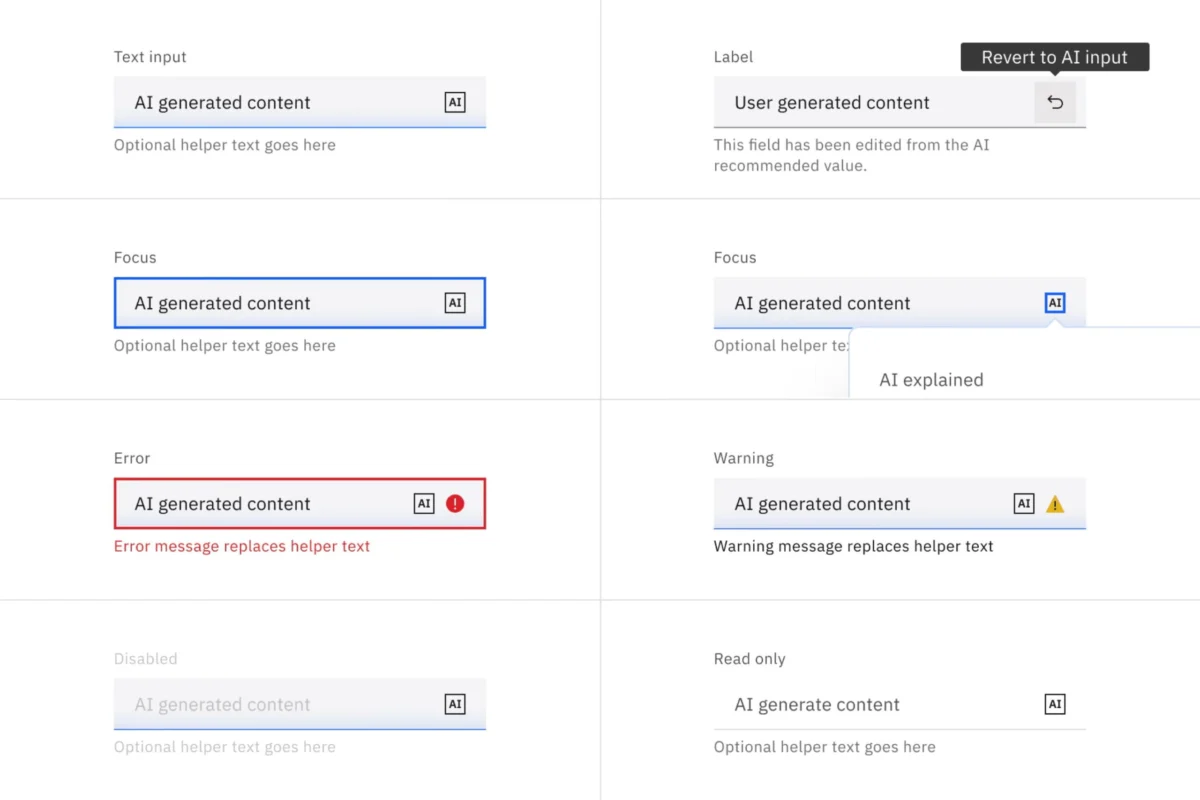
The European Commission has instead introduced an official EU AI icon set. This includes a specific "AI" mark designed to be "clear and distinguishable." The guidelines emphasize that the signal must be persistent, meaning it should remain attached to the content even when it is downloaded or reshared across different platforms.
Legal compliance is not achieved by the mere presence of an icon. The disclosure must be:

- Clearly Visible: A label buried in a footer or hidden within a "Terms of Service" link is non-compliant.
- Plain Language: The use of terms like "AI-generated" or "Artificially manipulated" is preferred over technical jargon.
- Accessible: Labels must be readable by assistive technologies, ensuring that visually impaired users are equally informed of the content’s origin.
- Contextual: The label should be placed in close proximity to the AI-generated element, rather than as a general disclaimer for an entire website.
Industry leaders, such as IBM through its Carbon Design System, have already begun implementing these patterns, utilizing inline labels and explainability panels that provide users with details on how the AI reached a specific conclusion or generated a particular piece of data.
Global Regulatory Alignment and the "Brussels Effect"
The EU AI Act is not an isolated phenomenon; it is part of a global trend toward AI transparency that legal experts refer to as the "Brussels Effect"—where European regulations set the de facto standard for global markets. Similar legislative efforts are currently being enacted or debated worldwide:
- United States: In California, SB 942 (the California AI Transparency Act) requires large generative AI providers to include latent watermarks in AI-generated content. In Utah, the Artificial Intelligence Policy Act focuses on consumer protection and the disclosure of AI interactions in regulated professions.
- China: The Cyberspace Administration of China (CAC) has implemented strict rules requiring "conspicuous labels" on any AI-generated content that could mislead the public, including deepfakes and generative text.
- India: The Ministry of Electronics and Information Technology (MeitY) has issued advisories urging platforms to label "under-tested" or unreliable AI models and to ensure that generated content is identifiable.
This global convergence suggests that AI labeling is becoming a fundamental requirement for the digital economy. Companies that adopt these standards early will likely face fewer hurdles as other jurisdictions follow the EU’s lead.

Economic Implications and Stakeholder Reactions
The financial stakes for non-compliance are significant. Under the EU AI Act, penalties for violating transparency obligations can reach up to 3% of a company’s total worldwide annual turnover or €15 million, whichever is higher. For more severe violations involving prohibited AI practices, fines can climb to 7% of global turnover or €35 million.
Stakeholder reactions have been mixed but are trending toward cautious optimism. Tech advocacy groups have praised the "narrow" focus of Article 50, noting that it avoids a blanket labeling requirement for all AI tools, which would have created "disclosure fatigue" among users. Conversely, some small and medium-sized enterprises (SMEs) have expressed concern regarding the technical cost of implementing persistent watermarking and metadata standards, such as those proposed by the Coalition for Content Provenance and Authenticity (C2PA).
From a consumer perspective, civil society organizations have welcomed the rules as a necessary defense against the rise of "AI slop"—low-quality, mass-produced synthetic content that threatens to saturate information ecosystems. By mandating transparency, the EU aims to preserve the value of human creativity and the integrity of public discourse.

Technical Implementation: Metadata and Watermarking
To meet the 2026 deadline, organizations must look beyond visual labels and into the technical architecture of content. The EU guidelines encourage the use of technical metadata and digital watermarking. Unlike a visual icon, which can be cropped out, digital watermarks are embedded into the file’s data, making them harder to remove and easier for third-party platforms to detect.
The integration of C2PA standards is expected to become the industry benchmark. This technology allows creators to attach "Content Credentials" to a file, providing a cryptographically secure history of the content’s origin and any AI modifications it underwent. As browsers and social media platforms begin to automatically recognize and display these credentials, the burden of manual labeling for deployers will likely decrease, replaced by an automated ecosystem of verifiable information.
Conclusion: The Shift Toward Verifiable Information
The EU’s transparency rules for 2026 represent a fundamental shift in the relationship between humans and machines. By moving away from the "black box" approach to AI and toward a model of clear disclosure, the regulation seeks to balance the benefits of generative technology with the necessity of public trust. For businesses, the path forward involves a proactive audit of AI-powered features, a shift toward official iconographies, and the adoption of robust metadata standards. Ultimately, these measures are intended to ensure that as AI becomes more sophisticated, the human ability to discern reality remains uncompromised.

