
The global technology sector has entered a period of "conversational tunnel vision," a phenomenon where product designers and engineers default to chat-based interfaces for nearly all artificial intelligence capabilities. This trend, driven largely by the rapid ascent of Large Language Models (LLMs) trained on dialogue data, has led to a standardized industry assumption that the chat bubble is the natural home for AI. However, emerging research into user experience (UX) and cognitive load suggests that this "one-size-fits-all" approach may be hindering productivity and creating unnecessary psychological barriers for users.
As AI integration moves from experimental stages to enterprise-level implementation, the design community is beginning to advocate for a return to multi-modal interfaces. The core challenge lies in matching the modality—the way a person uses their senses to interact with a system—to the user’s specific context, intent, and physical environment. Experts argue that while a chat interface is a powerful tool for certain exploratory tasks, it often fails when applied to high-stakes, time-sensitive, or physically demanding scenarios.
The Evolution of the AI Interface: A Brief Chronology
To understand the current reliance on chatbots, it is necessary to examine the timeline of AI interface development over the past decade.
In the mid-2010s, the first wave of consumer AI, such as Siri and Alexa, focused primarily on voice interaction. These systems were limited by the underlying technology’s inability to handle complex reasoning. The landscape shifted dramatically in late 2022 with the release of ChatGPT, which demonstrated the profound capabilities of LLMs. Because these models were trained on conversational datasets, the chat interface became the immediate and most convenient delivery mechanism.
By 2023, "Chat-with-your-data" became the dominant enterprise AI trend. Software-as-a-Service (SaaS) providers across finance, healthcare, and logistics integrated chat boxes into their existing dashboards. However, by mid-2024, a "UX backlash" began to emerge. Users reported "prompt fatigue"—the mental exhaustion caused by having to repeatedly type complex instructions to achieve simple results. This has led to the current industry pivot: a move toward "Invisible AI" and multi-modal systems where the interface adapts to the user, rather than forcing the user to adapt to a text box.
The Linguistic and Cognitive Barriers of the Chatbox
The reliance on text-based input creates what UX researchers call a "linguistic barrier." In a traditional Graphical User Interface (GUI), buttons, menus, and sliders provide visual cues that signal available options. This relies on recognition rather than recall. Conversely, a blank chat box requires a user to perform a "creative act" every time they interact with the system. They must translate a vague intent into a specific, grammatically correct command, leading to choice paralysis.
On the output side, the challenges are equally significant. Large Language Models often return dense paragraphs of text, which the human brain must process as a "serial medium." This means the user must read one word after another to extract meaning, a process that is significantly slower than visual scanning. Supporting data from cognitive psychology indicates that the human brain can process images and spatial patterns up to 60,000 times faster than text. When an AI responds to a request for a data trend with three paragraphs of prose instead of a line graph, it transfers the interpretive work—and the resulting cognitive tax—to the user.
Implementing the Task Audit: A Framework for Selection
To move beyond conversational tunnel vision, product teams are increasingly adopting a "Task Audit" framework. This evidence-based approach moves teams away from assumptions and toward a rigorous analysis of the environment in which the work occurs. A comprehensive Task Audit evaluates four primary areas:
1. Input Constraints
This involves documenting the user’s physical state. Are their hands busy (e.g., a surgeon or a technician)? Are they in a loud environment where voice commands might fail? Are they using a mobile device where typing long strings of text is cumbersome?

2. Output Constraints
This examines how the information will be consumed. Does the user need "glance verification" (e.g., a pilot checking an altitude alert)? Is the environment too bright to read small text on a screen?
3. Cognitive Load
Researchers measure the mental effort required for the task. High-stakes environments, such as emergency rooms or financial trading floors, require interfaces that minimize "verification anxiety" and provide immediate, unambiguous data.
4. Social and Environmental Context
This considers whether the interaction is private or public. In an open-plan office, voice input may be socially awkward or a privacy risk. In a sterile operating room, gesture-based interaction may be the only safe option.
The Input/Output Alignment Matrix
Once the Task Audit is complete, designers utilize an Input/Output Alignment Matrix to map user intent to the optimal modality. This matrix serves as a strategic guide for product development:
- Quick Status Checks: For users who need immediate updates while "eyes-busy," the optimal combination is a single-tap button for input and an audio summary or push notification for output.
- Complex Analysis: For desk-based professionals, the matrix suggests a GUI (filters and sliders) for input and a visual dashboard (charts and tables) for output to allow for parallel processing of data.
- Creative Generation: Tasks involving drafting or design require multi-modal inputs (image + text) and an interactive canvas for output, allowing users to manipulate the AI’s work directly.
Case Study: Adaptive Modality in the Energy Sector
The practical implications of this shift are best illustrated by a recent overhaul of diagnostic tools for field technicians servicing high-voltage electrical grids.

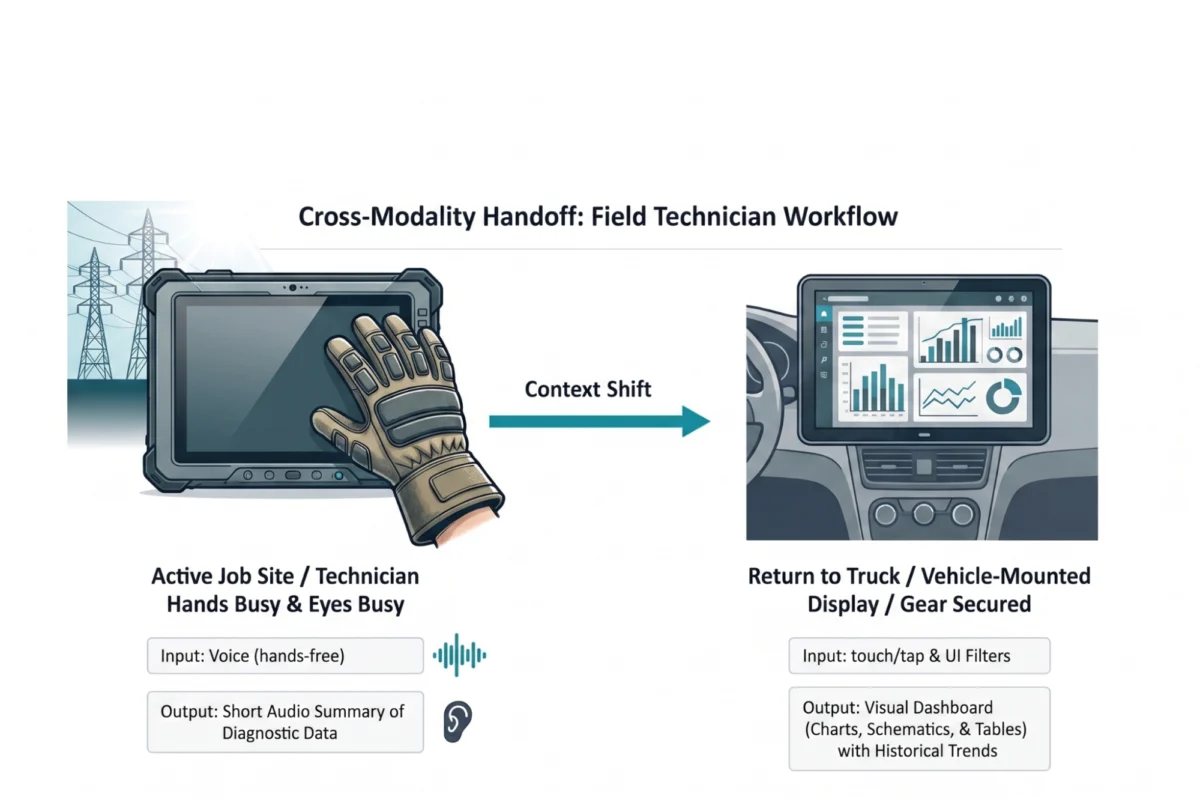
Initially, these technicians were provided with ruggedized tablets featuring a chat-based AI assistant. However, field observations revealed that the interface was nearly unusable. Technicians wearing thick protective gloves could not type on touchscreens, and screen glare from direct sunlight made reading diagnostic text impossible. Furthermore, the "cognitive load" of reading a narrative report while suspended in a bucket truck created significant safety risks.
The redesigned system implemented an adaptive modality handoff. While on-site, technicians now use voice input to query the system, and the AI responds with short, high-contrast audio summaries. This "hands-free, eyes-free" approach allows the technician to maintain situational awareness. Once the technician returns to their vehicle, the system automatically hands off the workflow to a large, vehicle-mounted visual dashboard, where complex schematics and historical trends can be reviewed in a safe, controlled environment.
According to data from the utility provider, this move away from a chat-centric interface reduced diagnostic time by 20% and significantly increased the daily adoption rate of the AI tool among veteran crews.
Industry Reactions and Broader Implications
The shift toward multi-modal AI has drawn support from various sectors of the technology community. Accessibility advocates note that moving away from a text-only default is a significant win for inclusive design. By providing audio, visual, and haptic alternatives, companies can ensure that AI capabilities are available to users with diverse physical and cognitive needs.
Enterprise leaders are also recognizing the financial impact of modality. A "lazy" chat interface that increases the time it takes for an employee to complete a task represents a hidden cost. "The goal is not to have the user talk to the machine," noted one senior UX researcher during a recent industry workshop. "The goal is to have the machine assist the user with the least amount of friction possible."

However, the transition is not without challenges. Developing multi-modal interfaces is more resource-intensive than deploying a standard chatbot. It requires deeper research, more complex engineering, and a more sophisticated understanding of hardware-software integration.
The Future of AI Interaction
As AI continues to permeate every aspect of professional and personal life, the "chat bubble" is likely to be relegated to its proper place: as one tool among many in an expansive toolkit. The future of AI interface design is expected to be a diverse ecosystem of visual, vocal, haptic, and ambient interactions, all calibrated to the user’s immediate intent.
The design brief for the next generation of AI products is clear: leave the screen and observe the world. By grounding interface decisions in the physical and social realities of the workplace—whether it is a warehouse floor, a sterile lab, or a busy airport—the industry can move past conversational tunnel vision and create tools that feel like a natural extension of human capability. The most successful AI will not be the one that talks the most, but the one that understands the context of the silence.

