
The failure of a branding project is rarely a result of poor technical execution in the final stages; rather, it is almost always rooted in the strategy phase, long before a logo is ever drafted. In the high-stakes environment of corporate identity, terms such as modern, trustworthy, premium, and disruptive are frequently deployed during stakeholder meetings without being strictly defined. This lack of precision creates a conceptual void—a gap between the strategic intent of the brand and the visual expectations of the designer. To bridge this divide, industry experts identify a critical, often overlooked stage known as the pre-concept phase. This phase serves as the intellectual and visual foundation upon which all subsequent design decisions are built.
In the contemporary design landscape, the pressure to produce immediate visual results often leads teams to bypass deep discovery in favor of rapid prototyping in tools like Figma. However, the strongest visual concepts do not originate in software; they begin with rigorous questioning. The pre-concept phase is dedicated to researching brand context, uncovering the hidden assumptions of stakeholders, and synthesizing a shared direction into a tangible visual framework. Without this intermediary step, the first concept presented to a client is essentially a guess—a high-risk gamble that relies on luck rather than logic.
The Language Gap: Why Adjectives Fail Design
At the outset of a branding engagement, designers are typically inundated with inputs: creative briefs, transcripts of stakeholder interviews, competitor audits, and lists of aspirational adjectives. While these inputs provide a surface-level understanding, they are often too broad to guide specific design choices. For example, a stakeholder may request a "premium" aesthetic. To one person, this might signify a minimalist, editorial layout with ample white space. To another, it could mean a dark, moody palette with gold accents and high-contrast photography. To a third, it may imply a traditional, serif-heavy typographic system.
A notable case study involves a health tech company seeking to project an image that was simultaneously modern, trustworthy, and disruptive. Initially, the term "disruptive" suggested a move toward bold colors and unconventional layouts. However, deep-dive conversations revealed a crucial nuance: the company’s primary clients were large, conservative government medical institutions. In this specific context, a brand that appeared too rebellious or visually loud would erode the very trust required to secure contracts. Their version of "disruption" actually required a more traditional, stable visual language than the word initially implied. This realization underscores the necessity of defining what these attributes mean in a specific market context before the first pixel is moved.
Stage 1: Researching Brand Context and Perception
The pre-concept phase begins with an intensive research period focused on perception. As Marty Neumeier, author of The Brand Gap, famously stated, "A brand is a person’s gut feeling about a product, service, or company." Because a brand ultimately exists in the mind of the audience, the discovery process must clarify what specific perception the team aims to create.

Research at this stage is less about collecting static facts and more about clarifying how the brand needs to make people feel. Key questions include:
- What does the brand need to make the audience believe?
- Where must the brand establish immediate credibility?
- Which category assumptions should the brand follow, and which should it challenge?
- How far can the brand deviate from industry norms before it loses the audience’s trust?
This stage is critical because it uncovers the "tension" within a brand’s identity. For instance, a fintech startup may want to appear "bold" to differentiate itself from legacy banks, yet it must remain "secure" to convince users to trust it with their capital. Identifying this tension—the need to be bold without appearing reckless—allows the designer to frame the project as a specific problem to be solved rather than a vague aesthetic preference.
Stage 2: Stakeholder Alignment and Visual Exercises
To move from verbal strategy to visual direction, designers must employ exercises that force stakeholders to think through images and associations. Passive agreement during a strategy presentation is common; active participation in visual exercises is where true alignment—or misalignment—is discovered.

Exercise 1: Competitor Perception Mapping
In this exercise, stakeholders are presented with visual assets from competitors and asked to place them on a two-axis map. The axes are defined by the specific tensions identified in the research phase, such as "Traditional vs. Progressive" or "Understated vs. Bold." This process is not about judging the quality of a competitor’s design but about understanding how the client reads the market. Disagreements between stakeholders during this exercise are highly valuable, as they reveal conflicting definitions of "innovation" or "credibility" that would have otherwise derailed the project during the concept review.
Exercise 2: Visual Brand Driver (The Metaphor Test)
The Visual Brand Driver exercise asks stakeholders to select images for unrelated categories—such as transportation, architecture, furniture, or animals—that represent the company. The goal is to move beyond personal taste and toward brand character. If the company were a vehicle, would it be a high-speed train (representing efficiency and mass scale) or a handcrafted bicycle (representing personal care and sustainability)? The adjectives stakeholders use to explain their choices are more important than the images themselves, as they provide a deeper layer of metaphor that informs the eventual design principles.
Stage 3: Establishing the Visual Foundation
Once the research and stakeholder alignment are complete, the findings are synthesized into a "visual foundation." This is a working layer that sits between the written strategy and the final identity. It consists of three distinct components:

1. Look and Feel (Perception Boards)
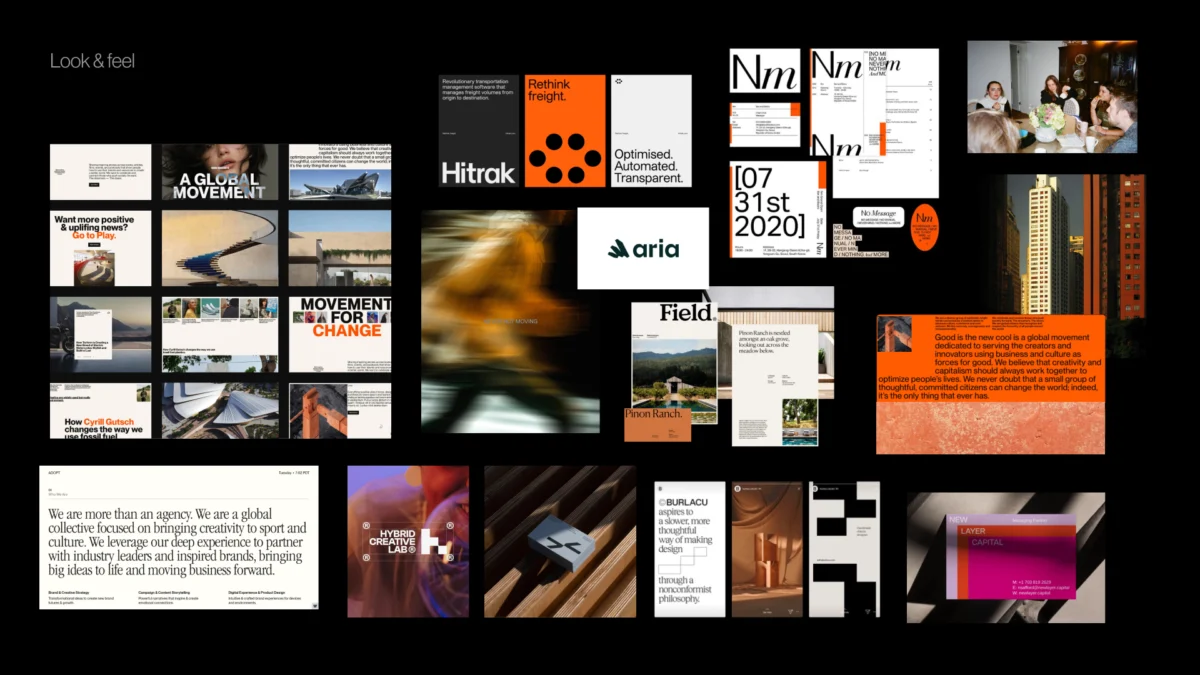
Unlike traditional moodboards, which often focus on aesthetics, Look and Feel boards are perception-based. They use third-party visual references to test whether the team is aligned on the "vibe" of the brand. If the brand is meant to be "warm and human," the board might explore different ways that humanity is expressed—through soft photography, organic shapes, or handwritten elements—allowing the client to react to these directions before a logo is even created.
2. Design Code (Visual Principles)
The Design Code translates strategic ideas into specific visual metaphors. For a parenting application, the strategy of "personalized support for a unique journey" might translate into a design code of "organic shapes and handwritten lines." For a PR agency focused on technology, "momentum in motion" might become a code of "ripple effects and motion blur." These are not final designs but the rules that will govern the creation of assets.
3. Brand Asset Direction
The final layer of the pre-concept phase involves discussing the building blocks of the identity: typography, color, photography style, and logo direction. At this point, the designer can set boundaries. For example, the team might agree that the typography should be a clean, geometric sans-serif to emphasize modernity, while the photography should be candid and unposed to emphasize authenticity. Setting these boundaries prevents the design process from becoming an aimless exploration.

Chronology of the Pre-Concept Process
A typical pre-concept phase follows a structured timeline to ensure maximum efficiency:
- Week 1: Kickoff and Discovery. Deep-dive interviews and brand audits are conducted to identify the "Language Gap."
- Week 2: The Brand Workshop. Stakeholders participate in Competitor Mapping and Visual Brand Driver exercises.
- Week 3: Synthesis and Perception Mapping. The design team analyzes workshop results to identify core tensions and visual metaphors.
- Week 4: Foundation Presentation. The team presents the Look and Feel, Design Code, and Asset Direction for approval.
- Week 5+: Concept Development. Only after the foundation is approved does the designer begin creating original concepts.
Analysis of Implications: The Value of the Pre-Concept Phase
The implementation of a pre-concept phase has significant implications for both agencies and clients. From a business perspective, it reduces "design debt"—the cost of repeating work due to misaligned expectations. According to industry data, projects that include a formal alignment phase are 40% less likely to require major revisions during the final delivery stages.
Psychologically, this phase builds "stakeholder buy-in." When clients are involved in the visual decision-making process from the start, they are less likely to view the final concept as a subjective "reveal" and more likely to see it as the logical conclusion of a shared journey. This shifts the conversation from "I like this" or "I don’t like this" to a more objective standard: "Does this express the brand we agreed upon?"

Furthermore, the pre-concept phase allows for greater creative risk. When the "safe" boundaries are established early, the designer has the freedom to explore more innovative solutions within those parameters, knowing that the underlying logic is sound. It transforms the designer from a decorator into a strategic partner, ensuring that the brand identity is not just beautiful, but functional and enduring.
Conclusion: Moving Beyond Guesswork
In the competitive world of brand identity, the first concept should never feel like a surprise. By investing in the pre-concept phase, design teams can ensure that their work is rooted in strategy, aligned with stakeholder expectations, and optimized for the target audience’s perception. This methodical approach replaces the uncertainty of "gut feelings" with a rigorous, evidence-based framework, leading to stronger visual concepts and more successful brand outcomes. The pre-concept phase is not a delay in the creative process; it is the essential work that makes true creativity possible.

