
The landscape of modern web development is currently undergoing a significant paradigm shift as native browser capabilities rapidly expand to absorb functionalities that previously required heavy third-party libraries. For over a decade, the standard operating procedure for frontend engineers has been to supplement the web platform with an array of packages from the npm ecosystem to handle tasks ranging from date formatting to complex UI positioning. However, as browser engines converge on shared standards through initiatives like the WebDX Community Group’s "Baseline" project, many of these dependencies have become redundant, leading to unnecessary "bundle bloat" that impacts performance, accessibility, and security.
The Rise of Baseline and the Interop Initiative
To understand the current movement toward native browser features, one must look at the historical fragmentation of the web. For years, developers were forced to use libraries like jQuery, Axios, or Moment.js because browser support for native equivalents was either non-existent or inconsistently implemented across Internet Explorer, Firefox, and Chrome.
This began to change with the launch of the Interop project, an annual collaboration between major browser vendors—Google, Apple, Microsoft, and Mozilla—designed to improve interoperability across the web platform. In tandem with this, the WebDX Community Group introduced "Baseline," a status indicator that provides developers with clear information about which features are safe to use. A feature is categorized as "Newly Available" when it is supported across all major engines (Chrome, Edge, Firefox, and Safari) and moves to "Widely Available" after 30 months. This 30-month window serves as a buffer, ensuring that the vast majority of users have updated their browsers to versions that support the feature.
The Hidden Cost of Dependency Inertia
In a typical mid-sized JavaScript application, dependencies can often account for 60KB to 90KB of minified and gzipped code that the browser could now handle natively. While individual packages may seem small, the cumulative effect is significant. According to industry data, every 100KB of JavaScript added to a page can increase the Time to Interactive (TTI) by over a second on mid-range mobile devices.
The reason these libraries persist in modern codebases is rarely due to a lack of technical skill. Instead, it is a byproduct of "dependency inertia." Once a package is integrated into a project and the tests pass, it is seldom revisited. Security teams may run npm audit to check for vulnerabilities, but a functional audit—asking whether a library is still necessary—is rarely part of the standard development lifecycle.

Cluster 1: The Transformation of Internationalization
The most immediate area for optimization lies in the Intl (Internationalization) namespace. Historically, developers relied on libraries like numeral.js, timeago.js, and pluralize to handle the complexities of localizing data.
Today, the native Intl API is Widely Available and covers nearly every common use case. Intl.RelativeTimeFormat allows for the creation of localized strings like "3 days ago" or "yesterday" without the need for external arithmetic logic. Similarly, Intl.NumberFormat handles currency, percentages, and compact notations (e.g., "1.2M" instead of "1,200,000") with native performance.
The impact of shifting to native Intl features is twofold. First, it reduces the JavaScript payload by approximately 14KB gzipped for apps using multiple formatting libraries. Second, it improves performance by offloading the processing to the browser’s highly optimized internal C++ code rather than executing interpreted JavaScript.
Cluster 2: HTTP Clients and the Fetch Paradigm
The ubiquity of axios and superagent is another example of dependency inertia. When axios gained popularity, it solved the problem of the cumbersome XMLHttpRequest and provided a promise-based API before fetch was widely supported.
Currently, fetch combined with AbortController is Widely Available and handles the vast majority of networking requirements. While axios provides automatic JSON parsing and request interceptors, these can be replicated with a few lines of native code or a thin wrapper.
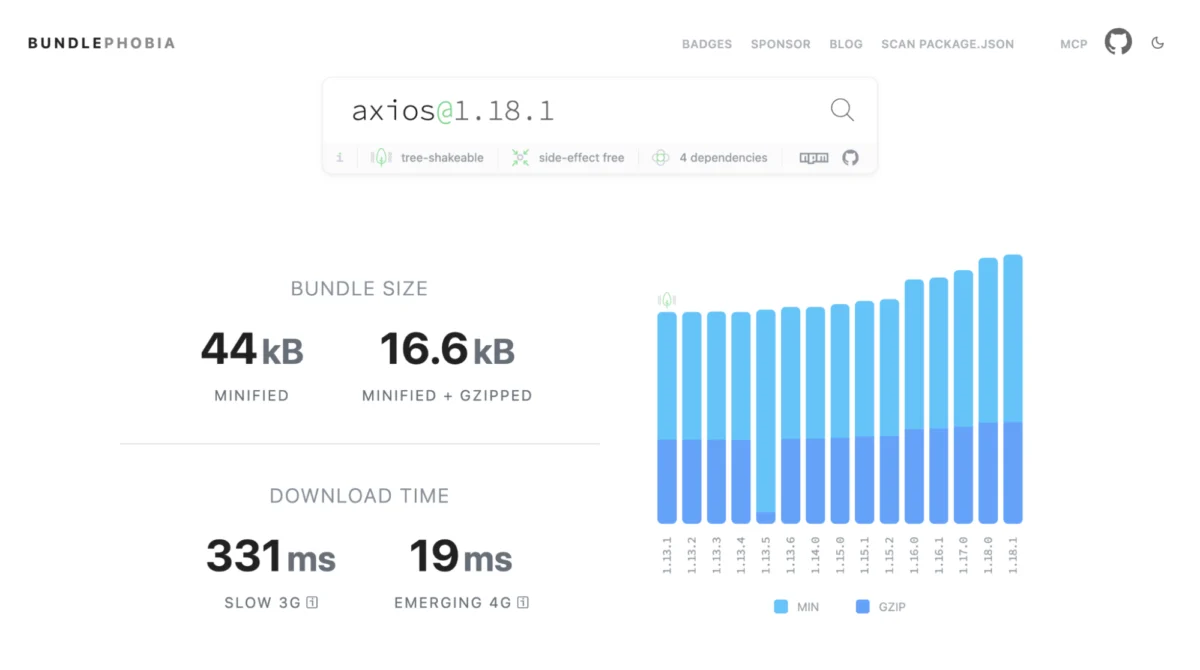
Industry analysis suggests that while axios (at 17KB gzipped) remains a powerful tool, it is often overkill for applications that only perform standard REST API calls. However, experts note that for applications requiring complex features like automatic retries or upload progress tracking—which fetch does not natively support as elegantly—retaining the library may still be the more pragmatic choice.

Cluster 3: UI Primitives and the "Top Layer" Evolution
Perhaps the most significant advancement in recent years involves UI primitives. Historically, creating a modal dialog that was accessible, trapped focus, and rendered correctly above all other elements was a complex task requiring libraries like a11y-dialog or focus-trap.
The introduction of the <dialog> element and the Popover API has fundamentally changed this. The <dialog> element, now Widely Available, handles focus management and accessibility by default. When a developer calls showModal(), the browser automatically places the element in the "Top Layer," a special rendering layer that sits above the rest of the DOM, effectively ending the "z-index wars" that have plagued CSS for decades.
Furthermore, the recent introduction of CSS Anchor Positioning (Newly Available as of early 2026) aims to replace positioning libraries like Popper.js. This allows developers to pin tooltips or menus to trigger elements using pure CSS. By migrating to these native primitives, teams can remove approximately 24KB of gzipped JavaScript while simultaneously improving the accessibility profile of their applications.
Cluster 4: Utility Libraries and Native Methods
Utility libraries like Lodash have seen their surface area shrink as ECMAScript continues to evolve. Functions that were once staples of the JavaScript ecosystem are now built directly into the language.
- Deep Cloning:
structuredCloneis now Widely Available, replacinglodash.clonedeep. - Array Grouping:
Object.groupByandMap.groupBy(Newly Available) replacelodash.groupby. - Set Operations: Native methods for
union,intersection, anddifferenceare now available in theSetobject.
While specialized utilities like debounce and throttle still lack native equivalents, the vast majority of data manipulation can now be performed using native ES2020+ methods.
A Case Study in Caution: The Temporal API
Despite the aggressive push toward native features, the case of the Temporal API serves as a vital reminder to maintain a data-driven approach to dependency removal. Temporal is the proposed replacement for the notoriously flawed Date object in JavaScript.

While Temporal is a superior API, it has not yet reached Baseline status. As of early 2026, Safari support is still in the Technology Preview phase. Developers who attempt to switch from dayjs (3KB) to Temporal today would require a polyfill weighing approximately 19KB to 44KB. In this specific instance, the native solution currently results in a larger bundle size, illustrating that "native" is not always synonymous with "optimized" until cross-browser support is universal.
Strategic Implications for Engineering Teams
The shift toward the web platform carries broader implications for long-term maintenance and security. Every third-party dependency represents a potential security vulnerability and a maintenance burden. By reducing the number of external packages, organizations minimize their "attack surface" and decrease the frequency of breaking changes caused by library updates.
Furthermore, native features are often more energy-efficient. JavaScript execution is one of the most power-intensive tasks on mobile devices. By utilizing browser-optimized APIs, developers contribute to better battery life for their users and a smaller overall carbon footprint for their digital products.
Conclusion and Recommendations
The gap between what the web platform can handle and what developers think they need a library for is closing faster than ever before. To remain competitive and performant, engineering teams should adopt a "platform-first" mentality.
Industry experts recommend a quarterly dependency audit as part of a healthy development lifecycle. The process is straightforward:
- Inventory: Use tools like
npm ls --omit=devto identify production dependencies. - Analysis: Utilize "Bundlephobia" or bundle analyzers to determine the weight of each package.
- Cross-Reference: Check the Baseline status of features on MDN or webstatus.dev.
- Validation: Ask if the native feature covers the specific use case and if the audience’s browser demographic supports the change.
By handing functionality back to the browser, developers can ship less code, reduce technical debt, and build a faster, more resilient web. The era of the "library-for-everything" is ending, replaced by a more mature, platform-centric approach to frontend engineering.

