
The rapid proliferation of artificial intelligence across the global corporate landscape has hit a significant plateau, as recent industry data suggests a growing disconnect between executive-level implementation and end-user adoption. While major technology firms and enterprise leaders have operated under the assumption that consumers and employees crave a constant stream of new AI-driven features, market realities indicate a different trend. High delivery costs and the potential for reputational damage are increasingly being met with low retention rates and user resistance, signaling that the current trajectory of AI development may not align with actual human needs.
The Disconnect Between Corporate Vision and User Utility
Since the public debut of generative AI tools in late 2022, a "gold rush" mentality has dominated product development. Companies have integrated large language models (LLMs) into everything from refrigerators to enterprise resource planning (ERP) systems. However, industry analysts now point to a significant "AI adoption gap." Research, including studies cited by IBM and MindStudio, indicates that many AI features suffer from poor long-term engagement. The primary driver of this failure is the misconception that "Powered by AI" is a standalone value proposition.
In professional environments, AI features are frequently implemented as "bolt-on" tools rather than integrated solutions. This architecture forces employees to step out of their established workflows to interact with a separate interface. Instead of streamlining processes, these fragmented systems require users to hop between disconnected platforms, often increasing the cognitive load rather than reducing it. The promise of magic-bullet solutions has, in many cases, resulted in the exposure of existing organizational shortcomings, such as poor data quality and broken internal communications, which AI tends to amplify rather than resolve.
A Chronology of the AI Integration Wave
The current state of AI adoption is the result of a condensed timeline of technological pressure and competitive anxiety.
- November 2022 – Early 2023: The launch of ChatGPT triggers a global shift. Enterprise leaders fear obsolescence, leading to a "panic-buying" phase of AI software and the rapid rebranding of legacy automation as "AI."
- Mid-2023: The "Feature War" begins. Major software suites (Microsoft 365, Google Workspace, Adobe Creative Cloud) launch AI "copilots." Companies begin mandating AI usage in internal workflows to justify the high subscription costs.
- Early 2024: The first wave of "AI Fatigue" is documented. Users report that AI-generated content often requires more time to edit and verify than it would have taken to create from scratch.
- Late 2024 – Present: Data begins to show a "Productivity Paradox." While AI can generate output faster, the time spent on "work about work"—such as managing AI agents, fixing hallucinations, and coordinating between AI tools—has seen a measurable increase.
Supporting Data: The Productivity Paradox
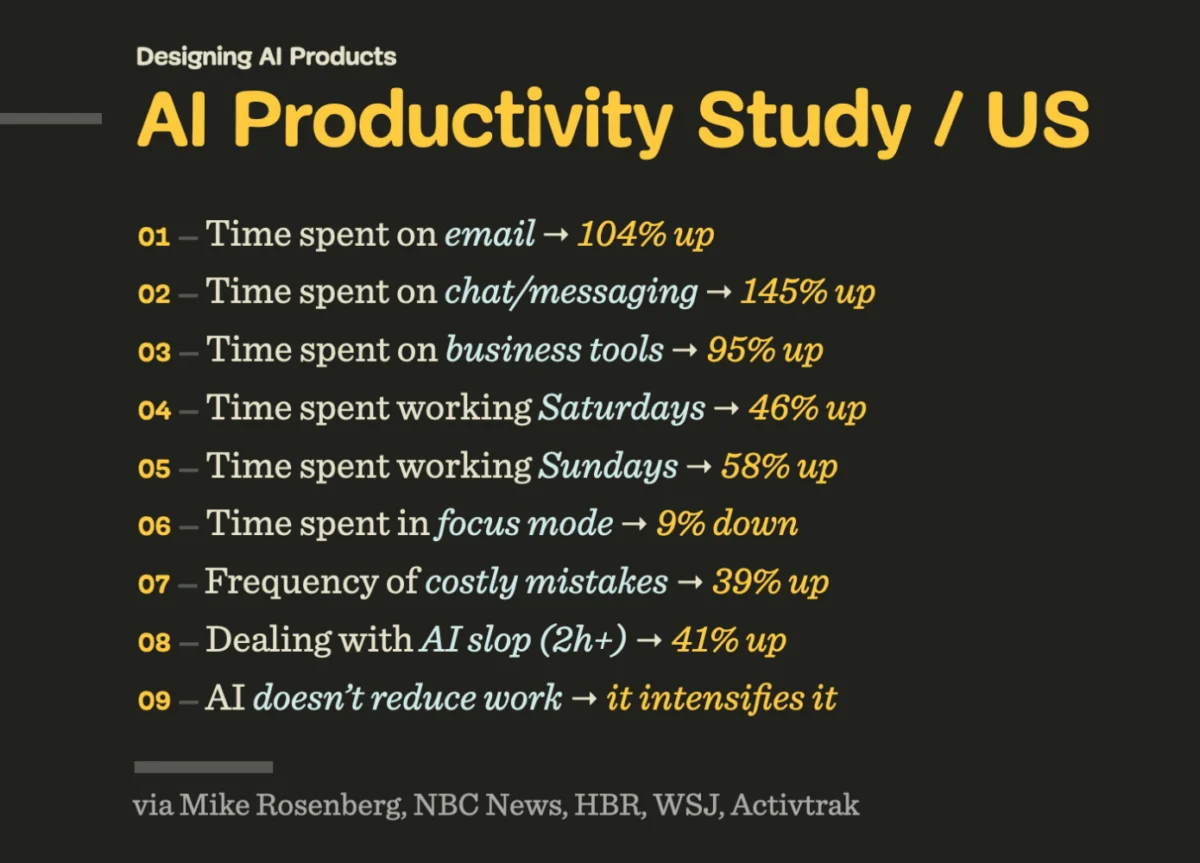
Statistical analysis of AI’s impact on the workplace reveals a stark contrast to the marketing narratives of increased leisure time and efficiency. According to data compiled from NBC News, the Harvard Business Review, and the Wall Street Journal, the "intensification" of work is a more common outcome than its reduction. Key findings from recent productivity studies include:
- Communication Overhead: Time spent on email has increased by 104% in some sectors, while chat and messaging time has surged by 145%. AI-generated drafts often lead to a higher volume of low-quality communication that requires more human oversight.
- Accuracy and Risk: Costly mistakes attributed to over-reliance on unverified AI output have risen by 39%. The phenomenon of "AI slop"—low-quality, AI-generated content that clutters databases and communication channels—is up by 41%.
- The Weekend Shift: Contrary to the promise of a shorter work week, the use of business tools on Saturdays has increased by 46%, and Sunday usage has risen by 58%.
- Cognitive Impact: "Focus mode"—the ability to work on a single task without interruption—has decreased by 9%, as users are forced to constantly manage and "clean up" after AI agents.
These metrics suggest that AI, in its current implementation, acts more as a work intensifier than a labor-saving device. The "hallucination tax"—the time and mental energy required to fact-check AI—remains a significant barrier to true efficiency.

The Architecture of Fragmentation and Technical Debt
One of the most significant hurdles to AI adoption is the state of modern corporate infrastructure. Most organizations operate on a patchwork of legacy systems, technical debt, and "quick patches" accumulated over decades. When AI is introduced into this environment, it does not fix the underlying issues; it makes them more visible.
For example, an AI tool designed to assist with customer service depends entirely on the quality of the underlying data. If a company’s internal documentation is contradictory or outdated, the AI will provide inconsistent answers to users. Instead of the "magic" experience promised by leadership, the user is left to make sense of a "mess" that has been handed to them by a machine.
Furthermore, the "AI-first" design philosophy often ignores existing mental models. Users have spent years fine-tuning their workflows and decision-making processes. When a tool demands that a user change their fundamental way of thinking to accommodate the software, resistance is the natural result. Industry experts argue that for AI to be successful, it must be "AI-second"—subtle, supportive, and deeply integrated into the background of existing tasks.

Official Responses and Industry Sentiment
The shift in sentiment is being reflected in the statements of UX designers and labor experts. Vitaly Friedman, a prominent figure in UX design, notes that people do not compare AI features with human performance; they compare them with other software features. If a traditional, non-AI feature is more predictable and reliable, the user will choose it every time.
Bo Young Lee, a respected voice in corporate diversity and organizational culture, has expressed a sentiment that is gaining traction across social and professional networks: "I don’t want AI to teach my children… I want AI to do all the physical and mental labor that taxes me so I can read books written by humans and go to art galleries to engage with art made by humans."
This perspective highlights a critical misunderstanding in the tech industry: the assumption that humans want AI to take over creative or interpersonal tasks. In reality, the demand is for the automation of the "mundane, annoying, and boring" tasks—the administrative overhead that prevents humans from engaging in the work they actually find rewarding.

Broader Impact: Employment Vulnerability and the Human Element
The Washington Post, utilizing data from GovAI and the Brookings Institution, recently mapped the vulnerability of various professions to AI automation. The findings suggest that while "knowledge work" (software development, public relations, middle management) is highly exposed, there is a limit to what automation can achieve.
The roles least vulnerable to AI are those that require physical presence, high-stakes human empathy, or complex manual dexterity—such as firefighters or specialized healthcare providers. However, even in highly exposed fields like software development, the "human element" remains the primary value. Taste, intuition, and a specific point of view are qualities that AI currently cannot replicate.
The broader implication for the labor market is not necessarily a total replacement of jobs, but a transformation of what those jobs entail. If AI is used to automate the "boring parts," it could lead to higher job satisfaction and productivity. If, however, it is used to replace the "rewarding parts" (creativity, storytelling, complex problem-solving), it is likely to face continued resistance and low adoption.

Conclusion: Toward a Human-Centric AI Strategy
The data suggests that the path forward for AI is not "more features," but "better integration." For organizations to see a return on their massive AI investments, a strategic shift is required:
- From Value Proposition to Key Resource: AI should be viewed as an internal tool to improve efficiency (Key Resource) rather than the product itself (Value Proposition).
- Predictability Over Novelty: Users prioritize reliability and predictability over the "novelty" of a generative interface.
- Augmentation Over Replacement: The most successful AI implementations are those that support the user’s existing workflow rather than forcing a total overhaul of their methods.
Ultimately, the human desire for connection and authentic experience remains unchanged. People do not want "AI art museums" or "AI therapists"; they want more time to spend with other humans. The companies that succeed in the next phase of the AI era will be those that use technology to give people back their time, rather than those that demand more of it. Professional, reliable, and predictable tools that handle the "slop" of modern bureaucracy will always find a market, regardless of whether they are branded as "AI" or simply as "good software."

