
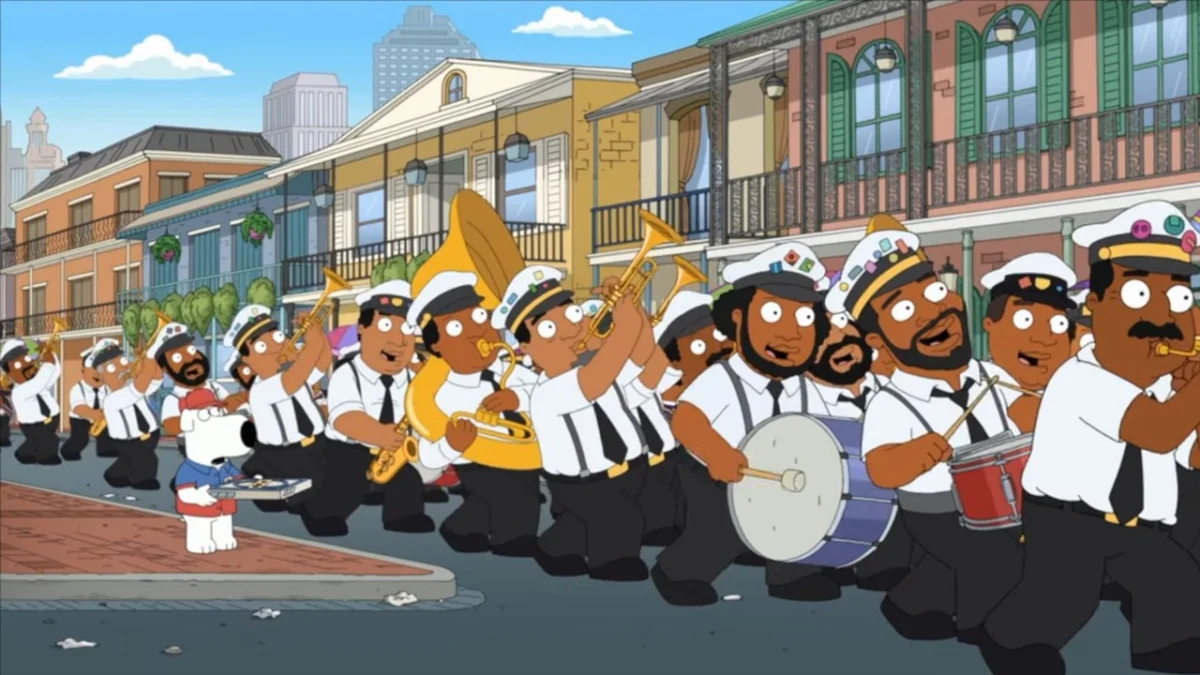
The song and its accompanying animation serve as a satirical take on the New Orleans "second line" tradition. In the original context, the scene depicts a brass band marching boisterously down a narrow street, physically preventing the character Brian Griffin from delivering a pizza. The lyrics of the song—repetitive, upbeat, and intentionally obstructive—directly address the act of causing a public nuisance under the guise of a celebration. This specific juxtaposition of joyful musicality and logistical annoyance has provided the foundation for a wide array of user-generated content across TikTok and Instagram Reels.
Historical Origin and Source Material
The sequence first appeared in Family Guy season 15, episode 18, titled "The Peter Principal," which originally aired on the Fox Broadcasting Company on April 30, 2017. The episode, written by Billy Domineau, primarily follows Peter Griffin as he becomes the temporary principal of his children’s high school. However, the "blocking the street" segment occurs as one of the show’s signature cutaway gags, a hallmark of the series’ comedic structure developed by creator Seth MacFarlane.
In the scene, Brian Griffin is seen attempting to navigate a vehicle through a New Orleans-style parade. The band, complete with trumpets, trombones, and a grand marshal, sings: "We’re all just blocking the street / We’re all just blocking the street / We’ve got no place to go, we’re moving real slow / And we’re all just blocking the street." The humor is derived from the band’s self-awareness and the mounting exasperation of the protagonist, who is trapped behind the procession.
While the episode was moderately well-received during its initial 2017 broadcast, the segment remained largely dormant in the public consciousness for nearly a decade. Its transition into a viral meme began in earnest during the summer of 2026, signaling a shift in how audiences interact with "archival" animation.
Chronology of the 2026 Viral Resurgence
The timeline of the meme’s explosion reveals a steady build-up followed by a rapid escalation in September 2026. The initial spark is often attributed to a July 17, 2026, post by TikTok user @chaoscriterion. This user uploaded a high-definition rip of the scene, which served as the primary audio source for subsequent creators. Over the following two months, this original upload accrued over 98,000 likes, serving as a quiet precursor to the mainstream viral moment.
The true "breakout" occurred in mid-September 2026, when the audio began to be paired with real-world footage and alternative animations. On September 15, TikTok user @littledillthetenorboy posted a video overlaying the Family Guy audio onto footage of an actual marching band. This meta-commentary on the realities of being a performer in such a parade resonated with the music community, garnering over one million views within a six-day window.
The meme then migrated to Instagram Reels, where on September 17, the account @repostbate utilized the audio to satirize the difficulty of navigating school hallways. The caption, "How people walk in the hallways when you only have 59 seconds to get to class," garnered 38,000 likes in four days and shifted the meme’s focus from literal parades to the general concept of human-induced traffic jams.
By September 19, the trend reached its peak of relatability with a post from TikToker @karoline.io. Her video, captioned "How it feels living in a tourist town," used the audio to vent frustrations about pedestrians who obstruct sidewalks and roads in vacation destinations. This iteration earned over two million views in just 48 hours, demonstrating the meme’s capacity for social commentary.
Anatomy of the Meme: Mechanics and Usage
The success of "We’re All Just Blocking the Street" as a digital format can be attributed to its structural simplicity and the universal nature of the frustration it depicts. Digital media analysts categorize the meme into three primary archetypes:
1. The Relatable Inconvenience
This is the most common application, where users film themselves or others in crowded environments. Common settings include airports, grocery store aisles, music festivals, and urban centers. The audio acts as a soundtrack for the "main character" who is trying to get somewhere, while everyone else is depicted as the oblivious marching band.
2. The Self-Deprecating Participant
In this version, the creator identifies as the one "blocking the street." This is frequently seen in videos featuring pet owners whose cats or dogs trip them in the kitchen, or parents whose toddlers stand in doorways. On September 21, TikToker @kopikat used digital art to illustrate how her cats dart in front of her during feeding time, a post that highlighted the meme’s adaptability to the artist community.
3. The Animation Meme
A more technical subset involves "animation memes," where creators animate original characters (OCs) or characters from other fandoms to the beat of the song. A notable example occurred on September 20, 2026, when user @v1trealis posted an animation based on the Roblox game Doors. This version, which gained 168,000 views in 24 hours, illustrates how the meme has successfully crossed over into various subcultures, including gaming and independent animation.
Cultural and Socio-Economic Context
The viral nature of the "blocking the street" sentiment reflects a growing global discourse regarding urban density and "over-tourism." As cities become more crowded and the "Instagrammability" of public spaces leads to increased pedestrian congestion, the Family Guy clip provides a low-stakes outlet for public vent-sharing.
Sociological observations suggest that the song’s catchiness makes the frustration more palatable. By framing an annoying situation through a rhythmic, celebratory brass band performance, users are able to express "communal annoyance." This is particularly evident in the "tourist town" iterations of the meme, where residents of cities like Venice, New York, or New Orleans use the audio to highlight the friction between local logistics and tourist leisure.
Furthermore, the meme highlights the "Family Guy Pipeline" to social media prominence. The show’s "cutaway" format—short, self-contained jokes that require little context—is perfectly suited for the 15-to-60-second constraints of modern video platforms. This has allowed Family Guy to maintain a high level of relevance among Gen Z and Gen Alpha audiences who may not watch the full episodes on traditional television.
Technical Analysis of the Audio and Composition
Musically, the track is a pastiche of traditional New Orleans jazz, characterized by its "swing" feel and syncopated brass lines. The choice of a "second line" band is significant; historically, second lines are the descendants of jazz funerals, representing the "rejoicing" part of the procession. By using this specific musical style to sing about something as mundane and irritating as a traffic obstruction, the composers (led by the show’s musical team) created a comedic irony that translates well to the "irony-poisoned" culture of the mid-2020s.
The lip-dub potential of the audio is also a factor in its spread. The lyrics are clear, the cadence is steady, and the "we’re moving real slow" line allows for comedic slow-motion video editing. This technical ease of use lowers the barrier to entry for creators, allowing the meme to scale rapidly across different demographics.
Broader Implications for Legacy Media
The phenomenon of "We’re All Just Blocking the Street" serves as a case study for media companies on the longevity of animated content. It suggests that the value of a television library in the 2020s is not just in its viewership numbers, but in its "meme-ability."
For Fox and Disney (which now owns the Family Guy IP), such viral moments provide free marketing and drive "search interest" back to legacy platforms like Hulu or Disney+. While there have been no official statements from Seth MacFarlane or the Family Guy production team regarding this specific 2026 resurgence, the show has historically embraced its internet fame, occasionally referencing memes in newer episodes.
As of late September 2026, the trend shows no signs of immediate deceleration. It has moved beyond a simple lip-sync trend into a broader linguistic shorthand; "just blocking the street" has entered the digital lexicon as a way to describe any form of unoptimized or oblivious behavior in public spaces.
Conclusion
We’re All Just Blocking the Street stands as a testament to the unpredictable lifecycle of digital content. What began as a 20-second joke about New Orleans traffic in 2017 has evolved into a global anthem for the frustrated pedestrian and the overwhelmed commuter in 2026. By bridging the gap between traditional television satire and modern social media participation, the meme encapsulates the current state of internet culture: a place where the old is made new, the annoying is made rhythmic, and everyone, eventually, finds themselves blocking the street.

