
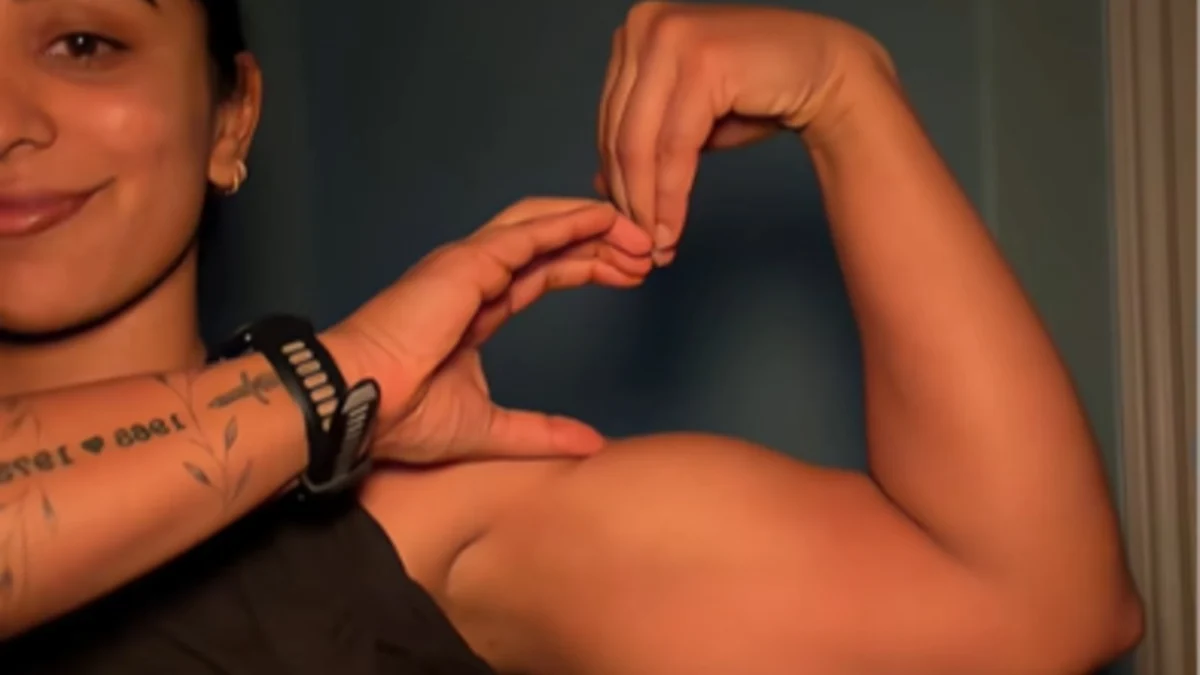
The Bicep Heart Trend has emerged as a dominant cultural phenomenon across major short-form video platforms, blending the aesthetics of the fitness community with the viral nature of digital affection symbols. This trend, which gained significant traction in late 2026, involves a specific sequence of physical movements: a participant flexes their bicep toward the camera, extends their fingers toward their forearm to create a partial enclosure, and then uses their opposite hand to form a "C" shape, completing the silhouette of a heart within the gap between the arm’s musculature and the hand. Classified primarily as a "thirst trap"—a social media term for content intended to attract attention through physical appeal—the trend has successfully bridged the gap between niche bodybuilding circles and mainstream lifestyle content.
The Mechanics of a Viral Aesthetic
The technical execution of the Bicep Heart requires a combination of muscular definition and specific camera framing. Unlike traditional flexing, which focuses solely on the size or peak of the bicep, this trend prioritizes the negative space created by the arm’s positioning. By tucking the fingers of the flexed arm back toward the inner elbow or forearm, a triangular or semi-circular void is created. When the free hand enters the frame to complete the "C" shape, the resulting heart symbol serves as a visual juxtaposition between strength and sentimentality.
Digital media analysts suggest that the trend’s success lies in its accessibility and its dual-purpose nature. For fitness enthusiasts, it provides a socially acceptable "reason" to showcase physical progress without appearing overtly boastful. For the general user, it offers a creative way to engage with the "hand heart" trope that has been a staple of digital communication for over a decade. The trend utilizes the "low barrier to entry" model common in viral challenges, where the core action is simple enough for anyone to attempt yet offers enough variation for influencers to add their unique flair through lighting, music, and transitions.
Chronological Development and Origin
The Bicep Heart Trend can be traced back to the final day of October 2026, marking a transition from seasonal holiday content to a new wave of fitness-oriented virality.
On October 31, 2021, TikTok creator @kavithageorge uploaded a brief video that would serve as the catalyst for the movement. Captioned with the rhetorical question, "Have you ever heard of a bicep heart?", the video demonstrated the movement with precise execution. The simplicity of the prompt, combined with the visual payoff of the heart shape, resonated immediately with the platform’s algorithm. Within seven days, the original post amassed over 5.3 million views, sparking a wave of "duets" and "stiches" as other users attempted to replicate the pose.
The momentum accelerated rapidly as the calendar turned to November. On November 1, 2026, TikToker @chrisphamne posted a variation of the trend that emphasized the physical fitness aspect. His video achieved a massive 8.2 million views in less than a week, signaling that the trend had moved beyond a singular viral moment and into a structured "challenge" format.
By November 3, 2026, the trend migrated to Instagram Reels, a platform known for its high-production-value fitness content. User @baldbangbaddie posted a collaborative version of the trend featuring her partner, which garnered 40,000 likes in three days. This evolution was significant as it demonstrated the trend’s versatility; it was no longer just a solo "thirst trap" but a "couple’s goal" or a shared activity, further broadening its demographic appeal.
Recognizing the growing demand for "how-to" content, prominent creator @brookemonk_ posted a detailed tutorial on November 4, 2026. This video, which broke down the finger placement and arm angles necessary to achieve the perfect heart shape, gained 8.3 million views in just 48 hours. The tutorial’s success confirmed that a large segment of the audience was interested in participating rather than just observing.
Quantitative Impact and Platform Saturation
The rapid scaling of the Bicep Heart Trend is reflected in the engagement metrics across TikTok and Instagram. As of mid-November 2026, the primary hashtags associated with the trend have garnered hundreds of millions of collective views. Data from social media monitoring tools indicate a 400% increase in "bicep heart" search queries during the first week of November.
The trend’s saturation can be attributed to the "algorithmic feedback loop." Platforms like TikTok prioritize content that has high completion rates—meaning viewers watch the video until the end. Because the Bicep Heart involves a "reveal" (the moment the heart is formed), viewers are incentivized to stay until the final second of the clip. This high retention rate signals the algorithm to push the content to a wider audience, including the "For You" pages of users who do not typically engage with fitness content.
Furthermore, the trend has seen a significant presence on Facebook and YouTube Shorts. While TikTok remains the primary incubator for such trends, the migration to Facebook suggests an aging-up of the demographic, where older fitness enthusiasts and casual users are adopting the pose for profile pictures and status updates.
Socio-Psychological Analysis of the Trend
The Bicep Heart Trend represents a broader shift in how physical fitness is presented in the digital age. Historically, bodybuilding and fitness content were characterized by "hard" imagery—strained muscles, sweat, and intensity. The Bicep Heart introduces a "soft" element, using the body as a canvas for a universal symbol of love and kindness.
Psychologists specializing in digital behavior note that this trend functions as a form of "vulnerable strength." By combining a display of power (the flexed muscle) with a symbol of affection (the heart), creators project an image that is both disciplined and approachable. This duality is particularly effective in the "thirst trap" subgenre, where the goal is to be attractive without being perceived as overly aggressive or arrogant.
Additionally, the trend has taken on emotional dimensions. On November 5, 2026, Instagram user @jennifer_jinn posted a video utilizing the trend as a form of community support. In her post, she requested "bicep hearts" from her followers during a period of personal sadness. The post received over 314,000 likes in a single day, illustrating how the trend evolved from a physical display into a digital "hug" or a gesture of solidarity. This pivot from vanity to empathy is a common trajectory for long-lasting social media trends, as it provides the movement with a sense of purpose beyond the aesthetic.
Industry and Expert Reactions
The fitness industry has largely embraced the trend, with gym owners and personal trainers using it to drive engagement on their business pages. "It’s a fun, non-intimidating way to get people to look at fitness content," says one industry analyst. "It breaks down the barrier between the ‘scary’ gym culture and the everyday social media user."
However, some physical therapists have offered lighthearted "warnings" regarding the trend. While the pose is generally safe, the repetitive flexing and awkward wrist positioning required for the perfect "C" shape could, in theory, lead to minor muscle strain if practiced excessively by those not accustomed to physical activity. These "expert" reactions, often delivered in a humorous tone, have themselves become part of the trend’s ecosystem, adding another layer of content and commentary.
Broader Implications for Digital Culture
The Bicep Heart Trend is a testament to the power of "visual shorthand" in the 2020s. As global attention spans continue to shorten, content that can convey a complex message—strength, beauty, and affection—in under seven seconds becomes the gold standard for virality.
The trend also highlights the ongoing "gamification" of the human body. Through filters, specific poses, and challenges like the Bicep Heart, social media users are increasingly viewing their physical selves as tools for digital expression. The arm is no longer just a limb; it is a component of a graphic design. This shift has implications for how future generations will perceive body image, potentially prioritizing "camera-ready" flexibility and specific shapes over functional strength.
As November 2026 progresses, the Bicep Heart Trend shows no signs of immediate decline. It has already begun to spawn sub-trends, including "leg hearts" and "back-muscle hearts," though none have yet reached the ubiquity of the original bicep version. Whether it remains a seasonal fad or becomes a permanent fixture of the fitness influencer’s repertoire, the Bicep Heart has successfully carved out a unique space in the crowded landscape of social media iconography.
In conclusion, the Bicep Heart Trend is more than a simple pose; it is a sophisticated intersection of fitness culture, digital emotionality, and algorithmic strategy. By turning a display of strength into a symbol of connection, it has captured the collective imagination of millions, proving once again that on social media, the most successful content is that which speaks to both the eyes and the heart.

