
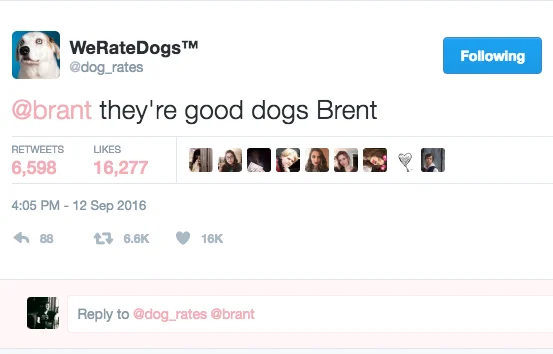
In the fast-evolving landscape of social media, few interactions manage to transcend their immediate context to become permanent fixtures of the digital lexicon. On September 12, 2016, a brief exchange between a dog-themed humor account and a skeptical observer did exactly that, birthing the phrase "They’re good dogs Brent." What began as a minor disagreement over the logic of a rating system evolved into a cultural touchstone, illustrating the unique power of wholesome content, the mechanics of viral humor, and the shift in how online communities handle conflict.
The Genesis of the Interaction
The origin of the phenomenon lies with the Twitter account WeRateDogs, operating under the handle @dog_rates. Founded in 2015 by Matt Nelson, then a college student at Campbell University, the account established a niche by "reviewing" user-submitted photographs of dogs. The reviews typically featured a blend of whimsical commentary, intentional misspellings (a dialect often referred to as "doggo-speak"), and a rating system that frequently exceeded the traditional 10-point scale. Ratings such as 11/10, 12/10, or even 14/10 became the account’s hallmark, signaling that the "goodness" of a dog could not be contained by standard mathematical constraints.
On the afternoon of September 12, 2016, a Twitter user named Brant Walker, posting from the handle @brant, took public issue with this inflationary logic. Walker tweeted at the account, stating: "your rating system sucks. Just change your name to ‘CuteDogs’."
The interaction escalated when WeRateDogs responded with a dismissive but playful query: "Why are you so mad Bront?" The intentional misspelling of Walker’s name—changing "Brant" to "Bront"—served as the first comedic hook. Walker, seemingly undeterred, doubled down on his critique, replying: "well you give every dog 11s and 12s. It doesn’t even make any sense."
It was at this juncture that WeRateDogs delivered the definitive rebuttal: "they’re good dogs Brent." By reverting to a version of his name that was still slightly "off" in context (as he had just been called Bront) and pairing it with a simple, unassailable defense of the canine subjects, the account struck a chord with the platform’s user base.
The Mechanics of Virality and Spread
The exchange was almost immediately recognized as a classic example of "ratioing" combined with high-concept absurdity. Within hours, screenshots of the conversation began to circulate outside of the original thread. A post by the user @Braydenominator, which captured the entire sequence, garnered over 57,000 retweets in its first few months.
The rapid spread can be attributed to several factors inherent to Twitter’s culture in 2016. First, the response "they’re good dogs Brent" functioned as a "mic drop" moment. It reframed Walker’s logical, pedantic argument as an unnecessary attack on something inherently pure: dogs. In the eyes of the internet, criticizing a dog’s rating was not seen as a valid critique of a social media brand, but as a failure to appreciate the universal joy that pets provide.
By September 13, 2016, major digital media outlets including Mashable and Elite Daily had published articles chronicling the exchange. The Washington Post later cited the interaction as one of the defining memes of the year. This mainstream coverage transitioned the phrase from an "inside joke" among WeRateDogs followers to a recognized piece of internet slang.
Quantitative Impact on the WeRateDogs Brand
For Matt Nelson and the WeRateDogs brand, the "Brent" incident was a transformative commercial event. Prior to the exchange, the account was already successful, but the viral nature of the rebuttal catalyzed a massive surge in growth. Internal data and third-party analytics suggested that the account gained approximately 50,000 new followers in the immediate 48-hour window following the tweet.
As of late 2018, the account’s following had ballooned to over 7 million, a trajectory that allowed Nelson to turn a hobby into a full-scale media enterprise. The phrase "They’re good dogs Brent" was quickly monetized, appearing on official merchandise including t-shirts, coffee mugs, and hats. The success of this specific meme helped solidify the "WeRateDogs" business model, which now includes a non-profit arm (the 15/10 Foundation) dedicated to paying the medical bills for shelter dogs.

The Cultural Significance of "Doggo-Speak" and Wholesome Content
The "Brent" meme emerged during a period of significant digital transition. In 2016, social media was increasingly characterized by political polarization and heightened hostility. In this environment, "wholesome memes"—content that focuses on empathy, kindness, and simple joys—became a form of digital escapism.
The phrase "they’re good dogs Brent" became the unofficial slogan for this movement. It suggested that some things are beyond the reach of cynical analysis. Linguistically, the meme also popularized the use of "Brent" or "Bront" as a placeholder name for anyone perceived as being unnecessarily negative or "missing the point." This follows a long tradition of internet "placeholder" names, similar to how "Karen" or "Becky" would later be used in different cultural contexts, though "Brent" remained largely lighthearted.
The misspelling of Brant’s name also played into the "doggo-speak" trend, where words like "dog" became "doggo," "puppy" became "pupper," and "solid" became "bollo." This subculture of internet linguistics served to create an in-group for animal lovers, and the "Brent" exchange provided the perfect entry point for newcomers to that community.
Chronology of a Resolution: Brant’s Perspective and the Return of Charlie
One of the reasons the "They’re good dogs Brent" meme maintained longevity was the good-natured participation of Brant Walker himself. While many "main characters" of the internet (individuals who become the focus of collective mockery) often retreat from the spotlight or react with litigiousness, Walker embraced his role in the narrative.
In the years following the exchange, Walker’s Twitter bio frequently referenced the meme. He reportedly received "They’re good dogs Brent" as a message on his wedding cake, a gesture that signaled he had taken the ribbing in stride. This lack of animosity allowed the meme to remain "wholesome" rather than becoming a tool for harassment.
The narrative reached a full-circle conclusion on July 23, 2018. In a moment of digital symmetry, Walker sent a direct message to WeRateDogs asking them to rate his own new dog, a Havanese named Charlie. The account shared the request publicly, posting a photo of Charlie napping in a pineapple-shaped bed. The rating was a definitive 14/10, accompanied by the caption: "you’ve got a good dog, Brent."
This follow-up tweet was a massive success in its own right, earning over 92,700 likes and 16,500 retweets within 24 hours. Twitter even curated a "Moments" page dedicated to the event, titled "Remember the man from ‘they’re good dogs Brent?’ He got a dog." This resolution provided a rare "happy ending" to an internet conflict, reinforcing the brand’s message of positivity.
Analysis of Implications for Social Media Management
From a professional communication perspective, the "Brent" incident serves as a case study in effective brand voice. Matt Nelson’s response was successful because it:
- Remained Consistent with the Brand: The response was funny and slightly irreverent, matching the established tone of the account.
- Avoided Direct Hostility: While it corrected the user, it did so through humor (the misspelling) rather than insults.
- Engaged the Community: It provided a "catchphrase" that followers could use to defend the account in the future.
Furthermore, the incident highlights the shift from "customer service" to "community management." In the early days of social media, brands were advised to respond to all criticism with professional, apologetic tones. The WeRateDogs approach demonstrated that for personality-driven brands, standing one’s ground with humor can be more effective for building loyalty than a standard corporate apology.
Long-term Legacy
Today, "They’re good dogs Brent" is more than just a quote; it is a template. It is frequently adapted to other contexts—"They’re good [X], Brent"—to defend everything from films and video games to other social media accounts. It remains a shorthand for the idea that some things are inherently valuable regardless of their flaws or the logic used to measure them.
The legacy of the exchange is visible in the continued success of the WeRateDogs ecosystem, which has expanded into books, calendars, and a massive presence across Instagram and TikTok. It stands as a reminder of a specific era of the internet where a simple typo and a defense of a dog could unite millions of people in a shared moment of levity. In an increasingly complex digital world, the simplicity of the sentiment—that dogs are fundamentally good—remains its most enduring quality.

