
The European Union has finalized a comprehensive set of transparency guidelines under the landmark EU AI Act, establishing a definitive timeline for when and how artificial intelligence must be identified to the public. As of August 2, 2026, AI labeling will transition from a voluntary industry best practice to a stringent legal requirement for any entity operating within the European Union or serving its citizens. This regulatory shift is designed to mitigate the risks associated with synthetic media, deepfakes, and automated misinformation by ensuring that users can clearly distinguish between human-generated and machine-generated content. While initial industry reactions ranged from confusion to concern over potential "drastic measures," the finalized rules provide a more targeted framework focusing on high-stakes content and public interest.
The Regulatory Framework and Implementation Timeline
The EU AI Act, which officially entered into force on August 1, 2024, represents the world’s first comprehensive horizontal regulation on artificial intelligence. However, the implementation of its various provisions is staggered to allow businesses and developers sufficient time to adapt. The transparency obligations, primarily housed under Article 50 of the Act, are scheduled for full enforcement starting in the summer of 2026.
The chronology of the Act’s rollout serves as a roadmap for global tech compliance. Following the initial entry into force, the EU established the AI Office to oversee the development of "Codes of Practice." These codes, developed in collaboration with industry stakeholders and civil society, aim to refine the technical standards for watermarking and metadata. By February 2025, specific prohibitions on "unacceptable risk" AI (such as social scoring) will take effect, followed by the transparency mandates in 2026, and finally, the full suite of requirements for high-risk AI systems in 2027.

The scope of the labeling law is notably extraterritorial. Much like the General Data Protection Regulation (GDPR) and the European Accessibility Act (EAA), the AI Act applies to any company worldwide if their AI-generated output is utilized by people within the EU. This "Brussels Effect" ensures that major technology firms based in the United States, Asia, and elsewhere must align their global interface designs with European standards to maintain access to the single market.
Defining the Mandate: What Requires Disclosure
The primary objective of Article 50 is "recognizability." The European Commission asserts that any person exposed to AI-generated content should be able to identify it in a clear, distinguishable, and persistent manner. Under Article 50(4), the labeling requirement applies specifically to three categories of output:

- Deepfakes and Realistic Media: Any AI-generated or manipulated image, audio, or video that significantly resembles existing persons, objects, places, or events in a way that would falsely appear authentic to a reasonable person.
- Text in the Public Interest: AI-generated text intended to inform the public on matters of public interest, including but not limited to health, safety, the environment, fundamental rights, and political processes.
- Automated Interactions: AI systems designed to interact with natural persons (such as chatbots) must disclose their artificial nature at the start of the interaction, unless it is obvious from the context.
Crucially, the legal burden falls on both "providers"—those who develop the AI technology—and "deployers"—the businesses or individuals who use the tools to generate content. A company cannot circumvent these obligations by citing the use of a third-party API or licensed software; the responsibility to ensure the end-user sees the disclosure remains with the entity presenting the content.
The Exclusion of Human-Edited Content
One of the most significant clarifications in the recent guidelines is the distinction between "AI-generated" and "AI-assisted" work. The European Commission has signaled that the disclosure obligation does not apply where the AI-generated content has undergone substantive human review and editing. In such cases, a named person or entity must take editorial responsibility for the final output.

The guidelines provide a "fuzzy" but navigable line regarding what constitutes a minor edit versus a substantive rewrite. Assistive tasks—such as standard spell-checking, grammar correction, basic formatting, image cropping, and color correction—do not trigger the labeling requirement. Furthermore, AI-generated translations are generally exempt, provided they are used for purely communicative purposes and do not alter the fundamental meaning of the source text in a deceptive way.
Conversely, AI-generated summaries, composite imagery created from text prompts, and substantive rewrites are classified as AI generation. The Commission is explicit: a "human skim" before publishing does not qualify as editorial review. To bypass the labeling requirement, the human intervention must be meaningful, with the human editor exercising final control over the accuracy and intent of the message.

The Decline of the Sparkle Icon and the Rise of EU Standards
For several years, the "sparkle" icon (✨) has served as the de facto industry standard for signaling AI-powered features. However, the new EU guidelines suggest that this symbol alone is insufficient for legal compliance. The Commission’s "Code of Practice" argues that the sparkle is too ambiguous; it is frequently used to denote "magic," "new features," or "premium status" rather than the specific presence of synthetic content.
To address this, the European Commission has introduced an official EU AI icon set. This set includes three distinct variants designed to communicate different levels of AI involvement: basic AI interaction, fully generated content, and partially modified media. The guidelines mandate that these signals must be "clear and distinguishable."

UX researchers, including those from the Nielsen Norman Group, have highlighted that users often ignore or misinterpret vague icons. Consequently, the EU recommends pairing icons with plain-language labels, such as "AI-generated" or "Synthetically altered." These labels must also be accessible to assistive technologies, ensuring that visually impaired users are equally informed of the content’s origin. Furthermore, the disclosure must be persistent—if an AI-generated image is downloaded or reshared, the label or metadata must remain attached to the file.
Supporting Data and Industry Implications
The push for regulation is supported by a growing body of data regarding the prevalence of synthetic media. Industry analysts estimate that by 2026, upwards of 90% of online content could be generated or modified by AI. This explosion of data poses a significant challenge for information integrity. According to a 2023 report by the Center for Countering Digital Hate, AI-generated misinformation can be produced at a fraction of the cost of traditional propaganda, making mandatory labeling a vital tool for digital hygiene.

Financial implications for non-compliance are severe. Under the AI Act, companies found in violation of transparency obligations could face administrative fines of up to €15 million or 3% of their total worldwide annual turnover, whichever is higher. For systemic violations by "providers of general-purpose AI models," the fines can climb even higher, reaching up to 7% of global turnover.
Global Regulatory Convergence
The EU is not acting in isolation. The emergence of these rules is part of a global pattern of regulatory convergence. In the United States, California’s recently proposed (and in some cases enacted) legislation, such as the California AI Transparency Act, mirrors the EU’s focus on manifest disclosures and latent watermarking. Similarly, China’s Cyberspace Administration (CAC) has already implemented strict rules requiring "prominent labels" on any synthetically generated content that could mislead the public.

In the corporate sector, Adobe’s "Content Authenticity Initiative" and the C2PA (Coalition for Content Provenance and Authenticity) standard are being adopted by major players like Microsoft, Google, and Nikon. These technical standards allow for the embedding of tamper-evident metadata, which aligns with the EU’s requirement for persistent labeling.
Official Responses and Future Outlook
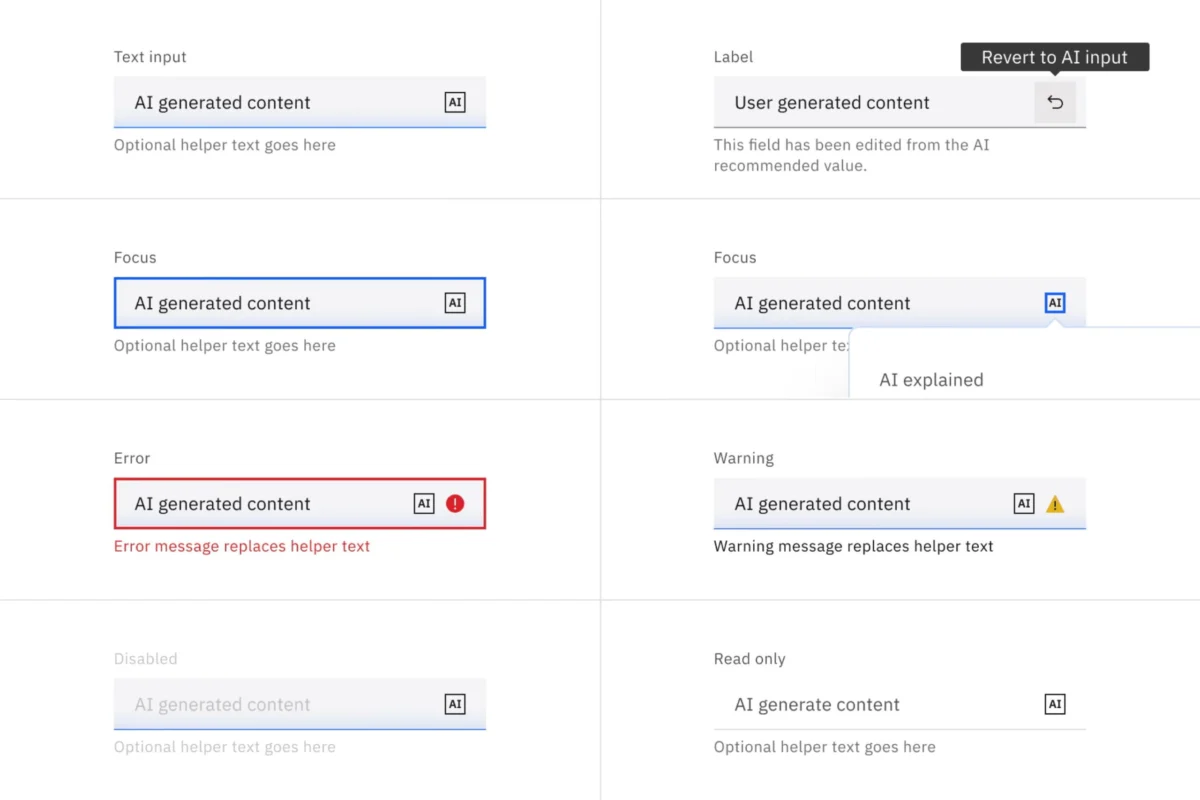
While some tech advocacy groups initially expressed concern that mandatory labeling might stifle innovation or clutter user interfaces, the response from major design systems has been proactive. IBM’s Carbon Design System, for instance, has already integrated standardized AI labels that offer "explainability panels," allowing users to see exactly which parts of a data dashboard were generated by an algorithm.

The European Commission’s stance is that these rules will ultimately foster consumer trust. By providing a clear framework for what is real and what is synthetic, the EU aims to create a digital environment where "AI slop" is easily identifiable, and high-quality, human-curated content retains its value.
As the August 2026 deadline approaches, businesses must audit their AI implementations. The transition will require a multi-disciplinary approach involving legal counsel to interpret the nuances of "public interest" content, and UX designers to integrate non-obtrusive but legally compliant labeling systems. The era of "stealth AI" is effectively ending in the European market, replaced by a mandate for radical transparency that is likely to set the standard for the rest of the world.

