
The global technology sector is currently grappling with a significant divergence between corporate strategy and consumer behavior. While silicon valley giants and enterprise software providers have aggressively integrated generative artificial intelligence into nearly every digital interface, empirical evidence suggests a growing "adoption gap." Contrary to the prevailing industry assumption that users are eager for more AI-driven features, a mounting body of research indicates that the average consumer and employee may be reaching a point of saturation, or even active resistance. This phenomenon is not merely a rejection of new technology, but a nuanced reaction to how AI is being deployed—often as a disruptive "bolt-on" rather than a seamless utility.
The AI Adoption Gap: From Hype to Disillusionment
Since the public release of ChatGPT in late 2022, the corporate world has operated under the premise that AI is a universal value proposition. However, recent studies, including those conducted by IBM and MindStudio, highlight a troubling trend for developers: low adoption and retention rates for new AI features. The cost of delivering these features is immense, involving significant expenditures on GPU clusters, specialized talent, and data procurement. Despite this investment, many users find that these tools do not simplify their lives but instead add a layer of complexity to already fragmented workflows.
The core of the issue lies in the distinction between a "feature" and a "value proposition." In professional journalism and business analysis, a value proposition is defined as the specific benefit a customer receives from a product. Industry analysts now argue that "Powered by AI" is no longer a sufficient reason for a user to switch their habits. When AI tools exist as separate entities—requiring users to "hop" between systems—they increase cognitive load. Instead of streamlining a process, these tools often force users to exit their established environments to interact with a chatbot or a generation engine, only to have to bring that data back into their primary workspace.
A Chronology of the AI Surge and the Resulting Friction
The timeline of AI integration reveals how the industry arrived at this impasse. Following the initial excitement of 2023, which saw record-breaking venture capital flows into AI startups, 2024 has become a year of reckoning. In the first half of the year, major software suites across the creative, legal, and administrative sectors rolled out "AI Assistants." By mid-2024, however, user feedback began to highlight a recurring theme: the "hallucination tax."
The "hallucination tax" refers to the time and mental energy users must expend to verify the accuracy of AI-generated content. While it may take only seconds for an LLM (Large Language Model) to draft a response, the subsequent minutes spent checking for factual errors, tone inconsistencies, and "slop"—a term used to describe low-quality, unhelpful AI output—often result in a net loss of time. This has led to a paradoxical situation where tools designed to save time are actually intensifying the workday.

Quantitative Analysis: The Productivity Paradox
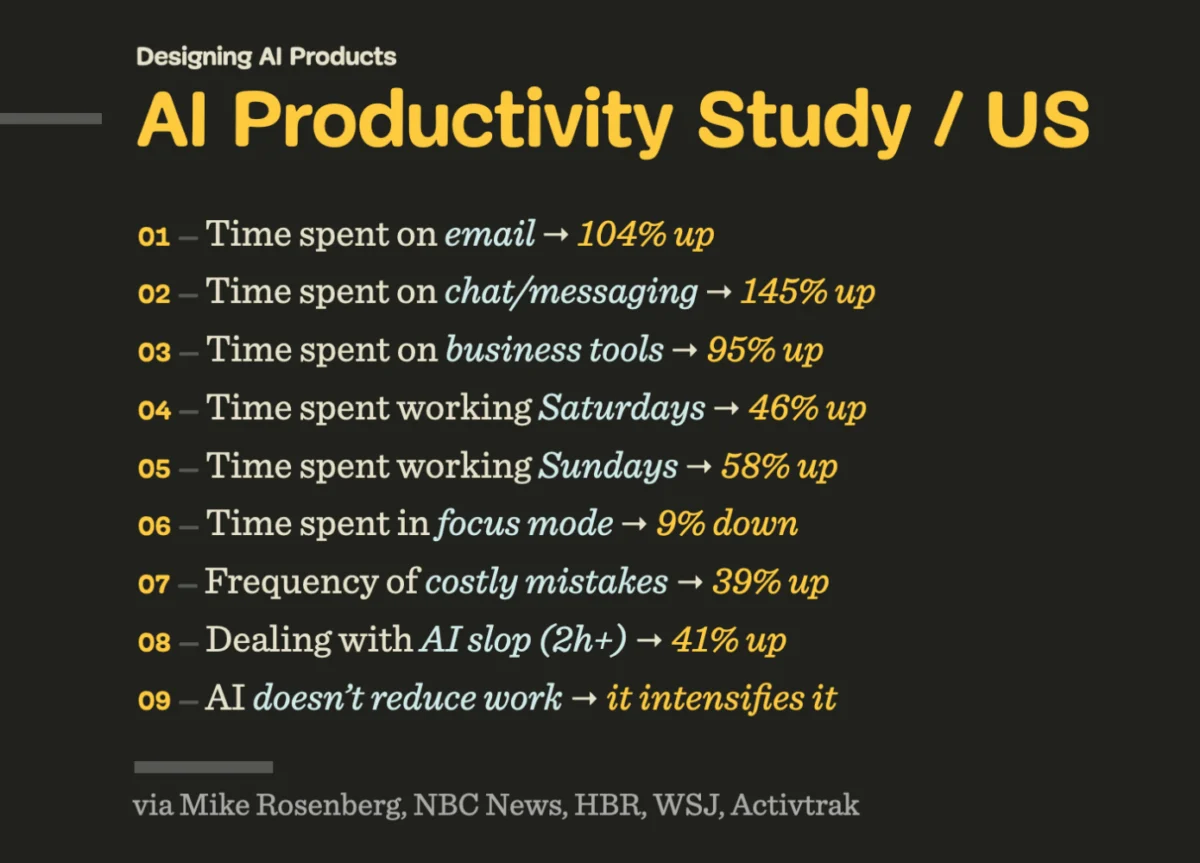
Data from recent productivity studies conducted by organizations such as NBC News, Harvard Business Review (HBR), and the Wall Street Journal provide a stark contrast to the marketing claims of AI developers. These studies indicate that instead of reducing labor, the current implementation of AI has had several unintended consequences:
- Increased Communication Volume: Time spent on email has increased by an average of 104% in organizations that have adopted AI-driven drafting tools. Messaging via platforms like Slack and Teams has surged by 145%.
- Diluted Focus: Focus mode—the time employees spend on deep, uninterrupted work—has decreased by approximately 9%.
- Heightened Error Rates: Costly mistakes attributed to over-reliance on AI outputs have risen by 39% in certain sectors.
- Weekend Work Surge: Despite the promise of a shorter workweek, data from ActivTrak suggests that work on Saturdays and Sundays has increased by 46% and 58%, respectively, as employees spend their weekends "cleaning up" the outputs generated during the week.
These statistics suggest that AI, in its current form, is not reducing the volume of work but is instead accelerating the pace of low-value communication, which in turn requires more human intervention to manage.
The Psychological Toll and Workplace Anxiety
Beyond the metrics of productivity, there is a profound human element to the AI resistance. For many, AI has arrived as an uninvited guest in their professional lives. The narrative surrounding automation is frequently framed in terms of "displacement" and "replacement," fostering an environment of deep-seated anxiety.

Employees often view AI not as a partner, but as a competitor that threatens the rewarding aspects of their roles. There is a psychological sense of achievement found in solving a complex problem or creating a piece of work from scratch. When AI automates the "vibe" or the creative core of a task, it can leave the human worker feeling like a mere editor of a machine’s first draft—a role that many find unfulfilling and dull.
Bo Young Lee, a prominent voice in the discussion of human-centric technology, recently articulated this sentiment: "I don’t want AI to teach my children. I don’t want to have an AI therapist. I want AI to do all the physical and mental labor that taxes me so I can read books written by humans and go to art galleries to engage with art made by humans." This sentiment highlights a critical misalignment: companies are using AI to create "art" and "narrative," while users actually want AI to handle "logistics" and "data entry."
Shifting Strategies: The "AI-Second" Approach
In response to these challenges, a new philosophy of design is emerging: "AI-Second." This approach prioritizes the user’s existing mental models and workflows, treating AI as a background utility rather than a front-and-center feature.

The most successful implementations of technology are often those that are "calm" and "ambient." For example, a system that automatically categorizes expenses in the background without requiring user prompts is far more valuable than a chatbot that asks the user to describe their expenses. The goal is to automate the mundane and the "boring" tasks that offer no creative or professional reward, thereby freeing up human headspace for higher-level decision-making.
Industry experts suggest that for AI to overcome the current adoption hurdle, it must meet five criteria:
- Predictability: Users must know exactly what the output will be.
- Reliability: The feature must work the same way every time.
- Integration: It must exist within the tools users already use.
- Accessibility: It must be easy to trigger without complex prompting.
- Utility: it must solve a problem the user actually recognizes as a pain point.
Broader Implications and Future Outlook
The implications of this "AI fatigue" are significant for the global economy. If the current trajectory of low adoption continues, the massive valuations of AI-focused companies may face a correction. Investors are beginning to look past the "AI" label and are asking for evidence of sustainable user engagement and tangible ROI.

Furthermore, the "exposure" of various jobs to AI automation—as tracked by institutions like the Brookings Institution and the Washington Post—does not necessarily equate to the "replacement" of those jobs. Roles such as software development and public relations are highly exposed to AI, but they also require a high degree of human intuition, taste, and social intelligence. The future of these industries likely involves a collaborative model where AI handles the repetitive "scaffolding" of a project, while the human provides the final 20% of "soul" and "judgment" that a machine cannot replicate.
In conclusion, the tech industry is at a crossroads. The assumption that the world "needs more AI" is being tested by a reality where people are craving more human connection, more time, and less digital clutter. The companies that thrive in the next decade will likely be those that use AI to disappear into the background, making life easier without demanding more of the user’s attention. As the market matures, the focus will inevitably shift from what AI can do to what AI should do, with the ultimate goal of returning time and autonomy to the human user. For now, the message from the market is clear: people do not want more AI in their lives; they want more life in their lives, facilitated by smarter, quieter technology.

