
The traditional lifecycle of a corporate website is defined by a singular moment of perfection followed by a slow, inevitable decline into obsolescence. In the professional web development industry, this phenomenon is often referred to as "digital decay," a process where a site begins to lose its relevance and technical efficiency the moment the final code branch is merged and the project goes live. While a site may continue to function technically, the shifting tides of market trends, brand messaging, and competitive landscapes often render a year-old website a "period piece"—a static relic that no longer accurately reflects the organization it represents. Pierre Burgy, a prominent figure in the headless CMS space and founder of the autonomous website platform Fimo, argues that this decay is not an unavoidable law of nature but a symptom of a systemic lack of maintenance resources. The emergence of autonomous websites, powered by specialized AI agents, seeks to solve this by creating "living" digital assets that optimize themselves in real-time, though the transition toward this model has revealed significant psychological and structural hurdles within design and development teams.
The Mechanics of Digital Decay and the Maintenance Crisis
Digital decay is rarely the result of a catastrophic technical failure. Instead, it is the cumulative effect of hundreds of minor oversights. For most organizations, the team that builds a website is reassigned to new projects immediately after launch, leaving the site in a "maintenance mode" that is often reactive rather than proactive. Over time, new marketing initiatives may lead to the creation of pages that do not strictly adhere to the original design system. Developers might rush a release, leaving behind unoptimized images or broken meta tags. Accessibility standards, such as the Web Content Accessibility Guidelines (WCAG), may evolve, leaving the site’s older components non-compliant.
Data from industry analysts suggests that the average lifespan of a corporate website is between two and three years before a complete redesign is required. This cycle is economically inefficient, costing enterprises hundreds of thousands of dollars in "re-platforming" fees every few years. Furthermore, research into user experience indicates that even minor technical regressions can have outsized impacts on business outcomes. For instance, a one-second delay in page load time can reduce conversions by up to 7%, while broken links and outdated information significantly erode brand trust. The concept of an autonomous website proposes a shift from this "launch-and-forget" model to a "continuous optimization" model, where AI agents handle the repetitive, rule-bound tasks that human teams often lack the time or inclination to perform.
A Chronology of Web Management: From Static Files to Agentic AI
To understand the significance of the autonomous web, one must look at the technological progression of web management over the last three decades.
- The Static Era (1990s): Websites were collections of manual HTML files. Updating a site required direct code edits and FTP uploads. Change was slow and technical.
- The CMS Revolution (2000s): The rise of platforms like WordPress and Drupal democratized content management, allowing non-technical users to update text and images. However, the underlying structure and performance remained the responsibility of manual developers.
- The Headless and Cloud Era (2010s): The decoupling of the frontend and backend (Headless CMS) allowed for multi-channel content delivery. Automation began to appear in the form of CI/CD (Continuous Integration/Continuous Deployment) pipelines, which automated the testing and deployment of code.
- The Agentic Era (2020s): The current shift involves moving beyond simple automation (if-this-then-that) toward autonomous agents. Unlike traditional scripts, these agents use large language models (LLMs) and computer vision to understand context, make decisions, and execute complex tasks across the entire site architecture.
The promise of this fourth era is a website that catches its own errors. If a design system change fails to propagate to a pricing page, an agent identifies the discrepancy and applies the fix. If a new component introduces an accessibility regression, the agent flags it or corrects it automatically. This vision, however, has encountered a significant roadblock: the human element of control and trust.
The Three-Tiered Model of Autonomy and Human Judgment
Through the development of the Fimo platform, Burgy and his team observed that the primary obstacle to autonomous websites was not the capability of the AI, but the varying comfort levels of the human stakeholders. A website has no single owner; it is a shared space between designers, developers, marketers, and legal teams. Each of these stakeholders views "autonomy" through a different lens. To address this, the work of maintaining a website can be categorized into three distinct tiers based on the level of judgment required.
Tier 1: The Rule-Bound Chores (The 80%)
The largest portion of website maintenance consists of tasks that are repetitive and governed by objective rules. This includes optimizing image compression, fixing broken links, ensuring meta tags are present for SEO, and maintaining WCAG compliance. In these instances, there is a "correct" answer that does not require creative taste. Burgy notes that most professionals are relieved to hand these tasks over to agents. This "no-brainer" category represents the low-hanging fruit of web autonomy, where agents can provide immediate value without threatening the creative agency of the human team.
Tier 2: The Subjective Middle
The most complex area of autonomy is the middle ground where tasks carry different weights for different people. A practical example is the implementation of a "dark mode" default. To a developer, this might be a simple technical toggle with a clear rationale based on user system preferences. To a brand designer, however, the default theme is a fundamental expression of the brand’s identity. For one person, it is a chore; for another, it is a high-stakes decision. This realization led to the conclusion that autonomy cannot be a global setting; it must be granular, allowing different users to draw the "line of trust" in different places.
Tier 3: The Human Core (Taste and Strategy)
The final tier consists of work that requires human "taste"—the intangible quality that determines if a page "feels" right or if the messaging resonates with a specific cultural moment. While an AI agent can ensure a page is technically perfect and follows a style guide, it cannot determine if a creative direction is groundbreaking or merely derivative. This tier remains the exclusive domain of human professionals, and it is the reason why full, unattended autonomy for an entire brand-facing website remains a goal that few organizations are willing to pursue.
Technical Implications and Market Impact
The shift toward autonomous agents represents a fundamental change in the "Total Cost of Ownership" (TCO) for enterprise websites. By delegating the "Tier 1" chores to AI, organizations can significantly reduce the overhead associated with site maintenance. Current estimates suggest that developers spend upwards of 30% of their time on "maintenance and support" tasks. Automating even half of this load would represent a massive gain in productivity, allowing teams to focus on feature innovation rather than bug fixes.
Furthermore, the "living website" model provides a competitive advantage in SEO and user retention. Search engines like Google prioritize sites that are technically sound, fast, and frequently updated. An autonomous site that continuously optimizes its Core Web Vitals and refreshes its metadata is likely to outperform a static site that only receives major updates once or twice a year.
Addressing the Trust Gap: The Evolution of Agent Composition
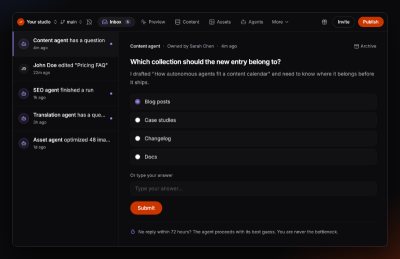
To bridge the gap between human oversight and machine execution, the next generation of web platforms is moving toward a "composable agent" model. Instead of a single, opaque "AI" managing the site, users can build and configure specific agents for specific tasks. For example, a legal team might deploy an "Accessibility Agent" with full autonomy to fix compliance issues, while a marketing team might deploy a "Content Agent" that is only allowed to suggest changes for human approval.
This "narrow-to-wide" approach to trust allows organizations to start small. As agents prove their reliability through transparent logs and before-and-after comparisons, the human owners can gradually loosen the restrictions. This creates a feedback loop where the agent "earns" its autonomy over time.
Conclusion: The Real Risk of the Frozen Site
The prevailing fear in the industry is that an autonomous agent will make an unauthorized or "wrong" change to a website. However, a fact-based analysis of the current digital landscape suggests that the greater risk is the "frozen site." A site that does not change is a site that is actively losing value. It becomes a liability as it drifts away from current security standards, accessibility requirements, and brand relevance.
The move toward autonomous websites is not about removing humans from the process; it is about removing the friction of digital decay. By allowing AI to handle the objective, rule-based maintenance that humans have historically neglected, organizations can ensure that their website remains at its "launch-day" quality indefinitely. The future of the web lies in this partnership: humans providing the taste and strategic vision, while autonomous agents provide the tireless, precision-based labor required to keep that vision alive in an ever-changing digital environment.

