
The success of a brand identity project is increasingly determined not by the final aesthetic execution in design software but by the strategic groundwork laid during the "pre-concept" phase. In the contemporary design landscape, where digital products must compete in oversaturated markets, the gap between abstract brand strategy and visual execution has become a primary point of failure for agencies and internal design teams alike. Industry experts note that when branding projects collapse, the root cause is rarely a lack of artistic skill; rather, it is the failure to define high-level adjectives—such as "modern," "trustworthy," or "disruptive"—before the creative process begins. This strategic vacuum leads to a misalignment between stakeholder expectations and the designer’s output, necessitating a rigorous "pre-concept" framework to bridge the divide.
The Economic and Strategic Necessity of Brand Alignment
In the modern corporate environment, brand consistency is more than an aesthetic preference; it is a financial imperative. According to data from a 2023 report on brand consistency, organizations that maintain a consistent brand presentation across all platforms see an average revenue increase of 23%. Conversely, the cost of a failed rebrand can be catastrophic, involving not only the loss of initial agency fees—which for mid-to-large enterprises can range from $50,000 to over $1,000,000—but also the "re-work" costs and the potential loss of market equity.
The "pre-concept" phase addresses this by moving away from the traditional model of the "big reveal," where designers work in isolation and present finished concepts to stakeholders. Instead, it focuses on uncovering hidden assumptions. In many cases, stakeholders agree on verbal descriptors while harboring wildly different visual interpretations. For example, a "premium" brand could be interpreted by one executive as minimal and quiet, while another envisions it as opulent and exclusive. Without a pre-concept phase to adjudicate these differences, the design process becomes a high-stakes guessing game.

Chronology of the Modern Branding Process
To understand the placement of the pre-concept phase, it is necessary to examine the evolution of the design timeline. Traditionally, the process followed a linear path: Briefing, Research, Concepts, and Delivery. The enriched modern framework inserts a critical intermediary step:
- Discovery and Kickoff: Gathering factual data regarding business goals, target demographics, and the competitive landscape.
- The Pre-Concept Phase: A collaborative period focused on clarifying perception, testing visual metaphors, and establishing "design codes" before any original logo work is initiated.
- Visual Concept Development: The creation of original brand marks, palettes, and systems based on the agreed-upon visual foundation.
- Implementation and Asset Production: The scaling of the brand across digital products, marketing materials, and internal guidelines.
By isolating the pre-concept phase, designers can secure stakeholder buy-in on the direction of the brand before investing hundreds of hours into the execution of the brand.

Stage 1: Researching Brand Context and Perception
The first stage of the pre-concept phase involves a transition from collecting facts to clarifying perception. Branding, as defined by industry veteran Marty Neumeier in The Brand Gap, is "a person’s gut feeling about a product, service, or company." Because a brand exists in the mind of the audience, the designer’s task is to engineer the visual cues that trigger the desired "gut feeling."
During discovery workshops, the focus shifts to specific perception-based questions:

- What must the audience believe about the brand within the first three seconds of interaction?
- Where does the brand need to appear established and credible, and where can it afford to be experimental?
- Which category conventions must be respected to maintain trust, and which can be challenged to ensure differentiation?
A notable case study involves a health tech firm aiming to appear "disruptive." In a vacuum, "disruptive" might suggest neon colors and radical layouts. However, through pre-concept research, it was discovered that the firm’s primary clients were government medical institutions. In this context, "disruption" needed to be signaled through extreme efficiency and clarity, rather than rebellious aesthetics. The "disruptive" visual direction actually required a more traditional, sober foundation to maintain the trust necessary for high-stakes medical contracts.
Stage 2: Stakeholder Engagement through Mapping and Metaphor
To move from verbal strategy to visual reality, the pre-concept phase utilizes specific exercises designed to make abstract ideas concrete. This stage is critical for moving stakeholders from passive observers to active participants in the design logic.

Competitor Perception Mapping
Designers collect visual references from the competitive set and ask stakeholders to place them on a two-axis map. These axes are tailored to the specific tensions of the project—for instance, "Traditional vs. Progressive" or "Understated vs. Bold." The value of this exercise lies in the disagreements it uncovers. When two executives disagree on whether a competitor is "premium" or "cold," it reveals the subjective filters that will eventually be used to judge the new design concepts.
The Visual Brand Driver Exercise
This exercise utilizes metaphor to bypass personal aesthetic bias. Stakeholders are asked to associate the brand with unrelated categories, such as transportation, furniture, or architecture. If a company were a vehicle, would it be a high-speed train (representing reliability and mass scale) or a quiet electric car (representing innovation and environmental consciousness)? The adjectives chosen to explain these selections provide a "design vocabulary" that is far more specific than a standard creative brief.

Stage 3: Building the Visual Foundation
The final stage of the pre-concept phase is the creation of a "Visual Foundation," which consists of three distinct layers: Look and Feel, Design Code, and Brand Asset Direction.
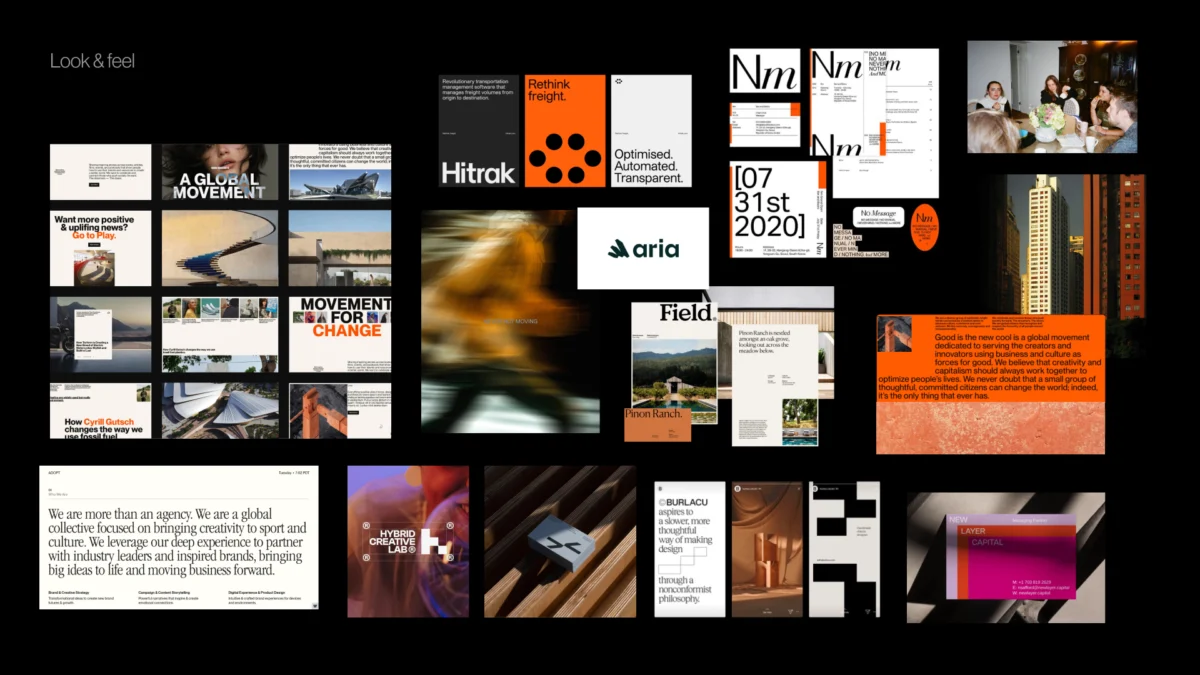
- Look and Feel Boards: These are not moodboards in the traditional sense. They are perception boards that test the "vibe" of a direction using third-party references. They allow the team to discuss whether a direction feels too institutional or too playful before any proprietary work is done.
- Design Code: This layer translates brand values into specific visual principles. For a parenting app, the value of "research-backed support" might be translated into a design code of "editorial layouts and data infographics," while "the messiness of parenting" might be translated into "organic shapes and handwritten lines."
- Brand Asset Direction: This involves testing the building blocks of identity—typography, color theory, and photography styles. For an AI infrastructure startup, the team might decide early on that "human-centricity" should be expressed through warm photography rather than the cold, blue tones typical of the tech sector.
Expert Analysis: The Shift from Artist to Strategist
The adoption of the pre-concept phase reflects a broader shift in the design industry. As AI tools and automated design platforms lower the barrier to entry for "creating graphics," the value of a professional designer is increasingly found in their ability to provide strategic counsel.

Industry analysts suggest that the "black box" method of design—where a designer disappears for two weeks and returns with three options—is becoming obsolete. In its place is a collaborative, transparent process that prioritizes "shared direction." Jake Knapp, creator of the GV Design Sprint, has famously advocated for these types of concrete exercises to remove the subjectivity from branding. The consensus among design leads at top-tier firms is that the first concept should never be a surprise; it should feel like the inevitable conclusion of the pre-concept work.
Broader Implications for Market Entry and Brand Equity
The implications of a robust pre-concept phase extend beyond the design department. For startups, a clear visual direction is essential for investor relations and talent acquisition. A brand that feels misaligned with its market can signal a lack of maturity or a misunderstanding of the customer base.

Furthermore, the pre-concept phase acts as a risk-mitigation strategy. By establishing "boundaries" (e.g., "the brand must never feel loud" or "the brand must avoid generic corporate blue"), the team creates a checklist for evaluating future creative work. This shifts the feedback loop from "I like this" to "This meets our agreed-upon criteria."
Conclusion: The Future of Brand Identity
As the digital economy continues to evolve, the distinction between "strategy" and "design" will continue to blur. The pre-concept phase represents the integration of these two disciplines. By researching context, uncovering assumptions, and building a visual foundation through collaborative exercises, design teams can ensure that their visual concepts are not just aesthetically pleasing, but strategically sound. In an era where brand equity is a primary driver of corporate value, the pre-concept phase is no longer an optional luxury—it is the foundation of a successful identity.

