
In the contemporary landscape of web development, a pervasive mental model exists among React practitioners: forms are inherently UI components. This architectural assumption has led to the widespread adoption of a standardized stack comprising React Hook Form (RHF) for state management and Zod for schema validation. While this approach remains highly effective for standard input scenarios such as login screens, user settings, and basic Create, Read, Update, and Delete (CRUD) operations, technical architects are increasingly identifying a "complexity ceiling." As business requirements evolve to include intricate conditional visibility, cascading derived values, and multi-step navigation logic, the component-driven model often transitions from a UI helper into a fragmented and difficult-to-maintain rule engine.
The Standard Paradigm: Component-Driven Architecture
The current industry standard for React form development prioritizes the encapsulation of form logic within the component tree. React Hook Form has emerged as the leader in this space, valued for its performance-centric approach to reducing unnecessary re-renders. By utilizing uncontrolled components and the ref API, RHF allows developers to build responsive interfaces that scale well in terms of raw DOM performance.
When paired with Zod, a TypeScript-first schema declaration and validation library, the developer experience is significantly enhanced. Zod provides a declarative way to define data shapes, ensuring that the information sent to an API matches the expected interface. However, the limitations of this model become apparent when "business logic" begins to leak into the "view layer." In a typical multi-step form, developers often find themselves using useWatch to monitor field changes, useMemo to calculate totals or subtotals, and complex JSX branching to handle conditional fields.
Industry analysis suggests that in enterprise-level applications, form-related code can account for up to 40% of the frontend codebase. When this code is tightly coupled with UI components, the cost of maintenance rises proportionally with the complexity of the business rules. This has prompted a re-evaluation of how forms should be structured in large-scale React applications.
The Chronology of React Form Management
To understand the current shift toward schema-driven engines, it is necessary to examine the decade-long evolution of form handling within the React ecosystem:
- The Era of Controlled Components (2013–2016): In React’s early years, the "Single Source of Truth" philosophy dictated that every input be a controlled component. While predictable, this led to significant performance bottlenecks in large forms, as every keystroke triggered a full component re-render.
- The Rise of Redux Form (2016–2018): As state management moved to Redux, forms followed. This centralized form state but introduced immense boilerplate and further performance issues, as the entire global state tree often updated on every input change.
- The Formik Revolution (2018–2020): Formik simplified the controlled component pattern, providing a robust set of helpers for validation and submission. It became the gold standard for several years by balancing ease of use with React’s declarative nature.
- The Performance Shift with React Hook Form (2020–Present): RHF shifted the focus to uncontrolled components, drastically improving performance and reducing code volume. It introduced the concept of "registering" inputs, which remains the dominant pattern today.
- The Emergence of Schema-Driven Engines (2023–Future): As applications move toward "Headless UI" and "Low-Code" integrations, developers are increasingly looking for ways to move form logic out of the JavaScript bundle and into serializable JSON schemas.
The Technical Debt of Conditional Logic
The transition from a simple UI to a complex rule engine is often a gradual process of "feature creep." A developer may start with a basic contact form, but soon, stakeholders request that the "Company Name" field only appear if the user selects "Corporate" from a dropdown. This is easily handled with a simple conditional in JSX.
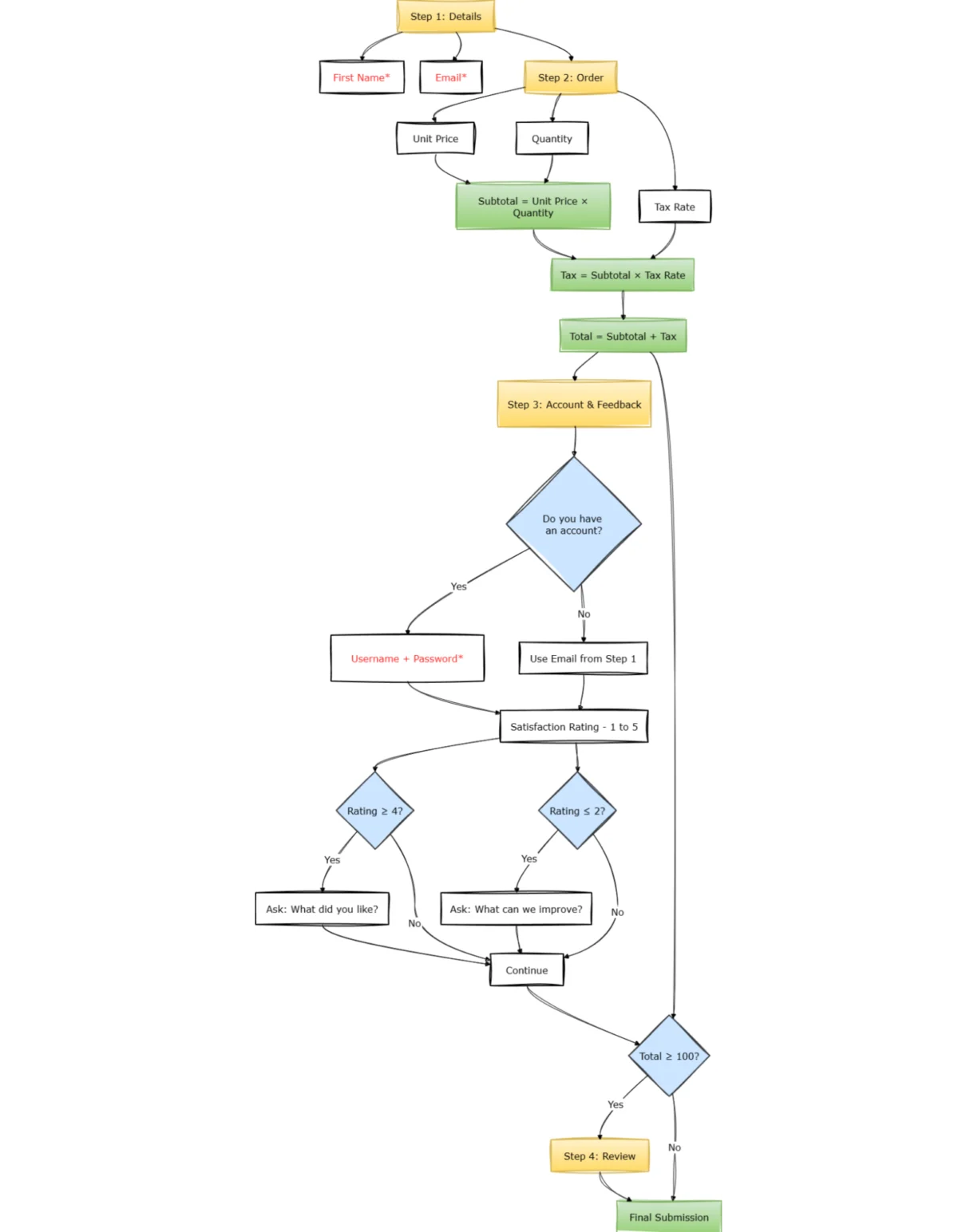
However, complexity scales non-linearly. When a form requires cross-field validation—such as ensuring a "Confirm Password" field matches a "Password" field, or requiring a "Feedback" comment only if a "Satisfaction Rating" is below three—developers must reach for advanced tools like Zod’s superRefine. This method allows for manual issue reporting based on the entire state of the form object. While powerful, superRefine effectively moves validation logic out of the declarative schema and into an imperative function.
Furthermore, multi-step navigation introduces state management overhead. Developers must track the current "step," handle "back" and "next" logic, and determine if certain steps should be skipped entirely based on previous answers. When these rules are embedded in React components, they become "opaque" to the rest of the system. Testing these rules requires mounting components, and modifying them requires a full deployment cycle.
The Schema-Driven Alternative: SurveyJS and Rule Engines
A schema-driven approach, exemplified by libraries like SurveyJS, proposes a fundamental shift: treating the form not as a component, but as a data structure. In this model, the entire form—including its layout, validation, calculations, and navigation rules—is defined in a JSON object.
This JSON schema is then interpreted by a dedicated "Model" or runtime engine. The React component’s role is reduced to a single task: rendering the engine’s current state. This separation of concerns offers several strategic advantages for engineering teams:
- Centralization of Logic: Visibility rules (
visibleIf), calculations (expression), and validations are all located in one serializable file. This eliminates the need to trace logic through multiple JSX files and hooks. - Decoupling from the UI: Because the logic is in the schema, the underlying UI framework could theoretically be swapped (e.g., from React to Vue) without rewriting the core business rules of the form.
- Operational Agility: In many enterprise environments, business analysts or legal teams may need to update form text or validation logic. With a schema-driven approach, these changes can be made via a JSON update or a specialized editor (like SurveyJS Creator) without requiring a developer to modify the source code or trigger a CI/CD pipeline.
Comparative Data and Implementation Analysis
When evaluating these two approaches, technical leads must consider the long-term implications of their choice. Data from internal developer productivity studies indicates that while component-driven forms are faster to "bootstrap" (taking roughly 20% less time for the initial setup), they become significantly more expensive to maintain as they grow.
| Concern | Component-Driven (RHF + Zod) | Schema-Driven (SurveyJS) |
|---|---|---|
| Visibility Logic | Manual JSX branching (show && <Input />) |
Declarative visibleIf in JSON |
| Calculated Values | useWatch and useMemo hooks |
Runtime expression evaluation |
| Cross-Field Rules | Imperative superRefine functions |
Centralized schema conditions |
| Navigation | Managed via React useState |
Built-in multi-page state machine |
| Logic Location | Distributed across hooks and files | Centralized in a single JSON object |
In a schema-driven model, the React component remains remarkably clean. The implementation typically involves initializing a model with the schema and wiring an onComplete event to an API call. This removes the "noise" of form management from the application’s core UI logic, allowing React to focus on what it does best: managing the application’s overall layout and integration.
Stakeholder Reactions and Industry Impact
The shift toward schema-driven forms has drawn reactions from various sectors of the software development lifecycle. Product managers have expressed support for the model, noting that it reduces the "engineering bottleneck" for minor form adjustments. "Being able to tweak a validation message or add a conditional field without waiting for a two-week sprint cycle is a massive win for our agility," noted one senior product owner in the fintech space.

On the other hand, some frontend developers caution against the "black box" nature of proprietary engines. There is often a learning curve associated with the specific JSON syntax of a library like SurveyJS. However, proponents argue that the trade-off is worth the gain in architectural clarity. By treating the form as a "policy engine," the code becomes more "inspectable." An automated script can parse a JSON schema to generate documentation or audit logs, a task that is nearly impossible with logic embedded in React components.
Strategic Framework for Decision Making
Choosing between these two models requires an objective assessment of the project’s trajectory. Architects are encouraged to use the "Delete Test": if you were to delete the form, would you be losing a UI component or a core business process?
React Hook Form + Zod is the optimal choice when:
- The form is a static part of the UI that rarely changes.
- The form is short (1-10 fields) with minimal conditional logic.
- The development team requires total control over every pixel and micro-interaction of the input fields.
- The primary goal is a small bundle size and high-performance rendering for simple data entry.
SurveyJS and Schema-Driven Engines are the optimal choice when:
- The form is a "living" document that requires frequent updates by non-engineers.
- The logic involves complex "skip patterns," where entire sections of the form appear or disappear based on complex criteria.
- The form requires real-time calculations (e.g., insurance quotes or tax estimators).
- The organization needs to store and version the form structure in a database.
Conclusion: The Future of Form Engineering
As web applications continue to move toward greater complexity and "server-driven UI" patterns, the traditional view of forms as mere collections of input components is becoming obsolete. The industry is moving toward a more nuanced understanding where the "mechanism" (the UI) is separated from the "policy" (the rules). While React Hook Form and Zod will continue to be the workhorses of the React ecosystem for standard tasks, schema-driven engines represent the next step in the evolution of enterprise-grade form management. By adopting the right abstraction for the right level of complexity, engineering teams can build systems that are not only performant but also resilient to the inevitable changes of business requirements.

