
The landscape of front-end development is currently witnessing a significant shift in how interactive, high-fidelity user experiences are constructed. Traditionally, when a digital agency is tasked with creating a web interface that feels tactile, bouncy, or "squishy," the standard procedural response has been to integrate a physics engine. Frameworks such as Matter.js, Cannon.js, or bespoke WebGL-based solutions have long served as the industry’s gold standard for simulating realistic physical interactions. However, a new architectural approach, pioneered by Isadora Agency during the development of their "Stress Release" digital project, suggests that the most effective way to serve art direction is not through simulation, but through absolute deterministic control.
The Genesis of the Stress Release Project
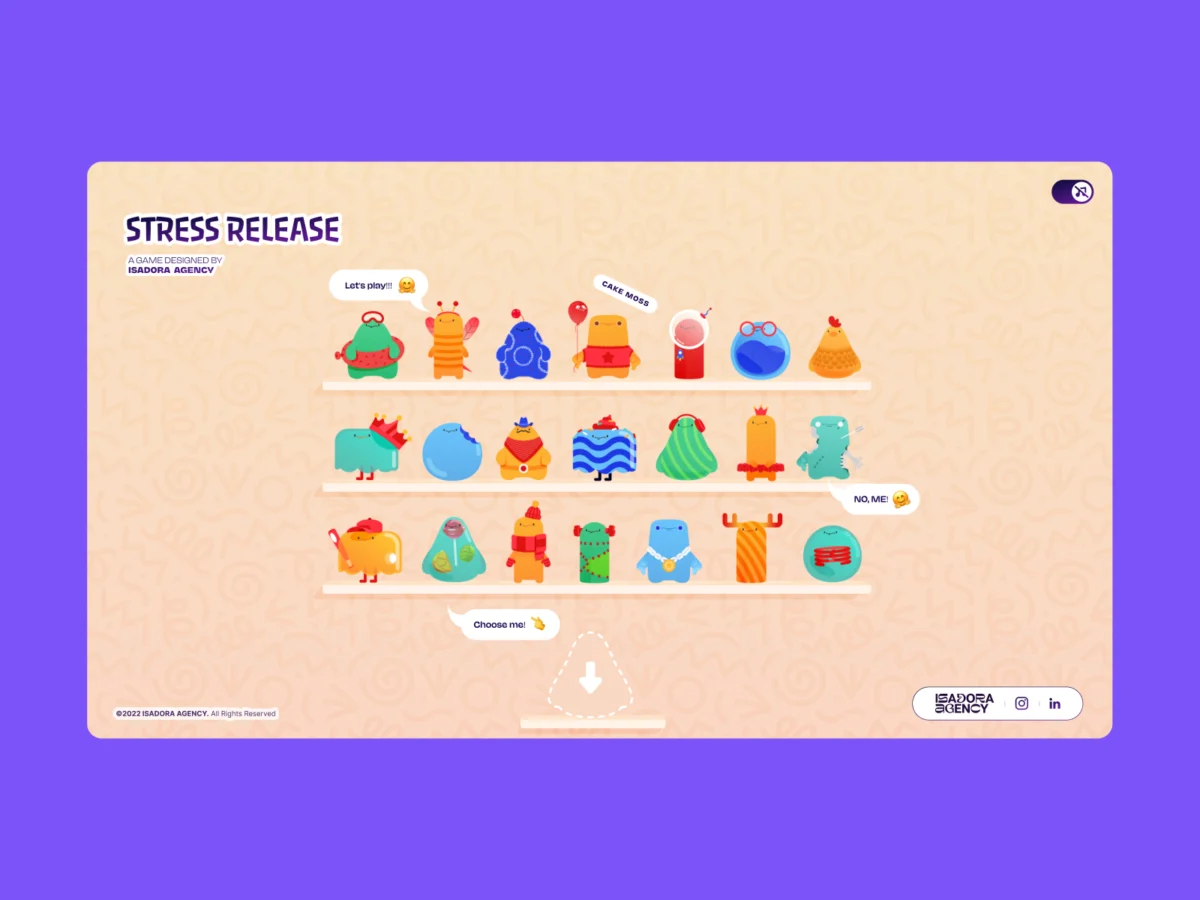
The "Stress Release" application was conceived as a digital stress-relief tool specifically tailored for creative professionals experiencing burnout. The core concept allowed users to interact with various animated characters, enabling them to "smash," "stretch," and "distort" UI elements in a satisfying, tactile manner. Alexey Kopytin, a lead technical voice on the project, noted that the initial instinct of the engineering team was to follow the industry trend by utilizing a physics engine to handle the motion.
The logic behind using physics engines is rooted in the desire for "plausible motion." In a standard physics-based environment, objects react to forces based on mass, friction, and gravity. While this creates a sense of realism, the team at Isadora Agency discovered a fundamental conflict during the prototyping phase: physics engines produce motion that is mathematically probable, but they often fail to capture the "intentional motion" envisioned by a professional animator. For a project where the emotional resonance of a "squish" or "bounce" is the primary product, relying on an algorithm to approximate gravity can dilute the artistic impact.
The Pivot: From Simulation to Deterministic Control
The realization that algorithmic motion could not replicate the frame-by-frame artistry of the design team led to a complete architectural pivot. The team decided to scrap Matter.js and WebGL entirely. Instead, they moved toward a stack comprised of Lottie animations, native Document Object Model (DOM) events, and distance-based mathematics. This shift ensured that the developers were not fighting against a physics engine to make a character move in a specific way; rather, they were using code to trigger the exact sequences designed in After Effects.
This approach honors the "12 Principles of Animation," particularly squash and stretch, by allowing animators to bake specific timing and easing into the JSON-based Lottie files. By using programmatic state controls through Lottie’s native API, the developers created an interaction layer that served as a flawless trigger for the animation layer, ensuring that every click resulted in a predictable and satisfying visual payoff.

Technical Implementation: Radial Input Mapping and Math-Driven Feedback
To achieve a tactile feel without a physics engine, the team implemented a system of radial input mapping. This process involves converting a user’s click from global page coordinates into the local coordinate space of the animated character. This is achieved using standard JavaScript to find the character’s center point and calculating the offset of the click relative to the element’s position.
The core of the hit detection relies on the Pythagorean theorem. By calculating the straight-line distance between the center of the character and the point of the click, the system generates a single numerical value. This value—the distance—becomes the primary driver for the entire interaction logic.
The Scoring and Visual Feedback System
The "Stress Release" game utilizes a concentric zone system, effectively treating each character like a dartboard. Based on the calculated distance:

- Bullseye (Distance < 10): Maximum point rewards and high-intensity feedback.
- Outer Rings: Gradually decreasing points based on the proximity to the center.
- Miss (Distance > 145): No points and no reaction.
Crucially, this math also dictates the positioning of secondary animations, such as "explosion" effects. By repositioning the Lottie container for the explosion to the exact (x, y) coordinates of the click, the developers created a spatial accuracy that mimics physical impact. This "I hit exactly where I clicked" sensation is the cornerstone of tactile UX, achieved here through simple geometry rather than complex collision manifolds.
Chronology of Development and Optimization
The development of the "Stress Release" toy followed a rigorous timeline that highlighted the challenges of high-fidelity web animation:
- Phase 1: Conceptualization and Character Design. Animators created 21 distinct characters, each with unique "personalities" and reaction states.
- Phase 2: Physics Prototyping. The team spent three weeks attempting to map Matter.js to vector assets, eventually finding the results too "floaty" and disconnected from the art style.
- Phase 3: The Lottie Pivot. The architecture was rebuilt to focus on frame-range sequencing.
- Phase 4: Mobile Optimization. Recognizing the heavy load of 21 JSON-based vector animations, the team implemented aggressive performance tiers.
- Phase 5: Launch and Feedback. The project was released as a showcase of how intentional motion can outperform emergent simulation in branded experiences.
Addressing the Performance Cost of Lottie
One of the primary criticisms of using Lottie for complex games is the potential for high file sizes and CPU overhead, particularly on mobile devices. Lottie renders animations as SVGs within the DOM, and having multiple high-frame-rate SVGs playing simultaneously can lead to "jank" or dropped frames.

To combat this, Isadora Agency utilized a tiered quality system. On the "Character Shelf" screen, where 21 animations play at once, the team set the Lottie quality to 50% and reduced the playback speed to 60%. This significantly lowered the interpolation calculations required by the browser. Once a user selects a specific character for the "Play" screen, the system scales the quality back to 100%, focusing the hardware resources on a single, high-fidelity interaction.
Responsive Design and CSS Integration
A significant benefit of staying within the DOM rather than moving to a Canvas-based WebGL environment was the ease of responsive design. Scaling bounding boxes in a physics engine across different screen sizes often requires complex coordinate remapping. By using the DOM, the "Stress Release" team was able to leverage CSS variables to handle scaling.
A global function was implemented to recalculate the --doc-height and --doc-width CSS custom properties on every window resize event. Because the Lottie SVGs were contained within standard HTML elements, they scaled naturally according to the CSS layout. This ensured that the hit detection math—which relied on the element’s width and height—remained accurate regardless of whether the user was on a 4K monitor or a mobile device.

Official Reactions and Industry Impact
The methodology used in this project has sparked discussions among UX engineers regarding the "Art vs. Algorithm" debate. While physics engines remain indispensable for sandbox games and complex simulations, the "Stress Release" project serves as a case study for "Designed Interaction."
"The goal wasn’t to simulate reality," the team explained in their architectural rationale. "The goal was to simulate the animator’s intent." This distinction is vital for branding. In a branded experience, every movement should communicate the brand’s voice. A physics engine might make a character bounce like a generic rubber ball, but a Lottie-controlled state allows that character to bounce with a specific "shyness," "aggression," or "joy" that is hand-crafted by an artist.
Broader Implications for the Future of Web UX
The success of this approach suggests a maturing of the web as a creative medium. As browsers become more capable of handling complex SVG animations, the need for heavy middleware like physics engines may decrease for specific types of high-touch marketing and gamified interfaces.

Furthermore, this architectural choice highlights the importance of the "deterministic UI." In a deterministic model, the developer knows exactly what frame will play at what time. This is essential for synchronization with audio, haptic feedback, and scoring systems. As digital burnout continues to be a topic of cultural conversation, the demand for these types of "satisfying" digital toys is expected to rise, pushing more agencies to explore the intersection of math, motion design, and native web technologies.
In conclusion, by mapping Lottie’s native timeline capabilities directly to the DOM and using fundamental mathematics for hit detection, developers can deliver incredibly rich, tactile user experiences. This method preserves the integrity of the art direction while bypassing the performance and complexity hurdles of traditional physics simulations, proving that sometimes, the best way to move forward is to return to the fundamentals of animation and geometry.

