
The modern landscape of web development is undergoing a silent but significant transformation as the gap between third-party library requirements and native browser capabilities continues to narrow. For over a decade, JavaScript developers have relied on a massive ecosystem of packages to bridge the functional deficiencies of web browsers. However, with the rapid acceleration of the "evergreen" browser model and the formalization of the Baseline initiative by the WebDX Community Group, a substantial portion of the code currently residing in the average package.json file has become redundant. Industry data suggests that a typical mid-sized JavaScript application may be carrying between 60KB and 90KB of unnecessary gzipped dependencies—code that performs tasks the web platform now handles natively with better performance and accessibility.
The Genesis of Baseline and the Shift in Web Standards
The challenge for web developers has historically been the inconsistency of feature support across different browsing engines. This friction led to the ubiquity of "polyfills" and utility libraries like Lodash, Axios, and Moment.js. To address the confusion regarding when a feature is truly "safe" to use, the WebDX Community Group—comprising representatives from Google, Apple, Mozilla, and Microsoft—introduced the "Baseline" status in 2023.
Baseline provides a clear, standardized lifecycle for web features. A feature is categorized as "Newly Available" the moment it becomes supported across the core engines: Chromium (Chrome/Edge), Firefox, and Safari. After 30 months of consistent support, the feature graduates to "Widely Available," signaling to developers that it can be used without significant risk of breaking the user experience for the vast majority of global traffic. This chronological framework has fundamentally changed the dependency audit process, shifting it from a security-only focus to a platform-compatibility assessment.
The Economic and Performance Cost of Dependency Inertia
The retention of legacy libraries is rarely a result of intentional neglect; rather, it is a byproduct of "dependency inertia." Once a library is integrated into a codebase and passes its initial tests, it is seldom re-evaluated against the evolving capabilities of the browser. However, the performance implications of this inertia are measurable.

JavaScript is the most expensive resource on the web because it must be downloaded, decompressed, parsed, compiled, and finally executed. According to performance metrics from the HTTP Archive, the median mobile page now ships upwards of 500KB of JavaScript. By removing 70KB of redundant gzipped dependencies, a developer can reduce the uncompressed execution load by 200KB or more. On low-end mobile devices, this reduction directly correlates to improved Time to Interactive (TTI) and reduced Total Blocking Time (TBT), which are critical components of Google’s Core Web Vitals.
A Strategic Framework for Dependency Auditing
Before a development team begins purging libraries, a rigorous decision framework must be applied to ensure the stability of the application. Industry experts recommend a three-tier inquiry for every candidate for removal.
First, the team must determine if the native replacement is "Baseline-safe" for their specific audience. While a feature may be "Newly Available" globally, a B2B application with users on older enterprise hardware may require a more conservative approach than a consumer-facing app with a tech-forward user base. Second, the cost of the swap must be calculated. If a native feature requires a heavy polyfill to support older browsers, the net bundle size might actually increase. Third, the functional coverage must be mapped. Libraries often provide "sugar" or edge-case handling—such as Axios’s automatic request retries—that the native fetch API does not include by default.
Cluster Analysis: High-Impact Areas for Library Removal
The most significant gains in bundle reduction are typically found in four distinct clusters: internationalization, HTTP communication, UI primitives, and utility functions.
Internationalization and Formatting
The Intl namespace has seen some of the most robust growth in recent years. Libraries like timeago.js, numeral, and pluralize were once essential for creating human-readable strings. Today, Intl.RelativeTimeFormat provides "Widely Available" support for localized time descriptions (e.g., "3 days ago"), while Intl.NumberFormat handles complex currency and compact notation. The Intl.ListFormat API, also Widely Available, automates the joining of arrays into grammatically correct sentences, including the handling of the Oxford comma. Collectively, replacing this cluster can save approximately 14KB gzipped.

HTTP Clients and the Fetch API
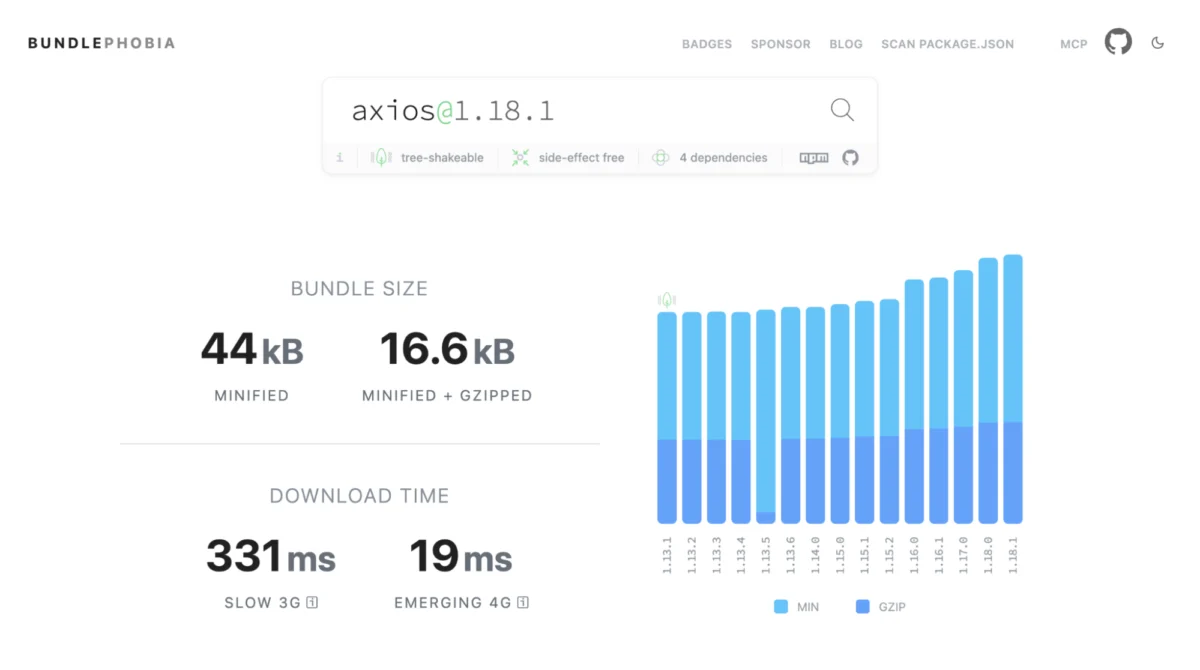
The transition from axios or superagent to the native fetch API is perhaps the most common audit point. While axios remains popular for its interceptors and automatic JSON transformation, the native fetch API combined with AbortController for request cancellation now covers 90% of standard use cases. With the addition of AbortSignal.timeout(), developers can now implement request timeouts natively, removing one of the last major reasons to rely on external HTTP wrappers for simple REST communication.
UI Primitives and Accessibility
One of the most complex areas of web development is managing the accessibility (A11y) of UI components like modals and tooltips. Libraries such as a11y-dialog or focus-trap were designed to manage focus cycles and "Top Layer" rendering. The native <dialog> element now handles these behaviors automatically, including closing on the Escape key and preventing background scrolling when used with the :modal pseudo-class. Furthermore, the Popover API and the nascent CSS Anchor Positioning API are beginning to replace heavy positioning engines like Popper.js (often bundled with Tippy.js), offering a declarative way to manage floating UI elements with zero JavaScript overhead.
Utility Functions and Lodash
The "Lodash-to-Native" pipeline has matured significantly. Object.groupBy and Map.groupBy, which reached Newly Available status in early 2024, have made the popular lodash.groupby utility obsolete. Similarly, structuredClone now provides a native, high-performance method for deep-cloning objects, handling circular references and complex data types like Date and Set that the old JSON.parse(JSON.stringify()) hack could not. The Set object itself has been upgraded with native methods for union, intersection, and difference, removing the need for custom math utilities.
Case Study: The Risks of Early Adoption (The Temporal API)
While the trend is toward removal, the "Temporal" API serves as a cautionary tale for premature migration. Intended as the long-term successor to the flawed Date object, Temporal offers an immutable and timezone-aware API. However, as of mid-2024, it has not reached Widely Available status.
A comparative analysis shows that the official Temporal polyfill weighs approximately 44KB gzipped. In contrast, the popular library dayjs weighs only 3KB. For most applications, switching to the native Temporal API today would result in a massive increase in bundle size due to the necessary polyfills. This highlights the importance of the second question in the audit framework: "What does the swap actually cost?" In the case of Temporal, the professional consensus is to remain on lightweight libraries until Safari and other major engines provide stable, native support.

Industry Reactions and Future Implications
The shift toward native browser features has drawn mixed but generally positive reactions from the developer community. Framework maintainers are increasingly stripping internal dependencies in favor of native APIs to reduce the footprint of their own tools. Security professionals have also lauded the trend, noting that a smaller node_modules folder represents a smaller attack surface for supply chain vulnerabilities, such as those seen in the "Polyfill.io" compromise of 2024.
However, some developers express concern over the "lowest common denominator" problem. Native APIs are often designed to be low-level primitives rather than high-level, "batteries-included" solutions. This means that while the platform provides the engine, developers may still need to write small, internal wrappers to maintain the developer experience they grew accustomed to with libraries like Axios or Lodash.
Methodology for Ongoing Dependency Audits
To maintain a lean production environment, engineering teams are encouraged to adopt a quarterly audit cadence. This process involves:
- Inventory: Using commands like
npm ls --omit=devto identify what code is actually being shipped to the end user. - Quantification: Utilizing tools like
Bundlephobiaorsource-map-explorerto visualize the gzipped weight of each dependency. - Cross-Referencing: Checking the Baseline status of features via MDN or
webstatus.devto see if a native alternative has reached "Widely Available" status. - Progressive Enhancement: Implementing "Newly Available" features behind feature checks (e.g.,
if ('showModal' in HTMLDialogElement.prototype)) to serve modern code to modern browsers while maintaining fallbacks for legacy systems.
Conclusion
The web platform is no longer the fragmented, stagnant environment it was during the "Browser Wars." Today, it is a fast-moving, standardized engine capable of handling complex formatting, sophisticated UI interactions, and deep data manipulation. By auditing dependencies against the Baseline standard, developers can reclaim significant performance margins, simplify their build pipelines, and provide a more accessible experience for their users. The mandate for the modern developer is clear: if the browser can do it, the browser should do it.

