
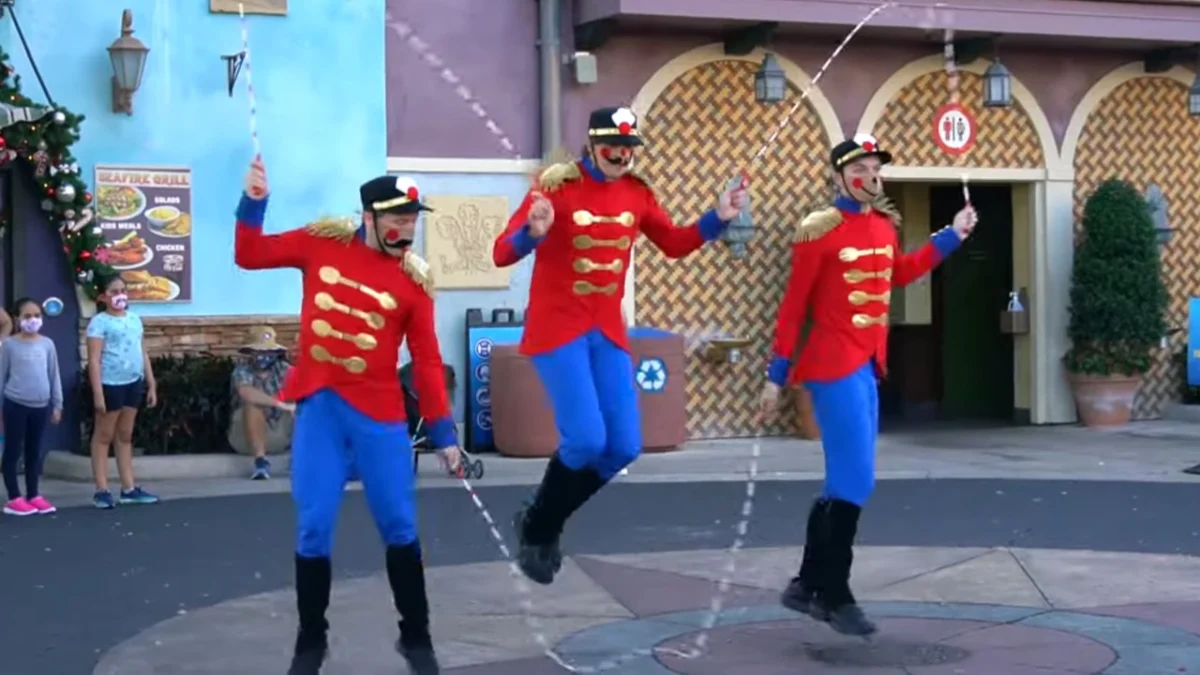
The Jump Rope Toy Soldiers have emerged as a dominant cultural phenomenon within the digital landscape of late 2026, marking a significant intersection between professional acrobatic performance and contemporary meme culture. What began as a series of seasonal live performances by the professional troupe WeFlip Entertainment has transitioned into an elaborate internet subculture characterized by fictionalized histories, competitive rivalries, and a resurgence of interest in athletic choreography. The troupe, consisting of performers known by the monikers Jackery Jingleson, Big Chestnut, Soulja Toy, and Holidave, has seen its archival footage repurposed into a multi-platform narrative that spans Instagram Reels, TikTok, and X. This shift highlights the evolving nature of digital consumption, where historical performance data is synthesized with modern artificial intelligence tools to create "lore-heavy" content that resonates with a global audience.
The Professional Foundations of WeFlip Entertainment
Before their ascension to viral status, the Jump Rope Toy Soldiers were established as a core component of WeFlip Entertainment, a professional acrobatic and jump rope collective also operating under the brand WeJump Rope. The troupe specializes in high-energy, synchronized routines that combine traditional jump rope techniques with gymnastics, parkour, and character-driven performance art.
The origins of the "Toy Soldier" aesthetic date back several years, rooted in seasonal entertainment contracts. On December 7, 2020, WeFlip Entertainment uploaded a definitive performance video to YouTube featuring the troupe at SeaWorld. In this footage, the performers are seen in traditional red and white toy soldier uniforms, executing complex "double dutch" maneuvers and individual stunts with high precision. While the initial viewership was modest—garnering approximately 1,700 views over the subsequent six years—the quality of the choreography provided a rich foundation for future digital manipulation. The troupe continued to document their work, with a final major toy soldier-themed video uploaded on January 8, 2024, maintaining their presence in the niche world of professional jump rope before the 2026 viral explosion.
Chronology of the 2026 Viral Resurgence
The transition from professional performance to internet meme began in earnest in mid-November 2026. The catalyst for this movement was the Instagram account wejumprope_memes, which began posting edited versions of the 2020 and 2024 footage. On November 13, 2026, a pivotal post pitted the Jump Rope Toy Soldiers against the "Decayed Brigade," a separate group of performers known as "sliders" who perform high-speed ground maneuvers. This "versus" format struck a chord with the Instagram algorithm, garnering over 70,000 likes in less than two weeks and establishing a competitive narrative framework that fans quickly adopted.
The momentum shifted to other platforms within days. By November 17, 2026, a new account titled toysoldiersuperfan introduced the concept of "fake lore" to the community. This involved using text-to-speech (TTS) AI voiceovers to narrate fabricated biographies for the performers. One particularly successful video detailed the "net worths" and "combat statistics" of Jackery Jingleson and Big Chestnut, amassing 84,000 likes on Instagram before being bridged to X by user @SamanthaD920, where it received an additional 20,000 likes. The trend reached a fever pitch on November 18, when TikTok creator @angel._ena reposted the lore-based content, attracting over 1.3 million views in under a week. This cross-platform pollination transformed the Toy Soldiers from a seasonal act into a set of digital icons with a perceived, albeit fictional, depth.
The Architecture of "Fake Lore" and Character Archetypes
The Jump Rope Toy Soldier meme is unique in its reliance on "lore-core," a trend where creators invent complex backstories for real-life figures or performers. In this ecosystem, the four primary performers have been assigned specific roles and personalities that drive engagement:
- Jackery Jingleson: Often depicted as the tactical leader of the group, Jingleson is frequently credited in memes with extreme athletic feats and a high "power scaling" within the fictional universe created by fans.
- Big Chestnut: Positioned as the "heavy" or the powerhouse of the troupe, his physical presence in the videos is often emphasized through edits that highlight the impact of his jumps and his stoic expression.
- Soulja Toy and Holidave: These members are typically characterized as the agile specialists, providing the necessary speed for the double-dutch ropes to function at high RPMs.
The use of text-to-speech narration provides a veneer of "documentary-style" authority to these claims, a common trope in modern niche communities (Nichetok). By presenting fabricated statistics regarding their "career earnings," "win-loss records," and "supernatural abilities," creators have built a world that rewards deep-diving and repeated viewing, despite the fact that the underlying footage is simply a well-executed jump rope routine.
Competitive Dynamics: The Toy Soldiers vs. The Decayed Brigade
A significant driver of the meme’s longevity is the manufactured rivalry with the Decayed Brigade. The Decayed Brigade consists of "sliders"—performers who wear specialized pads on their hands and knees to slide across pavement at high speeds, often in post-apocalyptic or "zombie" attire.
The contrast between the two groups is visually and tonally stark. The Toy Soldiers represent order, holiday cheer, verticality, and precision. In contrast, the Decayed Brigade represents chaos, grit, horizontality, and aggressive movement. Social media users have capitalized on this dichotomy, creating "edit wars" where the two groups are compared in "who would win" scenarios. This competitive element mirrors the dynamics found in professional sports or fighting games, allowing fans to "side" with a faction, thereby increasing engagement metrics through comments and shares.
Technical Analysis of the Performance Art
Beyond the memes, the viral success of the Jump Rope Toy Soldiers has brought renewed attention to the technical difficulty of jump rope as a competitive discipline. The footage used in the memes showcases several high-level skills:
- Double Dutch Synchronicity: The ability to maintain rope speed while multiple performers enter and exit the "pocket" requires millisecond-perfect timing.
- Acrobatic Integration: Performers are seen executing backflips and 360-degree spins while the ropes are in motion, a feat that requires immense spatial awareness and core strength.
- Character Consistency: Maintaining the "Toy Soldier" persona—stiff posture, rhythmic marching, and fixed facial expressions—while performing at a high aerobic capacity is a hallmark of professional theme park entertainment.
Industry analysts suggest that the "satisfying" nature of these synchronized movements is a primary reason for their success on short-form video platforms like Reels and TikTok. The rhythmic clicking of the ropes and the uniform movement of the performers provide a "brain rot" or "oddly satisfying" quality that encourages the algorithm to serve the content to a wider audience.
Broader Cultural Impact and Platform Specificity
The Jump Rope Toy Soldiers have become a case study in what digital creators call "Reels-exclusive" culture. On November 20, 2026, TikToker @hoopervalley8 noted that the Toy Soldier memes felt distinct to the Instagram Reels ecosystem, which has developed a reputation for hosting more surreal, niche, and lore-heavy communities compared to the broader trends of TikTok. This distinction highlights the fragmentation of the internet, where different platforms develop their own "internal languages" and recurring characters.
The implications of this trend for professional performers are significant. WeFlip Entertainment, originally a regional performance group, has gained a global "digital ghost" presence. While the performers may not have been active in the toy soldier roles in 2026, their past work has become a permanent fixture of the digital zeitgeist. This phenomenon raises questions about the "afterlife" of performance art in the age of social media, where a single season of work can be resurrected and reimagined years later by an audience the performers never intended to reach.
Conclusion: The Future of the Toy Soldier Legacy
As of late November 2026, the Jump Rope Toy Soldier phenomenon shows no signs of decelerating. The combination of high-level physical skill and low-stakes internet humor has created a sustainable cycle of content. While the "lore" of Jackery Jingleson and his cohorts is entirely a digital construct, the appreciation for the athleticism of WeFlip Entertainment is genuine.
The trend underscores a broader shift in how history is consumed on the internet. In the 2020s, "truth" in a meme is often secondary to "vibe" and "narrative." The Jump Rope Toy Soldiers have successfully bridged the gap between a 2020 SeaWorld stage and the cutting edge of 2026 internet culture, proving that with the right edit and a compelling (if fictional) story, any performance can find a second life in the digital arena. Whether this leads to a live-action revival of the troupe or remains a purely digital obsession, the Toy Soldiers have marched their way into the annals of internet history.

