
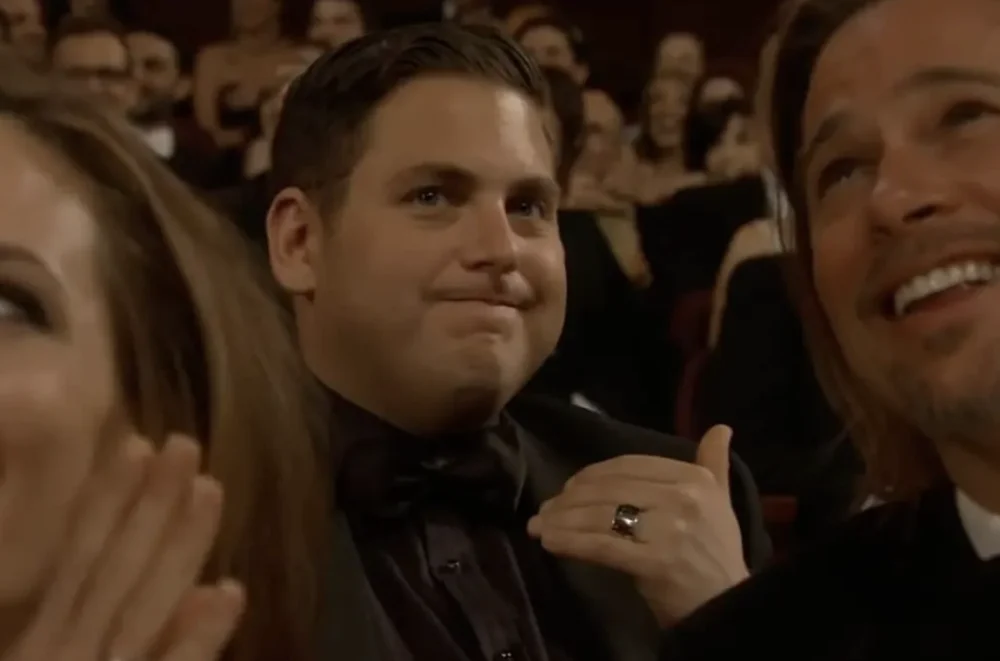
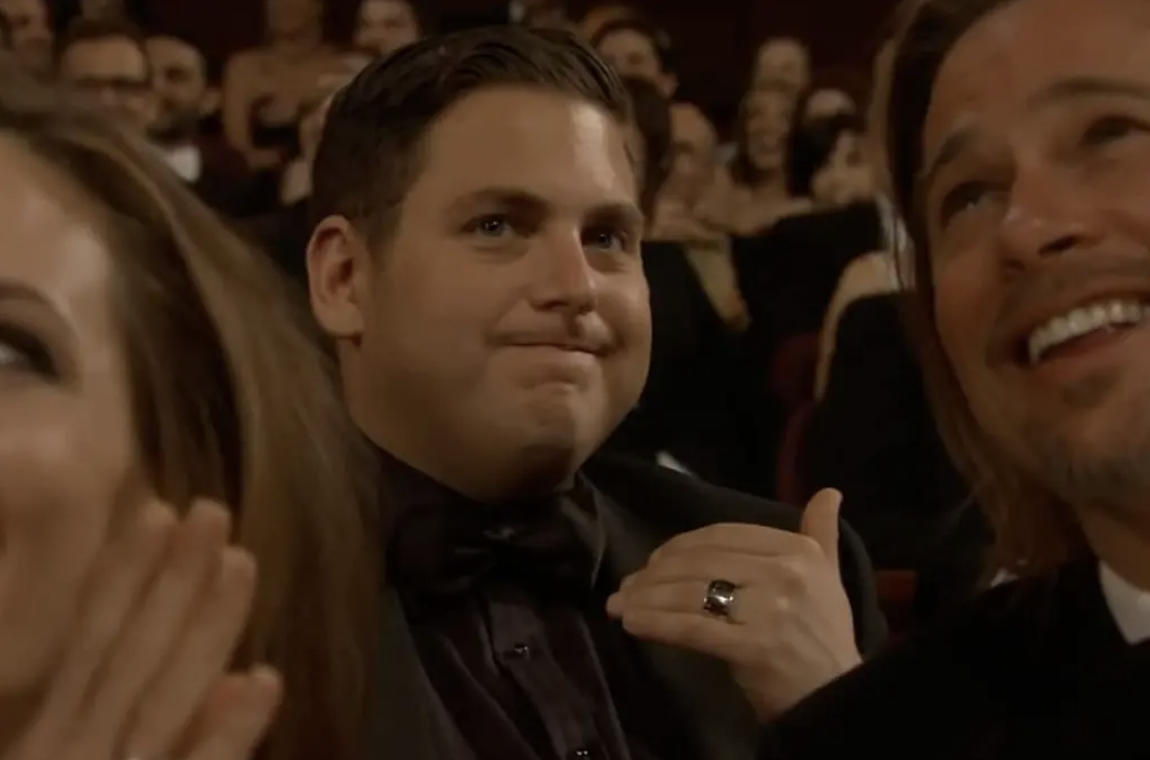
The Jonah Hill "Cut It Out" GIF, a digital artifact originating from the 84th Academy Awards in 2012, has transcended its initial broadcast context to become one of the most enduring non-verbal communication tools in the history of social media. Known variously as the "Jonah Hill Stop GIF," the "Jonah Hill No GIF," or simply "Jonah Hill Nah," the clip features the Academy Award-nominated actor dressed in a formal black tuxedo, executing a decisive downward side-swipe motion with an open palm. As the camera zooms in on his stoic yet dismissive expression, the gesture serves as a universal shorthand for social boundary-setting, second-hand embarrassment, or the desire to terminate a specific behavior. While the GIF maintained a steady presence throughout the 2010s on platforms like Twitter and Tumblr, its recent integration into the TikTok ecosystem—specifically following the platform’s 2025 technical updates—has solidified its status as a cornerstone of modern digital linguistics.
Historical Context: The 2012 Academy Awards
The origin of the footage dates back to February 26, 2012, during the 84th Academy Awards held at the Hollywood & Highland Center. The evening was a significant milestone for Jonah Hill, who was attending as a first-time nominee for Best Supporting Actor for his role in Moneyball. The specific moment captured in the GIF occurred during the presentation of the award for Best Visual Effects. Actors Ben Stiller and Emma Stone took the stage to present the category, with Stone performing a high-energy, comedic bit involving exaggerated enthusiasm and singing.
As Stone continued her intentionally awkward performance, the broadcast director cut to a reaction shot of the audience. The camera landed on Jonah Hill, who was seated among his peers. Rather than offering a standard polite laugh, Hill leaned into the comedic tension of the moment by performing the "cut it out" gesture—a flat-handed motion across his chest—while maintaining a mock-serious expression. The timing of the camera’s zoom, combined with Hill’s impeccable comedic delivery, created a visually perfect loop that was destined for internet immortality. The award for Best Visual Effects was ultimately won by the team behind Martin Scorsese’s Hugo, but the cultural footprint of that specific category presentation was largely defined by Hill’s brief, improvised reaction.
Digital Genesis and Early Indexing (2012–2019)
In the immediate aftermath of the 2012 Oscars, the clip was converted into various GIF formats and shared across early social media hubs. Unlike many viral moments that fade within months, the Jonah Hill gesture possessed a "high utility" factor; it was a visual representation of a feeling many users experienced daily. The earliest formal indexing of the GIF occurred on April 18, 2014, when the site Reaction GIFs uploaded the file with the meta-description: "Jonah Hill thinks you should cut it out."
Throughout the mid-2010s, the GIF became a staple of "GIF Caption" memes. On platforms like Reddit and Twitter, users paired the image with relatable scenarios, such as a friend making an embarrassing joke in public or a brand trying too hard to appear "edgy" on social media. Its popularity was bolstered by its clarity; even without the original context of Emma Stone’s presentation, the meaning of Hill’s gesture remained unmistakable. By 2018, the GIF had been integrated into the native search engines of major messaging apps like WhatsApp and Slack, further embedding it into the professional and personal communication habits of millions.
The Naughty Dog Reconstruction and Cross-Media Influence
A pivotal moment in the GIF’s history occurred on September 18, 2020, when the renowned video game development studio Naughty Dog released a high-fidelity recreation of the meme. As part of a promotional campaign for The Last of Us Part II, the studio used its proprietary character engines to have the protagonist, Ellie, mirror Hill’s exact movements and facial expressions from the 2012 Oscars.
This crossover between Hollywood awards culture and the gaming industry was a massive success. The Ellie version of the GIF garnered over 80.7 million views on Giphy within five years of its release. This event demonstrated the "transposable" nature of the meme; the gesture had become so iconic that it no longer required Jonah Hill’s likeness to convey its meaning. It had evolved into a "meme template" in the truest sense, capable of being reskinned for different subcultures while retaining its core communicative power.
The TikTok Renaissance and the 2025 Sticker Revolution
While the GIF remained a steady presence for over a decade, its most significant surge in usage occurred on TikTok. The resurgence began in early 2023 when users started utilizing the original Oscar footage to describe their own personal lives. On March 12, 2023, TikTok user @lucylaneofficial posted a video featuring the Stone-Hill sequence, labeling Stone as "me" and Hill as "another unavailable man." The video resonated deeply with the platform’s demographic, amassing over 9.5 million views and 1.2 million likes.
However, the true "explosion" of the Jonah Hill Cut It Out GIF occurred in March 2025, when TikTok officially updated its interface to allow the use of GIFs and photos in the comment sections. This "sticker" feature transformed the way users interacted with content. No longer limited to text or emojis, commenters began using the Hill GIF as a "vibe check" for controversial or cringeworthy videos.
By September 2025, specialized accounts like @.gif000 began uploading the GIF in formats optimized for the TikTok sticker library. One such upload received 1.7 million views in less than a year, as users raced to save the "sticker" for their own use. The GIF became a primary tool for "gatekeeping" or signaling that a particular trend had gone too far. For instance, in August 2024, user @realest.mf24 used the GIF to mock parents acting like "Karens" in public, a post that generated nearly 100,000 likes. By early 2026, the meme had become so prevalent that it was featured in "meme compilations" and "corecore" edits, signifying its transition from a simple reaction to a piece of digital heritage.
Psychological Appeal and Social Function
The enduring success of the Jonah Hill "Cut It Out" GIF can be attributed to several psychological and semiotic factors. From a functional perspective, the gesture provides a socially acceptable way to express dissent or discomfort. In a digital landscape often characterized by "toxic positivity" or aggressive confrontation, Hill’s mock-serious "cut it out" offers a middle ground—a humorous way to set a boundary.
Furthermore, the "straight man" nature of Hill’s performance in the clip is essential. Because he is reacting to an off-screen (in the GIF version) absurdity, he becomes a surrogate for the viewer. When a user posts the Hill GIF in response to a strange video, they are effectively aligning themselves with Hill’s perceived rationality. The zoom-in effect also plays a role, emphasizing the intimacy and "realness" of the reaction, which mirrors the "confessional" style of modern vlogging and TikTok content.
Broader Implications and Quantitative Impact
The trajectory of the Jonah Hill "Cut It Out" GIF serves as a case study in the longevity of digital content. In an era where most viral trends have a shelf life of less than a month, this 2012 clip has maintained relevance for fourteen years. Data from Giphy and TikTok indicates that the GIF’s usage peaks during major cultural events—such as subsequent Oscar ceremonies or controversial product launches—suggesting it has become a permanent part of the internet’s "reactionary infrastructure."
The sheer volume of engagement—ranging from the 80 million views on the Naughty Dog version to the millions of "sticker" saves on TikTok—highlights a shift in how we process celebrity culture. Jonah Hill, an actor with a diverse filmography including The Wolf of Wall Street and Superbad, is now equally known to a younger generation as "the guy who does the hand thing." This phenomenon illustrates the "decontextualization" of celebrity; the moment has become more famous than the event that produced it.
Conclusion
The Jonah Hill "Cut It Out" GIF is more than a humorous loop; it is a testament to the power of non-verbal communication in the digital age. From its origins as a brief comedic reaction at the 2012 Academy Awards to its status as a high-frequency "sticker" on TikTok in 2026, the image has navigated shifts in platform technology and social norms with remarkable agility. As TikTok and other social media platforms continue to evolve their interface to favor visual over textual communication, artifacts like the Hill GIF will likely remain essential components of the global digital vocabulary. Whether used to signal a "real" moment of embarrassment or to playfully shut down a friend, Jonah Hill’s silent command to "cut it out" continues to speak volumes.

