
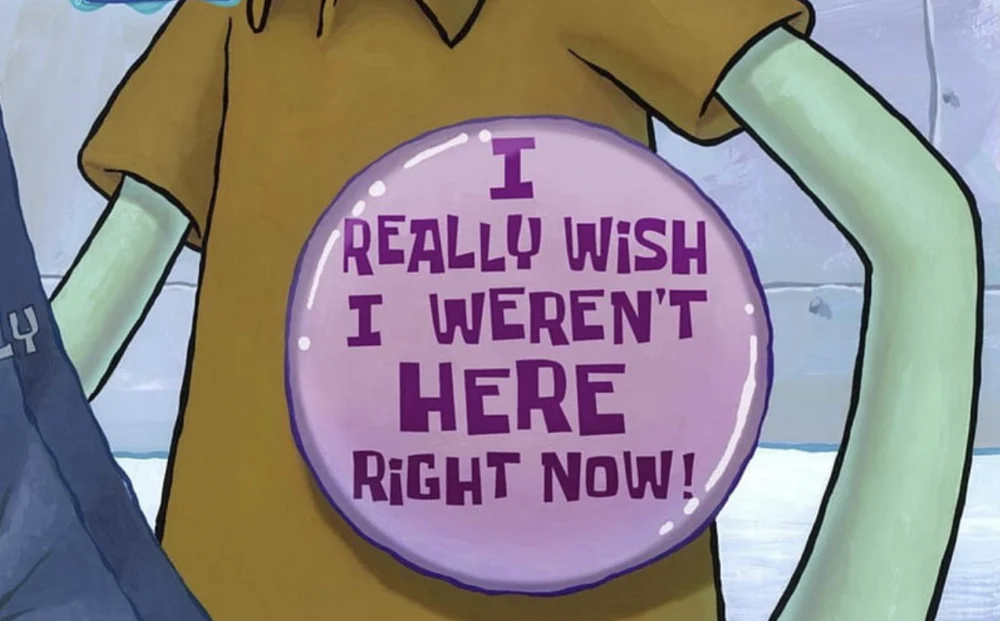
The digital landscape of the 21st century has been significantly shaped by the emergence of "exploitables"—image templates that users can modify to convey a wide range of emotions, social commentaries, and satirical critiques. Among the most enduring of these artifacts is the "Squidward’s Button" meme, also known by its primary caption, "I Really Wish I Weren’t Here Right Now." Originating from the animated series SpongeBob SquarePants, this reaction image has transcended its source material to become a definitive symbol of workplace apathy, existential dread, and, more recently, the collective exhaustion associated with living through tumultuous global eras. By examining its journey from a 2002 television episode to a viral sensation in 2026, one can chart the broader evolution of internet culture and the shifting nature of digital communication.
The Genesis of an Icon: The Krusty Krab Training Video
The visual foundation of the meme is rooted in the third season of Nickelodeon’s SpongeBob SquarePants, specifically Episode 10b, titled "Krusty Krab Training Video." First aired on May 10, 2002, the episode is framed as an industrial training film for new employees of the fictional Krusty Krab restaurant. The episode is celebrated by critics and fans alike for its meta-humor and its sharp parody of corporate bureaucracy.
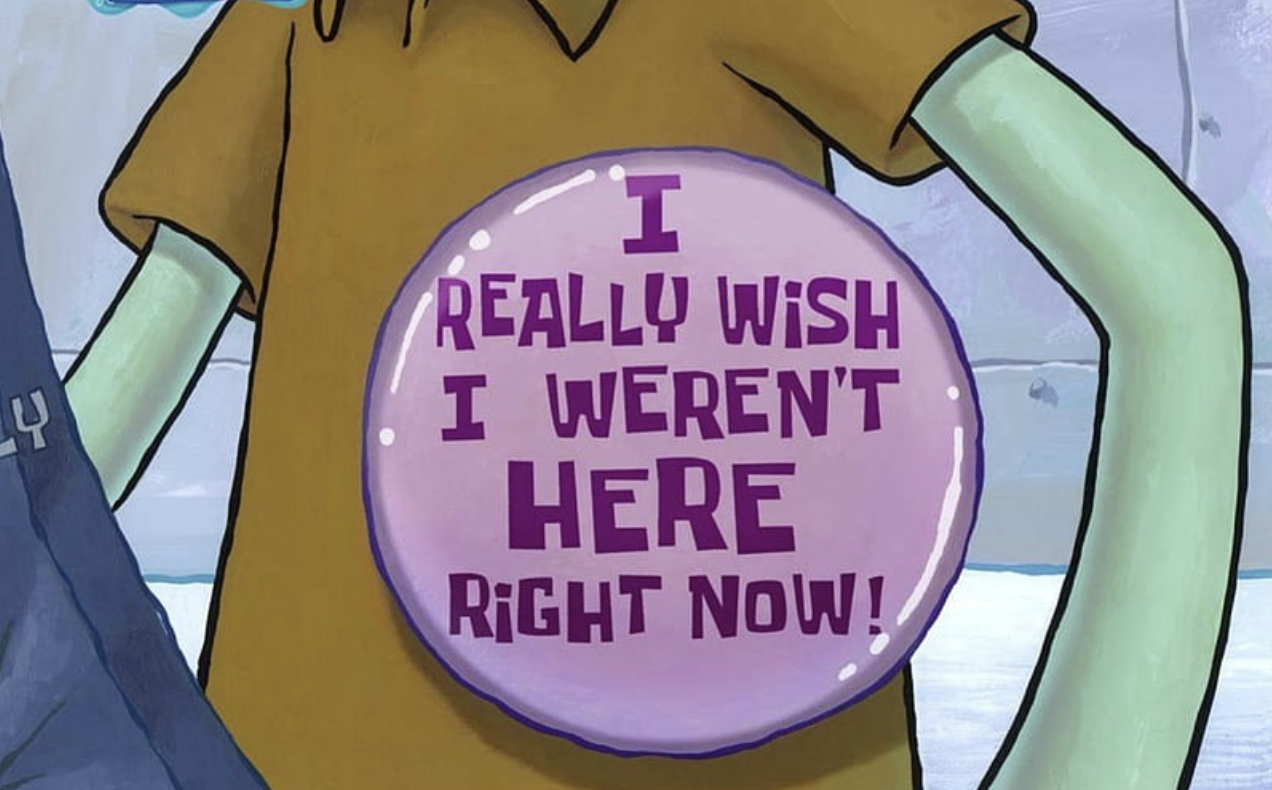
During the segment, the character Squidward Tentacles—a misanthropic octopus serving as the restaurant’s cashier—is used as a foil to the titular SpongeBob’s boundless enthusiasm. As the narrator chastises Squidward for his lack of "POOP" (People Order Our Patties) and general disinterest in customer service, the camera zooms in on a small, pinkish-purple button pinned to his uniform. The button bears the stark, desperate message: "I really wish I weren’t here right now!" This moment was intended as a brief comedic gag highlighting Squidward’s perpetual misery, yet it inadvertently provided the internet with one of its most versatile tools for expressing social withdrawal.
Digital Migration and Early Adoption (2008–2014)
While the episode aired in 2002, its transition into a digital meme required the maturation of social media and image-sharing platforms. Digital archivists have traced the image’s earliest indexed appearance to April 26, 2008, on the now-defunct Rapid Forum. During this era, memes were often localized within niche message boards and forums, used primarily as "reaction images" to signal a user’s boredom or desire to exit a digital conversation.
The meme gained significant momentum between 2010 and 2013, migrating to mainstream platforms such as Tumblr and DeviantArt. On Tumblr, the image resonated with the "relatability" culture that dominated the site, where users frequently shared content reflecting shared anxieties and workplace frustrations. On July 20, 2014, the meme reached a milestone in its mainstream trajectory when a 9GAG user, comidachina13, paired the image with the caption, "How I feel on 1st day of school." This specific iteration garnered over 5,300 upvotes and demonstrated the meme’s appeal to a younger demographic, cementing its status as a staple of student and employee subcultures.
The Commercialization of Apathy: The Meme-to-Merchandise Pipeline
By 2015, the "Squidward’s Button" meme had transitioned from a digital file to a physical commodity. The rise of "print-on-demand" marketplaces such as Redbubble and Etsy allowed independent creators to capitalize on the image’s ubiquity. Sellers began offering high-fidelity recreations of the actual button, as well as T-shirts, stickers, and phone cases featuring the catchphrase.
This commercialization phase is a critical point in the meme’s lifecycle, as it represents the "materialization" of digital culture. The phrase "I Really Wish I Weren’t Here Right Now" became a shorthand for modern ennui, worn by individuals in real-world settings like offices, retail jobs, and social gatherings. This physical presence further reinforced the meme’s longevity, ensuring that even those unfamiliar with the specific SpongeBob episode could recognize the sentiment it conveyed.
The 2020 Pivot: Historical Exhaustion and Global Crisis
The most significant evolution of the meme occurred in March 2020, coinciding with the global onset of the COVID-19 pandemic. As the world entered a state of unprecedented lockdown and uncertainty, the original sentiment of "not wanting to be here" (referring to a workplace or a social event) evolved into a broader existential complaint.
On March 29, 2020, Tumblr user darlingfreddie posted an edited version of the button that read: "I really wish I weren’t living through a major historical event right now." This variation tapped into a burgeoning collective sentiment known as "historical fatigue." The post went viral, amassing over 114,000 interactions within two years. This edit transformed the meme from a simple joke about work into a poignant commentary on the psychological toll of experiencing constant global upheaval.
The "Major Historical Event" variant saw a resurgence in 2021 and 2022 during periods of political instability and international conflict, such as the Russia-Ukraine crisis. On September 6, 2021, a Redditor named Francis_Faffywaffles further elevated the meme by pairing it with a quote from J.R.R. Tolkien’s The Lord of the Rings: "I wish it need not have happened in my time," said Frodo. "So do I," said Gandalf, "and so do all who live to see such times. But that is not for them to decide." This juxtaposition of a cartoon octopus and high-fantasy literature highlighted the meme’s ability to bridge disparate cultural spheres to articulate complex human emotions.
The 2026 Shift: Ironic Usage and the Critique of Triviality
As the meme entered the mid-2020s, its usage patterns shifted once again, moving toward irony and satire. By early 2026, the "Major Historical Event" variant began to be applied to news stories that were objectively mundane or insignificant. This "ironic inflation" served as a critique of the modern news cycle and the tendency of social media to treat every celebrity update or minor viral trend as a monumental development.
A prominent example of this occurred in March 2026, when TMZ reported on Donna Kelce—mother of NFL stars Travis and Jason Kelce—conducting home renovations. X (formerly Twitter) user envisionedluna replied to the report with the Squidward "Historical Event" button, a post that garnered over 1 million views and 61,000 likes in less than 72 hours. Similar usage was seen during the "World War Mog" event, where the meme was used to mock the exaggerated gravity assigned to niche internet subcultures. This ironic phase demonstrates the meme’s adaptability; it is no longer just a tool for expressing genuine distress, but a weapon for mocking the perceived "main character syndrome" of contemporary media.
Sociological Analysis: Why Squidward Endures
The longevity of Squidward’s Button can be attributed to several factors that are central to the study of digital sociology:
- Universal Relatability: The character of Squidward Tentacles represents the "everyman" of the service economy. His cynicism provides a safe outlet for users to express dissatisfaction with late-stage capitalism and the pressures of modern productivity.
- Visual Simplicity: The button is a clear, concise visual anchor. Its pink-on-brown color scheme is instantly recognizable, and the text-in-a-circle format makes it an ideal "exploitable" for editors to swap in new phrases.
- Generational Bridge: Because SpongeBob SquarePants has remained in constant production and syndication since 1999, the meme is understood by Millennials (who grew up with the show), Gen Z (who popularized its meme status), and Gen Alpha (who consume it via short-form video platforms).
- Semantic Fluidity: The meme has successfully moved from the literal (not wanting to be at a party) to the existential (not wanting to be in a historical era) to the ironic (mocking trivial news).
Chronological Summary of Key Milestones
- May 10, 2002: The original episode "Krusty Krab Training Video" airs on Nickelodeon.
- April 26, 2008: First recorded use of the image on Rapid Forum.
- 2010–2013: Wide adoption as a reaction image on Tumblr and DeviantArt.
- July 20, 2014: 9GAG post connects the meme to the "first day of school" trope.
- 2015: Commercialization begins on Redbubble and Etsy.
- March 29, 2020: The "Major Historical Event" variant is created on Tumblr, reflecting pandemic-era fatigue.
- September 6, 2021: The Tolkien/Lord of the Rings crossover variant gains traction on Reddit.
- March 2026: The meme enters its "ironic era," being used to respond to trivial celebrity news on X/Twitter.
Implications for Digital Communication
The trajectory of Squidward’s Button illustrates how digital communities archive and repurpose media to suit changing social needs. It serves as a testament to the power of animation in providing a visual language for the human condition. As users continue to navigate a world that feels increasingly saturated with "historical" developments, the image of a cynical, unamused octopus wearing a pink button remains a potent—and perhaps necessary—form of emotional catharsis. Whether used to express genuine burnout or to mock the absurdity of the 24-hour news cycle, Squidward’s Button has secured its place in the permanent gallery of internet history.

