
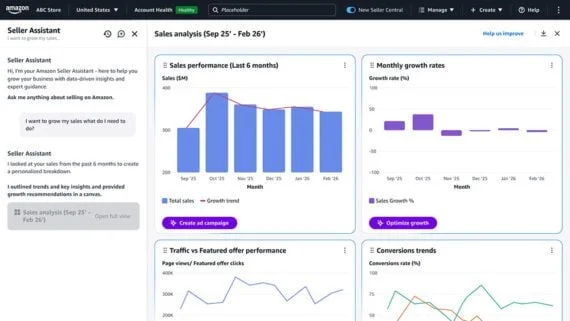
Amazon has introduced a significant new artificial intelligence feature within its Seller Central platform, fundamentally altering how merchants interact with their performance data. Moving away from traditional static reports, sellers can now explore complex marketplace analytics through dynamic, visual workspaces powered by AI. This innovation, described by Amazon as "a dynamic canvas experience," represents a pivotal step towards what is increasingly being termed "conversational business intelligence" within the e-commerce landscape. The implications for online sellers are substantial, promising a more intuitive, interactive, and potentially automated approach to data analysis and business decision-making.
The Canvas Experience: An Interactive Data Exploration Tool
The core of this new feature is an AI assistant integrated into Seller Central. Merchants can now engage with their sales, advertising, and operational data through natural language queries. Instead of sifting through rows of numbers or pre-defined charts, sellers can ask the AI specific questions, such as "How did my recent advertising campaigns impact product sales for SKUs X and Y?" or "Compare my sales performance in Q3 of this year against the same period last year."
In response, the AI assistant generates interactive charts, graphs, and visual representations of the requested metrics. This transforms the vast datasets of the Amazon marketplace into a user-friendly, text- or chat-based interface. The system is designed not merely to present information, but to facilitate exploration. Sellers can arrange these generated visualizations within a personalized workspace, creating a custom dashboard tailored to their specific analytical needs. Amazon emphasizes that this "canvas experience" is intended to encourage experimentation with data, allowing sellers to test hypotheses and uncover insights in a more fluid and intuitive manner than previously possible with standard reporting tools.
The visual workspace allows for a dynamic arrangement of charts and data points. For instance, a seller could overlay advertising spend data with corresponding sales figures for a particular product, or compare conversion rates across different product categories over time. This level of interactivity empowers merchants to quickly identify correlations, outliers, and trends that might be obscured in lengthy, static reports. The ability to drag, drop, and resize visual elements further enhances the personalized nature of the data exploration, making it feel more akin to an artistic or design process, albeit with data as the medium.
A Broader Trend: The Rise of Conversational Business Intelligence
The introduction of Amazon’s Seller Central canvas experience is not an isolated event but reflects a broader and accelerating trend across business analysis software. As artificial intelligence continues its rapid advancement and integration into various software applications, the paradigm of how businesses interact with their data is shifting dramatically. This evolution suggests a future where reliance on traditional spreadsheets, manual report generation, and even some existing business intelligence tools may diminish, superseded by AI systems that can interpret signals, provide actionable insights, and potentially even assist in decision execution.
The very nature of performance analysis is being redefined. Rather than requiring dedicated personnel to meticulously dig through data or construct complex reports, the process is becoming more conversational. A seller asks a question, and the AI surfaces relevant insights, often presented visually. This dialogue-driven approach promises to democratize data analysis, making it accessible and efficient for a wider range of business users, regardless of their technical expertise.
The implications of this trend extend beyond Amazon. Shopify, a major competitor in the e-commerce platform space, has also been aggressively integrating AI into its offerings. In its Winter ’26 platform update, Shopify announced over 150 AI-related enhancements, including significant upgrades to its AI assistant, Sidekick. Sidekick, along with its feature Sidekick Pulse, assists merchants with data analysis, task generation, and workflow automation. Similar to Amazon’s offering, merchants can query Sidekick about sales trends, inventory levels, marketing performance, and other critical business metrics using natural language. This parallel development underscores a market-wide recognition of the power and potential of conversational AI in e-commerce analytics.
Conversational BI: From Novelty to Necessity
The concept of conversing with AI about business data is not entirely new. Variations of conversational business intelligence (CBI) have been emerging in specialized analytics software for some time. Platforms such as Microsoft Power BI, Google Looker, and Qlik have already incorporated natural language query (NLQ) capabilities. These tools allow users to pose questions in plain English, such as "Why did our conversion rate drop yesterday?" or "What were our top-selling products in the last quarter?", and receive immediate responses in the form of charts, summaries, and explanations.
However, the integration of such capabilities directly into the operational platforms of major e-commerce marketplaces like Amazon marks a significant acceleration of this trend. By embedding CBI directly into Seller Central, Amazon is placing powerful analytical tools directly in the hands of millions of sellers, making sophisticated data exploration accessible at the point of action. This proximity to the operational environment is crucial, as it allows for more immediate insights and faster response times to market changes or performance issues.

Implications for Online Merchants: Streamlining Complexity
Online sellers today are often inundated with an overwhelming volume of data. Amazon Seller Central alone provides a wealth of reports covering crucial areas such as website traffic, conversion rates, advertising campaign performance, customer reviews, and inventory levels. The challenge for many merchants lies not in accessing this data, but in effectively analyzing it. Understanding the intricate interplay between these various metrics often necessitates exporting data into spreadsheets, building custom dashboards in external business intelligence tools, or hiring dedicated analysts. This process can be time-consuming, complex, and expensive, particularly for small and medium-sized businesses.
Conversational business intelligence, as exemplified by Amazon’s new canvas feature, promises to significantly reduce this complexity. Instead of navigating through multiple reports or wrestling with spreadsheet formulas, a merchant can simply ask the AI for the information they need. The system can then provide charts, summaries, and even textual explanations within seconds, streamlining the entire analytical process.
As these conversational BI tools mature, they have the potential to fundamentally alter how merchants interact with e-commerce data in several key ways:
- Democratization of Analytics: Complex data analysis will become accessible to a broader range of users, including those without deep technical expertise in data science or business intelligence.
- Faster Insights: The ability to ask questions and receive immediate answers will dramatically reduce the time it takes to identify trends, anomalies, and opportunities.
- Proactive Problem Solving: As AI becomes more sophisticated, it can move beyond reactive reporting to proactively identify potential issues and suggest solutions.
- Enhanced Strategic Decision-Making: By providing clearer, more accessible insights, these tools will empower merchants to make more informed and data-driven strategic decisions.
Beyond Queries: The Dawn of Automated Action
While the current iteration of Amazon’s Seller Central canvas focuses on answering questions and visualizing data, the trajectory of AI development strongly suggests a future where these systems will evolve beyond mere information retrieval. As AI technology improves, it is likely to move towards proactively recommending actions and, in some cases, executing them automatically within predefined parameters.
Imagine an AI assistant that, after analyzing performance data, automatically increases the advertising spend for a demonstrably profitable campaign, pauses keyword groups that are yielding poor results, or alerts a merchant that inventory for a fast-selling product is running critically low. Such capabilities would represent a significant leap forward, transforming AI from an analytical tool into an operational partner. This move towards "agentic" AI, capable of independent action, could lead to a more automated e-commerce environment where software not only explains the data but actively helps run the business.
For instance, an AI could monitor the performance of a new product launch. If early sales data and customer feedback indicate strong demand and positive reception, the AI might automatically trigger a promotional campaign, adjust inventory reorder points, or even suggest optimizing product listing details based on early customer inquiries. Conversely, if a product is underperforming, the AI could suggest A/B testing different product images or descriptions, or recommend a price adjustment, all without direct human intervention initially.
The Enduring Need for Human Oversight
Despite the exciting potential for AI-driven automation, it is crucial to acknowledge that conversational business analysis is unlikely to entirely replace traditional reporting and human oversight. Reliable data models, clearly defined metrics, and a fundamental understanding of business operations remain indispensable. Merchants will still need to establish their business goals, define what success looks like, and ensure that the data being analyzed accurately reflects their operational reality.
The AI tools, even in their most advanced forms, will operate within the frameworks and parameters set by their human users. The responsibility for setting strategic direction, defining ethical guidelines for automated actions, and ultimately making the final business decisions will continue to rest with the merchant. AI is poised to become a powerful co-pilot, augmenting human capabilities rather than replacing them entirely. The ability to interpret the nuanced context of a business, understand market sentiment beyond pure data points, and exercise human judgment in complex situations will remain vital.
A Future of Accelerated Insights and Action
Tools like Amazon’s Seller Central canvas are indicative of a future where the distance between gaining an insight from data and taking action on that insight will dramatically shrink. The evolution of e-commerce platforms towards more integrated, AI-powered analytical capabilities suggests a more dynamic, responsive, and efficient marketplace for online sellers. As AI continues to evolve within these platforms, the ability for merchants to understand their business performance and act upon it with unprecedented speed and accuracy is set to become a defining characteristic of success in the digital economy. The ongoing development of these conversational BI tools promises to reshape how e-commerce businesses operate, making data analysis less of a chore and more of an integral, intelligent component of day-to-day commerce.

