

The e-commerce landscape is experiencing a profound cultural shift, characterized by a burgeoning embrace of artificial intelligence (AI) and automation. This paradigm encourages a proactive, experimental approach to problem-solving, reminiscent of the industry’s nascent stages of innovation. This "test-and-see" mentality is not merely a fleeting trend but a fundamental recalibration of how businesses operate and adapt in an increasingly dynamic digital marketplace.
The AI Imperative: Data-Driven Transformation
The burgeoning adoption of AI within e-commerce businesses is not an isolated phenomenon but a response to evolving market demands and technological advancements. A significant body of research underscores this transformation. The LinkedIn "Work Change Report 2025," a comprehensive study examining the future of work, revealed that a staggering 80% of C-suite executives consider AI adoption crucial for fostering a more innovative workplace culture. This sentiment is echoed by a significant portion of the workforce itself. Gartner, a leading research and advisory firm, reported in December 2025 that 65% of employees expressed excitement about integrating AI into their daily work routines.
This convergence of executive foresight and employee enthusiasm points to a confluence of critical business priorities: enhancing operational efficiency, driving competitive advantage, and empowering employees with advanced tools. The underlying principle is a recognition that AI is no longer a futuristic concept but a present-day enabler of tangible business outcomes. This shift is particularly impactful in the e-commerce sector, where agility, data analysis, and customer responsiveness are paramount.

A Return to Foundational Ingenuity: The DIY Resurgence
This AI-driven cultural shift has ignited a renaissance of do-it-yourself (DIY) projects within e-commerce operations, mirroring the resourceful spirit that characterized the industry’s early days. Businesses are empowering their teams with access to sophisticated AI tools and automation platforms, enabling them to directly address operational challenges and identify opportunities for improvement.
A compelling illustration of this trend comes from an e-commerce business located in the northwestern United States. This forward-thinking company provided nearly every employee with premium access to leading AI platforms such as OpenAI and Gemini, alongside the robust workflow automation tool n8n. The explicit mandate from management was to encourage employees to leverage these tools for creative problem-solving.
Upon reviewing the outcomes of this initiative, it became evident that staff members had independently developed a remarkably effective, albeit relatively simple, n8n-driven tool designed to monitor competitor pricing. This custom-built solution involved a multi-step process: it systematically gathered pricing data from competitor websites, utilized an AI agent to compare this data against the company’s own product catalog, and subsequently populated a Google Sheet with the compiled information on a weekly basis. This meticulously updated spreadsheet then served as the foundation for a pivot table, which marketing professionals used to swiftly identify pricing fluctuations and strategic shifts by competitors.
This initiative bears a striking resemblance to innovations from an earlier era. In a 2015 article, "Monitor Competitor Prices with Python and Scrapy," a similar, albeit less sophisticated, price-monitoring solution was detailed. That article described a system developed for a regional retailer that, while less functional and more technically demanding, still offered a viable approach to addressing the challenge of competitive pricing intelligence. The current iteration, however, leverages advanced AI and user-friendly automation platforms to achieve a similar outcome with greater ease and scalability.

Streamlining Operations with Automation: The n8n Advantage
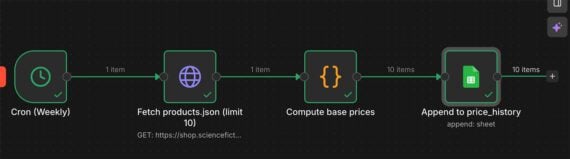
The ingenuity demonstrated by the northwestern e-commerce business highlights the potential for even more streamlined automation. A simplified version of the competitor price-monitoring workflow, for instance, might require as few as four core steps and, in some cases, might not even necessitate the direct involvement of AI. The power of platforms like n8n lies in their ability to visually construct complex automated workflows through a series of interconnected nodes, each representing a specific action or data manipulation.
The typical workflow for such a price-monitoring system would commence with a scheduled trigger, often a weekly cron job, ensuring the process runs consistently without manual intervention. This trigger would then initiate the fetching of product data, potentially from an API or a scraped source, which would be processed to extract relevant pricing information. Subsequently, the system would perform calculations to determine base prices or identify any discrepancies. Finally, the gathered and processed data would be appended to a designated Google Sheet, creating a historical record of competitor pricing. Status indicators within the workflow would provide immediate visual confirmation of each step’s successful execution, offering a clear overview of the automation’s progress.
The capacity for generative AI further amplifies this DIY trend. Merchants may soon find themselves not needing to manually assemble these workflows. Advanced generative AI tools can now interpret simple natural language prompts and produce n8n-importable JSON files, effectively translating human intent into functional automation code. This democratization of automation development significantly lowers the barrier to entry for businesses seeking to customize their operational processes.
Cultivating a Culture of Innovation and Empowerment
The true significance of the price-monitoring example extends far beyond the technical intricacies of the workflow itself; it lies in the transformative culture it fosters within the organization. The fact that a member of the marketing team, possessing minimal traditional programming background, could conceptualize and implement a sophisticated problem-solving automation is a testament to the empowering nature of these new tools.
While a seasoned developer might later refine the workflow or optimize the underlying code, the crucial achievement is the reduction of the friction between identifying an operational challenge and devising a practical solution. This DIY attitude, once the hallmark of entrepreneurial e-commerce ventures, is being revitalized and amplified by the current generation of AI and automation technologies.
By cultivating an "automate-first" culture, coupled with a strategic embrace of AI, teams can unlock the potential to build highly customized workflows addressing a myriad of business needs. These could include:
- Personalized Customer Journey Mapping: Automating the tracking and analysis of customer interactions across multiple touchpoints to deliver tailored experiences and product recommendations.
- Dynamic Inventory Management: Developing automated systems that predict demand, optimize stock levels, and trigger reorders to prevent stockouts and minimize holding costs.
- Proactive Customer Support: Implementing AI-powered chatbots and automated ticket routing to resolve common customer queries instantly and escalate complex issues efficiently.
- Streamlined Order Fulfillment: Automating the process from order placement to shipping, including inventory allocation, carrier selection, and tracking updates, thereby accelerating delivery times.
- Targeted Marketing Campaign Optimization: Creating automated workflows that analyze campaign performance data in real-time, adjust bidding strategies, and personalize messaging for enhanced ROI.
A Convergence of Opportunity: Strategic Advantages in the Digital Age
The burgeoning DIY trend in e-commerce represents a significant opportunity, arising from the convergence of AI capabilities, automation technologies, and evolving business imperatives. In an increasingly competitive digital marketplace, executives are actively seeking robust solutions for competitive protection, aiming to stay ahead of market trends and disruptive innovations. Simultaneously, employees are driven by a desire for enhanced efficiency and the acquisition of new, in-demand skills, recognizing that proficiency with AI and automation tools is becoming a critical asset.
Furthermore, budgetary constraints often limit the adoption of expensive, off-the-shelf software solutions or the extensive hiring of specialized development teams. The DIY approach, facilitated by accessible AI and automation platforms, offers a cost-effective and agile alternative, enabling businesses to build bespoke solutions tailored to their unique needs without incurring prohibitive costs. This democratization of technology empowers businesses of all sizes to innovate and compete effectively, ushering in a new era of agile, intelligent, and self-sufficient e-commerce operations. The ability for internal teams to rapidly prototype and deploy solutions means that businesses can adapt to market changes with unprecedented speed and precision, solidifying their competitive position in the ever-evolving digital economy.

