
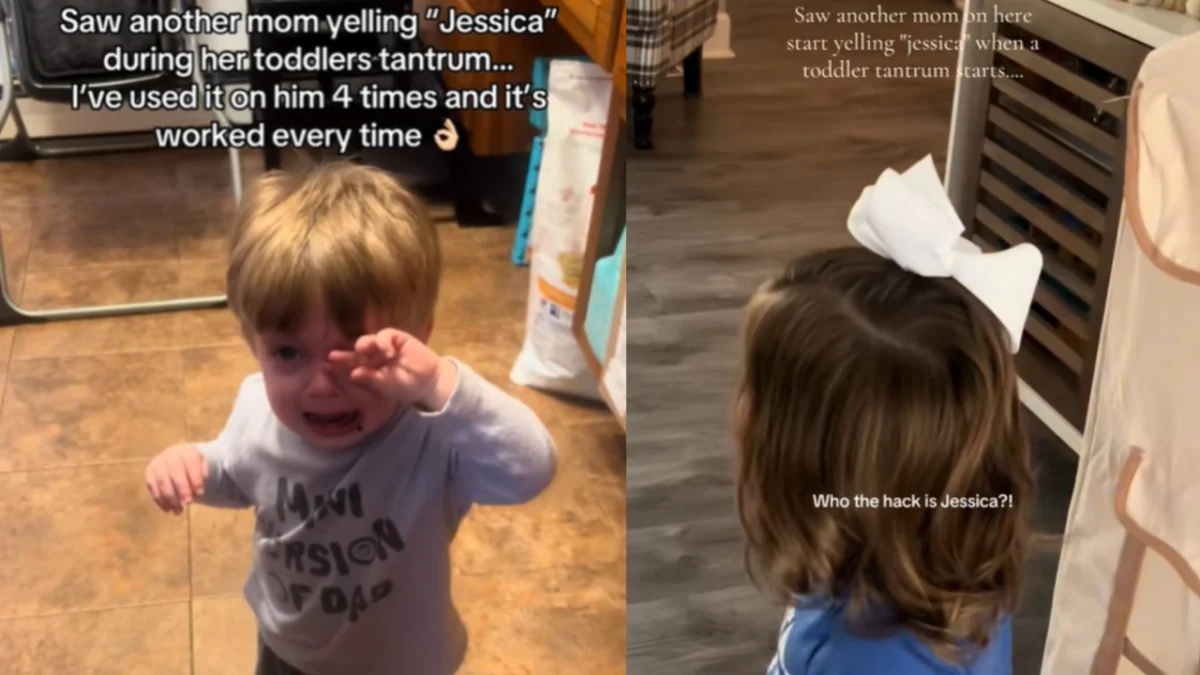
In the rapidly evolving landscape of digital parenting, a new phenomenon known as the Jessica Trend or the Jessica Trick has emerged as a viral sensation, captivating millions of social media users and sparking a broader conversation regarding child psychology and behavioral management. The trend, which gained significant traction on the short-form video platform TikTok in late March and April of 2026, involves a parent abruptly yelling or firmly stating the name "Jessica" during a toddler’s temper tantrum. To the surprise of many observers, the method appears to cause an immediate cessation of the child’s distress, leading to a surge of participatory videos and professional analysis from the pediatric mental health community. While the name itself appears to hold no inherent magical properties, the neurological implications of the "Jessica Trick" have provided a fascinating window into how external stimuli can interrupt emotional dysregulation in early childhood.
Chronology and the Genesis of a Viral Hack
The documented origin of the Jessica Trend traces back to March 26, 2026, when TikTok creator @krislynakuhn uploaded a video capturing a moment of domestic tension. In the footage, her toddler is shown in the midst of a standard emotional meltdown. Seeking to test a theory she had reportedly seen elsewhere on the platform, Kuhn called out the name "Jessica" in a tone that blended concern with suddenness. The effect was near-instantaneous: the child stopped crying, transitioned into a state of visible confusion, and shortly thereafter resumed playing as if the tantrum had never occurred.
The video resonated deeply with the "Parenting TikTok" (often referred to as #ParentTok) community, garnering over 12.2 million views within its first three weeks of publication. In the caption, Kuhn noted, "Saw another mom on here start yelling ‘Jessica’ when a toddler tantrum starts… I don’t think we will ever find this Jessica because she literally started playing after this like no tantrum even happened." This initial success served as the catalyst for a wave of imitation and experimentation.
By early April 2026, the trend had reached a critical mass. On March 30, creator @devinpalazzo shared her own successful attempt, which reached 6.4 million views, further validating the method’s efficacy for a global audience. The momentum continued into the first week of April, with creators like @ngo.quang.thao demonstrating the trick’s success on a young girl, a video that eventually surpassed 6.3 million views. The rapid dissemination of these videos created a feedback loop, where the success of one parent encouraged dozens of others to document their own experiences, turning a localized "trick" into a worldwide digital movement.
The Science of the Reset: Neurological Perspectives
The efficacy of the Jessica Trend has prompted various experts in child development to weigh in on why a seemingly random name can halt a physiological response as intense as a tantrum. Central to this discussion is the concept of "pattern interruption." In mid-April 2026, a child therapist interviewed by HuffPost provided a comprehensive breakdown of the neurological mechanisms at play during these viral moments.
According to the therapist, a toddler in the throes of a tantrum is experiencing a state of intense dysregulation. During such episodes, the amygdala—the part of the brain responsible for processing emotions and the "fight or flight" response—is highly active. Simultaneously, the prefrontal cortex, which governs logic, reasoning, and social behavior, is essentially "offline." When a parent introduces a sudden, incongruous stimulus—such as shouting a name that is unfamiliar or out of context—it forces a shift in the child’s brain activity.
"It’s pretty much impossible to stay in tantrum mode and enter curiosity mode at the same time," the therapist noted. The abrupt shift in tone and the introduction of a new "character" (the mysterious Jessica) disrupts the amygdala’s dominance. This "reset" allows the nervous system a brief window to reregulate. The child’s brain moves from a state of emotional flooding to a state of cognitive inquiry: Who is Jessica? Why is my parent looking for her? Is there someone here I don’t know? This transition into "curiosity mode" effectively breaks the cycle of the tantrum.
Celebrity Involvement and Cultural Saturation
The Jessica Trend eventually transcended the niche of parenting influencers and entered the sphere of mainstream celebrity culture. On April 11, 2026, acclaimed actress Jessica Biel joined the conversation. In a TikTok video that received over 277,000 views in less than a week, Biel responded to the trend with a mixture of humor and curiosity. "On behalf of all Jessicas, we are nice people," she remarked, while also joking that she intended to test the "Jessica Trick" on her dogs to see if the interruption tactic worked across species.
Biel’s involvement highlighted the trend’s saturation in the public consciousness. By mid-April, the "Jessica" name had become a shorthand for a specific type of viral parenting strategy. Major news outlets, including the New York Post, began reporting on the phenomenon, framing it as an "amusing new parenting trend" that provided a "weird hack" for stressed-out caregivers. The coverage often emphasized the humorous nature of the toddlers’ reactions—ranging from wide-eyed shock to immediate silence—which contributed to the high shareability of the content.
Supporting Data and Digital Metrics
The scale of the Jessica Trend can be quantified through social media engagement metrics and search interest data. Between March 26 and April 15, 2026, the hashtag #JessicaTrend and related terms saw a vertical increase in usage.
- Total Viewership: Aggregate views for videos tagged with #JessicaTrend and #JessicaTrick exceeded 50 million within the first month.
- User Engagement: The average "save" rate for these videos was significantly higher than standard parenting content, suggesting that users were bookmarking the videos to reference the technique later.
- Global Reach: While the trend originated in English-speaking territories, translated versions and similar "interruption" tactics began appearing in non-English speaking regions, demonstrating the universal nature of the toddler tantrum struggle.
Data from search engines indicated a parallel spike in queries such as "Why does the Jessica trend work?" and "Who started the Jessica trick?" This indicates that the trend moved beyond passive consumption into a subject of active investigation by parents seeking to understand the underlying psychology.
Ethical Considerations and the "Sharenting" Debate
Despite the popularity and apparent success of the Jessica Trend, it has not been without its critics. The phenomenon has reignited the debate over "sharenting"—the practice of parents sharing sensitive or potentially embarrassing content of their children online.
Privacy advocates argue that filming a child in a state of emotional distress, even for the purpose of a "hack" or a joke, may have long-term implications for the child’s digital footprint. Critics suggest that while the "Jessica Trick" itself might be a harmless psychological tool, the act of broadcasting a child’s vulnerability to millions of strangers raises questions about consent and the boundaries of digital parenting.
Furthermore, some child development specialists caution against over-reliance on "reset" hacks. While they acknowledge the science behind pattern interruption, they emphasize that these tricks do not replace the need for teaching children long-term emotional regulation skills. The "Jessica Trick" may stop a tantrum in the moment, but it does not necessarily address the underlying cause of the child’s frustration or provide them with the tools to manage their emotions independently in the future.
Broader Impact and the Future of Viral Parenting
The Jessica Trend represents a broader shift in how modern parents consume and implement advice. In previous generations, parenting techniques were passed down through family traditions or sourced from pediatricians and childcare books. In the 2020s, however, platforms like TikTok have become primary sources of "micro-advice."
The speed at which the Jessica Trend spread illustrates the power of the "proof of concept" video. When a parent sees a real-time recording of a technique working on a child similar to their own, the barrier to adoption is remarkably low. This has led to an era of "experimental parenting," where viral trends serve as a collective laboratory for testing behavioral theories.
As the Jessica Trend eventually stabilizes and enters the archive of internet culture, its legacy will likely be its contribution to the public’s understanding of cognitive distraction. Whether it is "Jessica," a "silly walk," or a "whisper method," the core principle remains the same: the human brain, particularly in its formative years, is highly susceptible to sudden shifts in environmental stimuli.
In conclusion, the Jessica Trend of 2026 stands as a testament to the intersection of neuroscience, digital virality, and the universal challenges of raising toddlers. While "Jessica" may be a phantom figure in the lives of these children, her name has become synonymous with a moment of calm in the often chaotic world of early childhood development. As parents continue to navigate the complexities of the digital age, trends like these highlight the ongoing search for balance between effective discipline, psychological insight, and the ever-present influence of social media.

