
The effectiveness of artificial intelligence (AI)-generated marketing content is increasingly being defined by its ability to capture organic traffic from search engines, large language models (LLMs), and platforms like Google Discover. This fundamental shift underscores a critical challenge for content marketers: while AI has democratized content creation, it has also amplified competition and altered consumer search behaviors, necessitating a renewed focus on quality and strategic execution to achieve meaningful engagement and customer acquisition.
Content marketing, at its core, serves the strategic objectives of attracting, engaging, and retaining customers. For e-commerce marketers, the initial attraction phase is paramount. Historically, this attraction was predominantly driven by search engine optimization (SEO). Content that ranked well in search results generated direct visits, effectively filling the top of the sales funnel. While customer retention remains a vital component of marketing strategy, the primary role of content marketing has increasingly gravitated towards the acquisition of new prospects.
The Double-Edged Sword of AI in Content Creation
The widespread availability of AI tools has presented content marketers with a complex scenario, often described as a double-edged sword. On one hand, AI has dramatically reduced the cost and time associated with content production, at least from a purely utilitarian perspective. This has enabled businesses to scale their content output at an unprecedented rate. However, this surge in AI-generated content has also led to an internet saturated with material of potentially lower intrinsic value. Simultaneously, AI has begun to reshape how consumers discover and consume information, influencing search patterns and content preferences.
The year 2026 has emerged as a critical juncture in this evolving landscape. Major search engines and content platforms are implementing algorithm updates that prioritize user experience and content quality, often at the expense of AI-generated content that lacks originality or depth. A significant indicator of this trend was Google’s algorithm update in February 2026, which specifically targeted improvements for Google Discover. According to analysis by DiscoverSnoop, a research firm specializing in Google Discover performance, numerous large websites experienced a substantial decline in their Discover exposure following this rollout. This suggests a strategic pivot by search giants to favor content that demonstrates genuine authority and user value over sheer volume.
The interplay between algorithm updates, the rise of zero-click search results (where users find answers directly on the search results page without needing to click through to a website), and evolving consumer behaviors has inadvertently created a self-perpetuating cycle for AI-generated content. As organic traffic across traditional search engines, LLM interfaces, and personalized feeds begins to decline, the perceived cost of producing content that does attract traffic increases. In an effort to mitigate these rising costs, marketers are increasingly turning to AI. Paradoxically, this increased reliance on AI further intensifies competition, as more businesses leverage similar AI models and prompts, ultimately exacerbating performance issues.
This saturation leads to a homogenization of content. When multiple AI models are used with similar prompts, the resulting articles often share a common tone, structure, and even substance. This phenomenon has been colloquially termed "AI slop" within the context of content marketing, where a deluge of uninspired and undifferentiated content floods the digital space, making it harder for any single piece to stand out and capture genuine audience attention.
The Imperative of Quality as the Solution
Just a year ago, the primary advantage offered by AI in content marketing was its speed and cost-effectiveness. This advantage, however, has largely eroded as the technology has become more widespread. The new differentiator, therefore, lies in execution and the strategic application of AI. Marketers can no longer rely solely on AI to generate content; instead, they must focus on producing AI-assisted content that is meticulously structured, factually validated, and expertly refined. In practical terms, this translates to a significant elevation in content quality.
A fundamental shift in mindset is required. Marketers must first overcome any inherent bias against AI-generated content, acknowledging that it can, with proper guidance and oversight, achieve or even surpass human-level quality. This assertion is supported by emerging evidence. A recent interactive quiz conducted by The New York Times, which pitted human-written text against an AI-generated rewrite, revealed a compelling outcome: approximately half of the Times’ readers preferred the AI-generated versions. This suggests that the technical capability of AI to produce high-quality prose is rapidly advancing, challenging traditional notions of authorship and quality.
Secondly, there needs to be a widespread belief and a systematic approach to optimizing and systematizing AI-assisted content creation. This involves recognizing that AI is a tool that, when integrated into a robust workflow, can enhance human creativity and efficiency rather than replace it entirely.
A 12-Step Framework for Elevated AI-Assisted Content
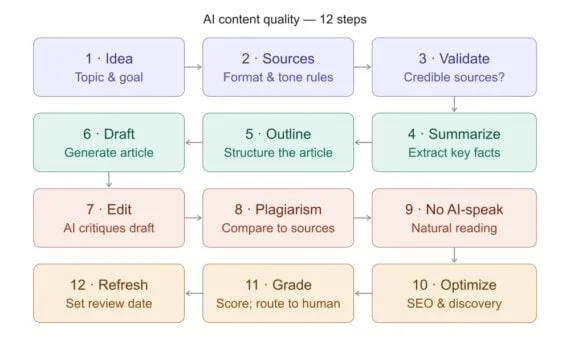
The path to improving the effectiveness of AI-generated content lies not merely in refining prompts but in establishing superior content creation processes. A practical and systematic approach involves treating content generation as a multi-step framework, where each stage contributes to enhanced structure, mitigated risk, and ultimately, improved quality. While human editors can intervene at any stage, these steps are generally designed to be executed by AI, with human oversight and refinement integrated throughout.
The following 12-step framework provides a structured approach to AI-assisted content creation, aiming to elevate output beyond the "AI slop" that currently saturates the digital landscape:
-
Topic Ideation & Keyword Research: Leveraging AI to analyze vast datasets of search queries, trending topics, and competitor content to identify high-potential keywords and emerging subject areas that align with target audience interests and business objectives. This step focuses on identifying opportunities for organic visibility.
-
Audience Persona Development: Utilizing AI to analyze demographic data, behavioral patterns, and online interactions to build detailed and nuanced audience personas. This ensures content is not only discoverable but also relevant and resonant with specific user segments.

-
Content Outline Generation: AI generates a comprehensive outline for the content piece, structuring it logically with clear headings, subheadings, and key talking points. This provides a solid foundation for the writing process and ensures all essential elements are covered.
-
Draft Generation (AI-Assisted): AI produces the initial draft of the content based on the detailed outline and persona insights. This draft is intended to be a comprehensive first pass, covering the core information and arguments.
-
Fact-Checking & Data Verification: AI tools are employed to cross-reference claims made in the draft against reputable sources, ensuring accuracy and the inclusion of up-to-date statistics and evidence. This is a critical step in building credibility and trust.
-
Expert Review & Validation (Human/AI): Subject matter experts (human) or advanced AI models trained on specialized knowledge can review the draft for technical accuracy, nuance, and completeness. This stage ensures the content meets a high standard of authority.
-
Tone & Style Adaptation: AI adjusts the writing style and tone to perfectly match the brand voice and the specific requirements of the target platform (e.g., formal for a white paper, conversational for a blog post).
-
SEO Optimization: AI analyzes the content for on-page SEO elements, including keyword integration, meta descriptions, header tags, and internal/external linking opportunities, to enhance its discoverability in search engines.
-
Plagiarism & Originality Check: Advanced AI algorithms scan the generated content against existing online material to ensure originality and prevent unintentional duplication, a crucial step in maintaining content integrity.
-
Readability & Engagement Enhancement: AI assesses the content for readability metrics (e.g., Flesch-Kincaid score) and suggests improvements for clarity, flow, and engagement, such as simplifying complex sentences or adding transition phrases.
-
Call to Action (CTA) Integration: AI identifies optimal placements and phrasing for compelling calls to action that align with the content’s purpose and guide the user towards desired next steps.
-
Final Human Edit & Refinement: A human editor conducts a final review, adding a layer of human intuition, creativity, and brand sensibility to ensure the content is polished, compelling, and perfectly aligned with marketing objectives. This step is crucial for adding a unique human touch and ensuring strategic alignment.
This structured workflow acknowledges that AI is a powerful co-pilot, not an autonomous pilot, in the complex journey of content creation. By integrating AI at specific, value-adding stages and ensuring human oversight, marketers can produce content that is not only cost-effective but also strategically superior.
The Future of Content Marketing: Quality Over Quantity
The landscape of digital marketing is in constant flux, driven by technological advancements and evolving consumer behaviors. AI has fundamentally altered the economics of content production, making it cheaper and faster to generate material. However, this accessibility has also led to an oversupply of generic content, diminishing its impact.
The advantage of AI in content marketing is no longer solely about speed or cost reduction. The key differentiator moving forward is the quality of execution. Marketers who succeed in 2026 and beyond will be those who can harness AI to produce content that is demonstrably better – more insightful, more authoritative, more engaging, and ultimately, more effective at attracting and retaining audiences. The marketers who win will generate the best content, not simply the most content. This paradigm shift demands a strategic, quality-centric approach, leveraging AI as a powerful tool to augment human expertise and creativity. The future of content marketing is undoubtedly intelligent, but it is also, and will remain, deeply human in its pursuit of genuine connection and value.

