
The global technology industry has entered a period of what design experts call conversational tunnel vision, a phenomenon where the chat bubble has become the default interface for nearly every artificial intelligence capability. This trend stems largely from the fact that Large Language Models (LLMs) are trained primarily on dialogue data, leading developers to conclude that text-based conversation is the natural home for AI. However, a growing consensus among User Experience (UX) professionals suggests that this reliance on a single modality is creating significant friction for users. Great design, according to industry veterans, is not about forcing a user into a specific interface but rather matching the interaction modality to the user’s specific context, intent, and cognitive load.
Modality refers to the sensory pathways through which a person interacts with a system—seeing, hearing, touching, speaking, or typing. As AI becomes more integrated into high-stakes environments, the necessity of choosing the right modality has moved from a matter of aesthetic preference to a critical requirement for safety and efficiency. To address this, product teams are being urged to utilize rigorous frameworks like Task Audits and Input/Output Alignment Matrices to ensure the interface adapts to the human, rather than forcing the human to adapt to the machine.
The Linguistic and Cognitive Barriers of Chat
The allure of the chatbot is its perceived versatility; it presents a "blank slate" that suggests infinite capability. However, this versatility comes at a high psychological cost. When an interface relies solely on text-based conversation, it imposes a dual burden on the user: a linguistic challenge for providing input and a cognitive challenge for interpreting output.
On the input side, a blank text box often leads to choice paralysis. In traditional graphical user interfaces (GUIs), buttons and menus provide visual cues that signal available actions. In a chat-based system, the user must suddenly become a writer, translating a vague intent into a precise linguistic command. For many professionals, this acts as a barrier. A designer might intuitively know how a texture should look but struggle to describe it in words; for that individual, a slider or a color picker is a far more efficient tool than a prompt.
On the output side, the burden shifts to "serial processing." Human language is a sequential medium; the brain must process one word after another to extract meaning. This is fundamentally different from visual processing, which allows for parallel recognition. A professional, such as a doctor or a stock trader, can glance at a graph and identify a trend in milliseconds. If that same data is delivered as a three-paragraph summary, the professional is forced into a "reading assignment," increasing the time to insight and the likelihood of error.
A Chronology of Interface Evolution
To understand the current obsession with chat, it is necessary to look at the timeline of human-computer interaction (HCI). The industry has moved through several distinct eras, each defined by the limitations of the underlying technology:
- The Command-Line Era (1960s–1980s): Interaction was purely textual and required high technical literacy. Users had to memorize specific syntax, creating a massive barrier to entry.
- The Graphical User Interface (GUI) Revolution (1984–Present): Pioneered by the Apple Macintosh and later Windows, this era introduced visual metaphors (folders, trash cans, buttons). It shifted the burden from recall (remembering a command) to recognition (seeing a button).
- The Mobile and Touch Era (2007–Present): Interaction became haptic and gestural. The "app" model simplified tasks into single-purpose tools optimized for on-the-go use.
- The Conversational AI Boom (2022–Present): Following the release of ChatGPT, the industry pivoted back toward a text-heavy model. Because LLMs excel at generating text, the chat window was seen as the path of least resistance for product deployment.
Industry analysts suggest that we are now entering a fifth era: Ambient and Multi-modal AI. In this phase, the interface disappears or changes dynamically based on the user’s environment. The goal is to move beyond the chat box and return to the principles of "calm technology," where the system demands the least amount of user attention possible.

Data-Driven Rationale for Multi-modal Diversity
Recent studies in cognitive ergonomics highlight why the "one-size-fits-all" chatbot is failing. Research indicates that cognitive load—the total amount of mental effort being used in the working memory—increases by as much as 40% when users are forced to switch from visual-spatial tasks (like dragging an object) to linguistic tasks (like describing that move in text).
Furthermore, accessibility data reveals that a reliance on text-heavy chat excludes a significant portion of the population. According to the World Health Organization, over 2.2 billion people have a near or distant vision impairment. For these users, a text-based output without robust audio or haptic alternatives is a functional dead end. Similarly, users with motor impairments may find typing long prompts into a mobile chat box nearly impossible.
| Modality | Cognitive Load | Best Use Case |
|---|---|---|
| Button / Tap | Low | Binary actions, quick confirmations |
| Visual Dashboard | Medium | High-density data, trend analysis |
| Voice Input | Medium | Hands-busy, eyes-busy environments |
| Natural Language Chat | High | Exploratory research, complex queries |
| Gesture | Low | Sterile or contactless environments |
Industry Reactions and the Task Audit Framework
Leading design firms and technology companies are beginning to push back against the "chatbot-first" mentality. In a recent internal white paper, a major Silicon Valley firm noted that "AI should be a feature, not a destination." This sentiment has led to the development of the Task Audit, a framework designed to ground interface choices in evidence rather than convention.
The Task Audit requires designers to answer four critical questions before building:

- Physical Constraints: Where is the user? Are their hands busy (e.g., driving or wearing gloves)?
- Visual Constraints: Where is the user’s focus? Are they looking at a surgical site, a live wire, or a steering wheel?
- Cognitive Load: How much mental energy is already being spent on the primary task?
- Social Context: Is the environment loud? Is privacy required? (e.g., a user won’t use voice input in a quiet library or a crowded train).
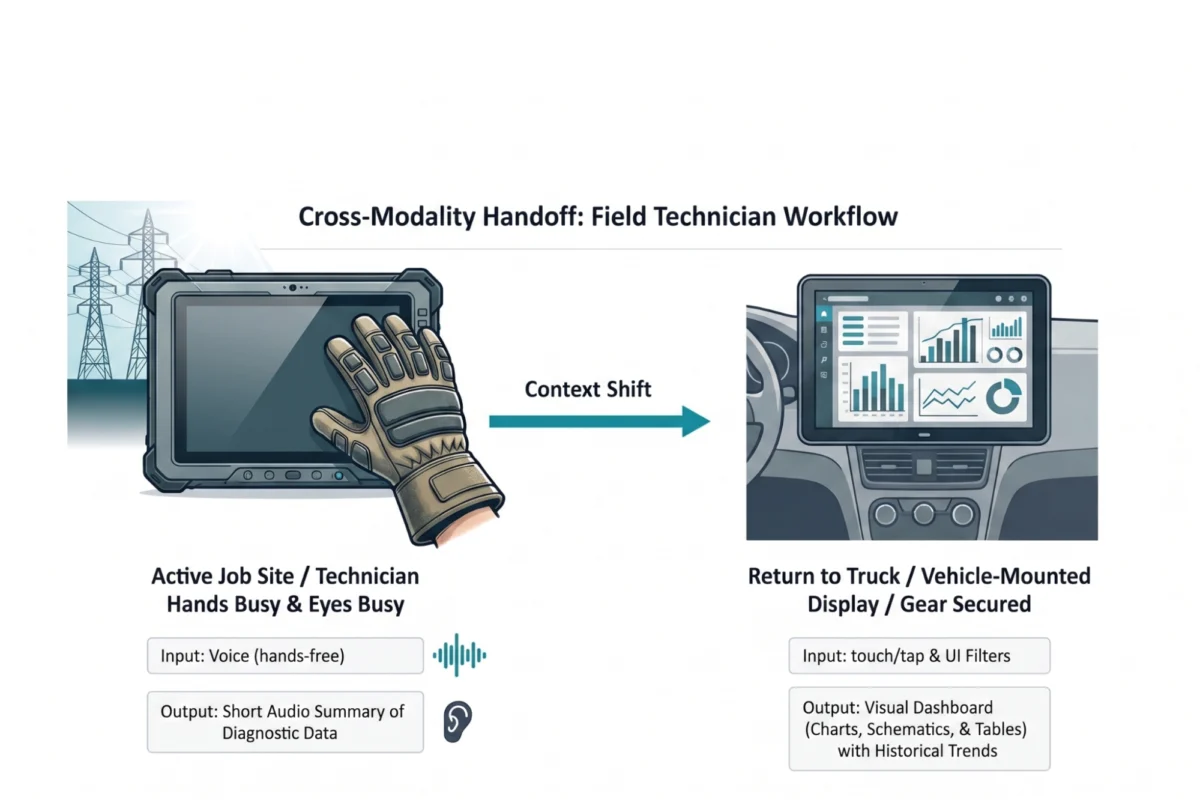
By conducting contextual inquiries—observing users in their natural habitat—designers can identify "hidden work." These are the small workarounds users perform, such as a technician balancing a tablet on their knee because they need both hands for a tool. A chatbot fails in this scenario, but a voice-activated audio summary succeeds.
Case Study: Adaptive Modality in the Energy Sector
A practical application of these principles can be seen in the recent redesign of diagnostic tools for field technicians servicing high-voltage electrical grids. These workers operate in "high-risk, eyes-busy" environments, often at great heights and in harsh weather conditions.
Initially, the utility provider issued ruggedized tablets with a chat-based AI assistant. However, field reports indicated the tool was rarely used. A Task Audit revealed why: technicians were wearing thick protective gloves, making typing impossible. Furthermore, direct sunlight caused screen glare that made reading long diagnostic paragraphs dangerous, as it required the technician to look away from live equipment for extended periods.
The solution was a multi-modal handoff. While on the job site, the technician uses voice commands to query the system. The AI provides a "glanceable" audio summary—short, direct answers focused on safety and fault location. Once the technician returns to their vehicle, the system automatically hands off the data to a large, vehicle-mounted dashboard. This transition allows for high-density visual analysis of historical trends and grid maps in a safe, low-stress environment. Implementation of this adaptive approach reportedly reduced diagnostic time by 20% and significantly increased safety compliance.

Broader Impact and the Future of AI UX
The implications of moving beyond conversational tunnel vision extend far beyond professional tools. In consumer technology, this shift represents a move toward more "human-centric" AI. For instance, an airline app that recognizes a traveler is sprinting through a loud airport could automatically switch from a chat interface to a high-contrast, large-font display of the gate number and a haptic pulse when the user is heading in the right direction.
The future of AI interface design is a diverse ecosystem where the modality is calibrated to the moment of interaction. This requires a departure from the "path of least resistance" in software development. While building a chatbot is fast and familiar, building an interface that feels like a natural extension of the user’s physical reality is the true challenge of the next decade.
As AI models become smarter, the industry must ensure that the interfaces delivering this intelligence do not become a bottleneck. By prioritizing the user’s physical and cognitive state, designers can move from building "smart tools" to building "useful tools." The chat window is a powerful instrument in the toolkit, but it is only one of many. To truly unlock the potential of artificial intelligence, we must stop asking users to speak the machine’s language and start designing machines that understand the human context.

