
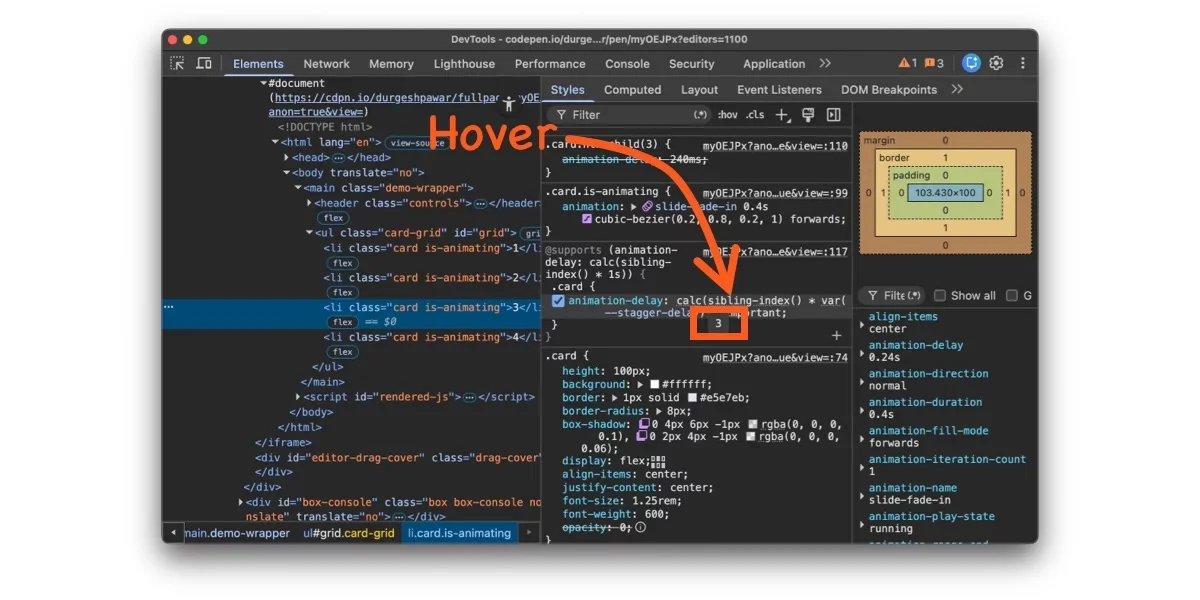
The landscape of front-end development is undergoing a significant shift as the World Wide Web Consortium (W3C) introduces native tree-counting functions to the Cascading Style Sheets (CSS) specification. With the arrival of sibling-index() and sibling-count(), developers can now implement complex, staggered animations and dynamic layouts with a single line of code, effectively eliminating the need for verbose preprocessor loops or fragile JavaScript workarounds. These functions, which have recently reached stable status in several major browsers, represent a fundamental change in how CSS interacts with the Document Object Model (DOM) tree.
The Historical Challenge of Staggered Layouts
For over a decade, web designers seeking to create "staggered" effects—where elements in a grid or list appear sequentially rather than simultaneously—faced a binary choice between inefficiency and complexity. The most common approach involved using CSS preprocessors like Sass to generate a series of :nth-child() selectors. For a list of ten items, a developer would write a loop that produced ten distinct rules, each assigning a unique --index variable to a specific child. While functional, this method lacked scalability; if a list grew beyond the hardcoded limit, the animation would fail for subsequent items.
Alternatively, developers turned to JavaScript to inject inline styles. By looping through a collection of DOM nodes and setting an index variable (e.g., element.style.setProperty('--index', i)), engineers could achieve dynamic staggering. However, this approach introduced a "layout concern" into the scripting layer, often leading to maintenance challenges where CSS dependencies were obscured from developers refactoring the component logic. Furthermore, the reliance on JavaScript added overhead, requiring the browser to wait for script execution before the final visual state could be rendered.
The core of the frustration lay in a data gap: the browser’s rendering engine already possessed the necessary information regarding an element’s position within the DOM, yet CSS had no mechanism to query that data. The introduction of sibling-index() and sibling-count() bridges this gap, allowing the stylesheet to access the browser’s internal tree-counting logic directly.
Technical Specifications and Implementation
Part of the CSS Values and Units Module Level 5, specifically Section 9, sibling-index() and sibling-count() are designed to return an <integer> value. Unlike the counter() function, which returns a string typically reserved for the content property of pseudo-elements, these new functions provide raw numbers that can be utilized within calc(), min(), max(), and other mathematical functions.
sibling-index() returns the index of the current element among its siblings, starting from 1. sibling-count(), conversely, returns the total number of sibling elements within the same parent container. Because these functions resolve to integers, they allow for sophisticated type coercion within the CSS engine. For instance, multiplying sibling-index() by a time unit (e.g., 100ms) automatically results in a valid <time> value, which can be applied directly to animation-delay or transition-delay properties.
This functionality marks a departure from the role of :nth-child(). While :nth-child() serves as a selector to target specific elements, sibling-index() serves as a value provider within a declaration. The industry consensus, as reflected in the CSS Working Group (CSSWG) discussions under Issue #4559, was that CSS required a way to utilize an element’s position as a variable rather than just a targeting mechanism.
Practical Applications in Mathematical Layouts
The introduction of these functions enables several high-impact design patterns that previously required significant effort:
- Reverse Staggering: By subtracting the current index from the total count—
calc((sibling-count() - sibling-index()) * 80ms)—developers can ensure that the last item in a list animates first. This is particularly useful for exit animations or layouts where the "focal point" is at the end of a sequence. - Proportional Widths: In navigation bars or tab systems,
sibling-count()allows for automatic distribution of space. Setting a width tocalc(100% / sibling-count())ensures that five tabs occupy 20% each, while six tabs automatically adjust to 16.66%, all without media queries or resize observers. - Hue and Color Distribution: Utilizing the HSL (Hue, Saturation, Lightness) color model, designers can spread colors evenly across the color wheel. By calculating the hue as
calc((360deg / sibling-count()) * sibling-index()), a dynamic list will always maintain a balanced color palette, regardless of how many items are added or removed. - Advanced Radial Layouts: Combined with native CSS trigonometric functions like
sin()andcos(),sibling-index()facilitates the creation of complex geometric arrangements. Elements can be positioned in a perfect circle or octagon by calculating their coordinates based on their index relative to the total count, effectively moving coordinate geometry from JavaScript into pure CSS.
Browser Support and Industry Adoption
As of mid-2025, the adoption of these functions has reached a critical mass. Chrome and Edge (version 138+) and Safari (version 26.2+) have shipped full support for sibling-index() and sibling-count(). Together, these browsers represent approximately 75% to 80% of the global market share.
Mozilla’s Firefox has signaled a positive position regarding the specification, with active development tracked under Bugzilla issue #1953973. While not yet available in the stable release of Firefox, the feature is anticipated to land in upcoming versions, bringing the web closer to full "Baseline" support.
For current production environments, the industry standard is to use the @supports rule for progressive enhancement. This allows developers to provide a static fallback for older browsers while delivering the dynamic, mathematically-driven layout to users on modern platforms. Unlike JavaScript polyfills, which can be heavy and performance-draining, the @supports approach ensures that the core functionality remains intact even if the advanced styling is unavailable.
Performance and Scaling Considerations
A critical aspect of the new functions is their performance profile. Because sibling-index() and sibling-count() are handled during the CSS cascade phase—before the layout and paint stages—they are generally more efficient than JavaScript-based DOM manipulation. The browser’s engine is optimized to track tree changes and update these values accordingly.
However, engineers must remain cognizant of the "recalculation cost" at scale. When an element is inserted at the beginning of a large container (e.g., 10,000 nodes), the browser must recalculate the sibling index for every subsequent element. While this is negligible for standard UI components like grids and navigation menus, it can become a bottleneck for highly dynamic, data-heavy applications such as infinite-scroll feeds or live financial tickers. In such specialized cases, experts suggest that JavaScript-managed virtualization may still be the preferred method to maintain peak performance.

Accessibility and Semantic Integrity
While the visual capabilities of sibling-index() are extensive, industry experts caution against overlooking accessibility standards. These functions are strictly visual; they do not alter the underlying DOM order or the accessibility tree.
If a developer uses sibling-index() math to visually reorder items—for example, using the order property in a Flexbox layout—the screen reader will still read the items in their original source order. Similarly, keyboard navigation (Tab order) will follow the DOM structure rather than the visual layout. To maintain compliance with Web Content Accessibility Guidelines (WCAG), any visual reordering that conveys meaning must be mirrored in the ARIA attributes, specifically aria-posinset and aria-setsize. Currently, there is no native CSS-to-ARIA synchronization, meaning JavaScript remains necessary for ensuring that assistive technologies accurately reflect the visual state.
Chronology of Development
The path to these functions began with the realization that CSS was falling behind the dynamic needs of modern web applications.
- 2020: CSSWG Issue #4559 was opened to discuss the need for a native index function.
- 2022-2023: The proposal was refined to include both
sibling-index()andsibling-count()to handle both relative positioning and total volume. - Late 2023: The functions were formally added to the CSS Values and Units Module Level 5 draft.
- June 2025: Major browser vendors began shipping stable implementations, marking the beginning of widespread adoption.
Future Outlook and Planned Extensions
The W3C is already looking toward the next iteration of tree-counting functions. A planned extension, documented in CSSWG Issue #9572, proposes an of <selector> argument for these functions. This would allow developers to count only siblings that match a specific class or attribute—for instance, sibling-index(of .active). This would provide even greater control for filtered lists and complex UI states where only a subset of elements is relevant to the layout calculation.
Additionally, proposals for children-count() and descendant-count() are under review. These would provide "vertical" data, allowing a parent element to know how many children or recursive descendants it contains. When combined with the "horizontal" data of sibling-index(), CSS will eventually possess a complete mathematical understanding of the DOM tree, effectively ending the era of hardcoded layouts.
The introduction of these functions represents more than just a convenience for developers; it is a fundamental shift toward a more intelligent, responsive, and mathematically sound styling language. As browser support continues to expand, the reliance on external scripts for basic layout logic is expected to diminish, leading to faster, more maintainable, and more robust web experiences.

