
A new wave of digital disillusionment has swept across the generation of twentysomethings, who find themselves increasingly weary of the superficiality and endless swiping endemic to mainstream dating applications like Tinder and Hinge. This widespread "swipe fatigue" and "dating app burnout" has created fertile ground for innovative solutions, even those leveraging artificial intelligence, to re-engineer the path to genuine human connection. At the forefront of this burgeoning movement are Ditto co-founders Allen Wang and Eric Liu, who, after a strategic departure from their studies at UC Berkeley, embarked on a mission to construct a dating service that liberates their peers from the monotonous grind of traditional apps. Their vision: a streamlined, AI-powered system designed to facilitate real-life connections without the weekly investment of countless hours in digital navigation and superficial banter.
The Genesis of Ditto: Addressing a Generational Vexation
The frustration with existing dating paradigms is palpable among Gen Z. As Allen Wang articulated to TechCrunch, "As Gen Z ourselves, we were firsthand witnessing the behavioral shift in terms of how people are connecting with each other. We see that people are getting super tired of all the endless swiping and endless small talk, and they’re really looking for something more genuine in real life." This sentiment resonates deeply within a demographic that has grown up immersed in digital interactions yet craves authenticity that often feels elusive in the curated, performance-driven environments of social media and dating apps. The promise of endless options has paradoxically led to decision paralysis and a perceived decline in the quality of interactions. Users report feeling commodified, judged solely on a few photos and a terse bio, leading to a cycle of fleeting conversations and ghosting that undermines the very purpose of seeking connection.
This growing discontent is not unique to Ditto’s founders. The dating app industry itself is recognizing the shift. Reports indicate that even established players like Tinder are exploring AI to combat swipe fatigue, while other ventures, such as the new AI dating service founded by the creator of Hinge, are emerging to cater to this evolving user demand. The market is ripe for disruption, and Ditto aims to be a significant player by offering a fundamentally different approach.
A Novel Approach to Connection: The Ditto User Experience
Breaking from the conventional app-based model, Ditto introduces a unique, text-centric onboarding and matching process. Prospective users, currently limited to college students, initiate their journey by texting a specific iMessage number along with a unique code. Upon doing so, they are greeted by an AI chatbot that introduces itself as "Ditto," a "dating initiative built by college students who get it… no swiping, no awkward DMs, just real dates every Wednesday at 7 pm." This direct, no-nonsense promise immediately signals a departure from the norms of digital dating, emphasizing efficiency and tangible outcomes.
The onboarding process is conversational, guided entirely through text messages. Users provide fundamental biographical details such as their name, gender, and birth date. The AI then delves into more nuanced inquiries, probing personality traits, specific interests, and intricate dating preferences. In a testament to the depth of insight the AI seeks, some users even upload images of their celebrity crushes, offering a visual shorthand for their aesthetic and personality "type," allowing the algorithm to build a more comprehensive profile beyond simple checkboxes.
The Science of Connection: Ditto’s Algorithmic Philosophy
Central to Ditto’s innovation is its sophisticated matching algorithm, which eschews the simplistic pairing of similar hobbies and interests. Instead, it endeavors to uncover the deeper psychological drivers and underlying personality traits that these activities reveal. Wang elucidated this philosophy with an illustrative example: "If there’s this guy, and he’s really into rock climbing, skydiving, and outdoor sports, and this girl, if she’s into hip hop, streetwear, and skateboarding, then even though those hobbies don’t look similar on the surface, I can tell you deeper down, both are very adventurous; maybe they’re very individualistic. So that’s actually the core reason why people will find chemistry with each other, and so basically our claim is that chemistry is actually predictable with the right signals."

This approach posits that true compatibility stems not from superficial commonalities but from shared values, temperaments, and life philosophies. By analyzing the "why" behind preferences, Ditto aims to foster genuine chemistry, believing it can be predicted and facilitated through intelligent data analysis. This is a significant shift from the keyword-matching and demographic-based algorithms that have dominated the dating app landscape for years, often leading to matches that look good on paper but lack real-world spark.
The Ritual of the Date: Wednesday at 7 PM
The culmination of Ditto’s process is a weekly, pre-arranged date. Every Wednesday at 7 p.m., users receive a message from Ditto detailing their match for the week. This message includes not only the person’s identity but also the precise time and location for their rendezvous. The directive is straightforward: "It comes with the person, it comes with a time, it comes with a location, and the users simply just need to show up and date each other and come back." This system drastically reduces the decision fatigue, planning anxieties, and endless back-and-forth messaging that often plague early-stage dating app interactions.
Following the date, Ditto collects feedback from both parties, which is then fed back into the AI to refine its understanding of each user and improve future matches. Wang emphasized the practical benefits: "Right now people’s goal is really just to go out there and meet each other, so it’s actually removing a lot of friction for our users, so that we are doing the heavy lifting for them, and they just simply go there and then meet whoever." This focus on removing barriers to real-life interaction is a core tenet of Ditto’s appeal, aiming to bridge the gap between digital discovery and tangible connection.
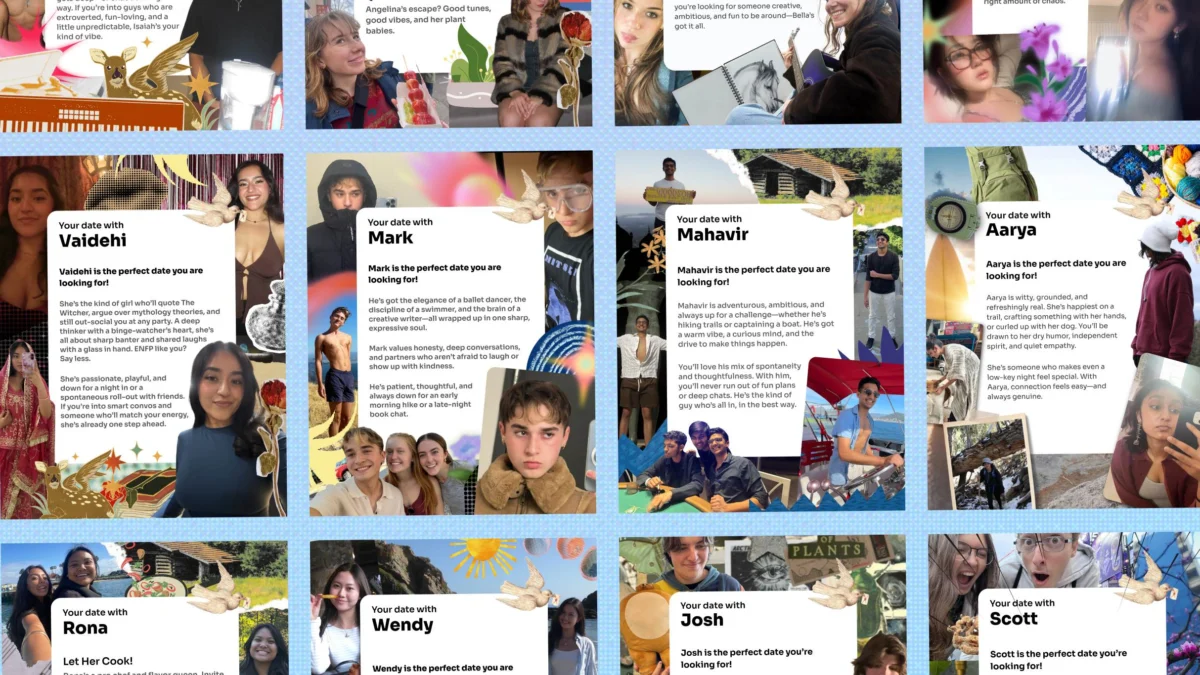
To introduce matches, Ditto utilizes a collage-like graphic, a visual aesthetic that resonates strongly with Gen Z and is increasingly adopted by other connection apps with young founders, such as Sonder. This artistic, personalized presentation helps frame the match not just as a data point but as a potential human connection, enhancing the user experience.
Rapid Growth and Significant Investment
Despite its relatively nascent stage, Ditto has demonstrated remarkable traction. The platform boasts an impressive 150,000 sign-ups, primarily within college communities. While a 20% conversion rate—meaning 20% of matches actually result in a date—might appear modest at first glance, Wang points out that in the context of mainstream dating apps like Tinder, where the ratio of matches to actual dates can be significantly lower due to endless swiping and minimal follow-through, Ditto’s figure is quite robust and indicative of serious intent from its users.
This promising early performance has attracted substantial investor interest, culminating in a significant $9.2 million in seed funding. This capital infusion comes from prominent investors including Gradient, Peak XV, and Scribble, underscoring the market’s belief in Ditto’s potential to disrupt the dating landscape. The founders noted that the majority of this investment was inbound, a testament to the buzz Ditto has generated. "99% of the investors just reached out to us through inbound, because we were pretty big on LinkedIn and Twitter for a bit," Wang revealed. Even high-profile figures like Severin Hacker, co-founder of Duolingo, took notice, reaching out to express admiration for Ditto’s mission and initiate discussions. This level of organic interest from the investment community highlights the acute need Ditto is addressing and the perceived strength of its innovative solution.
Irreverent Marketing: A Strategy for Gen Z Engagement
Ditto’s rapid ascent and investor appeal are not solely due to its product innovation but also its distinctive and often irreverent marketing strategy. The company has gained notoriety for viral campaigns, including engaging "robot stunts" captured in videos that have circulated widely on platforms like TikTok. This unconventional approach aims to capture the attention of a demographic that is highly attuned to authenticity and quickly dismisses traditional, corporate-driven advertising.

Wang articulates the rationale behind this strategy: "Our users are college students, and they can smell corporate marketing from a mile away." He further clarifies the dual objective: "But the stunts are the top of the funnel, not the product… Viral moments get college kids to look; a good first date is what makes them stay." This nuanced understanding of Gen Z engagement—where playful, attention-grabbing content serves as an entry point, but the core product delivers on the promise of genuine connection—is a key factor in Ditto’s success in building brand recognition and attracting users. The company, now based in San Francisco with 12 full-time employees, is even hiring a "chief yacht officer" to organize promotional parties, a testament to its commitment to experiential and unconventional marketing that resonates with its target audience.
Challenges and the Path Forward: Safety and Scalability
As with any dating platform, and particularly one that streamlines the process from match to in-person meeting, safety is a paramount concern. The inherent challenge lies in verifying identities and ensuring the security of users, especially when minimizing the typical pre-date digital interaction. Currently, Ditto mitigates some of these risks by operating exclusively within university environments, where a built-in vetting process exists through the requirement of a .edu email address. This ensures that users are, at minimum, verified students at their respective institutions.
However, Ditto’s ambition extends beyond college campuses. The company is actively strategizing how to expand to more schools and eventually beyond the university ecosystem while maintaining robust safety protocols. This scaling endeavor presents a significant hurdle, one that even the most established and well-funded dating apps continue to grapple with. Questions surrounding comprehensive identity verification, background checks, and effective reporting mechanisms will become increasingly critical as Ditto seeks broader adoption. The $9.2 million in seed funding provides a crucial runway to invest in these safety infrastructures and research solutions that can scale effectively without compromising user trust.
Beyond safety, the technological and logistical challenges of scaling an AI-driven matchmaking service are considerable. Maintaining the quality of matches, refining the algorithm with exponentially more data, and managing the operational complexities of arranging thousands of dates weekly will test Ditto’s infrastructure and team. The integration of user feedback into an continuously learning AI system is promising, but the nuances of human attraction and interaction remain incredibly complex to model.
Broader Implications: The Future of Romance in an AI-Driven World
Ditto represents more than just another dating app; it embodies a potential paradigm shift in how individuals seek and form romantic relationships in the digital age. Its emphasis on curated, pre-arranged, real-life dates, rather than endless digital interaction, directly challenges the prevailing model that has often prioritized quantity over quality. This shift could have profound implications for mental well-being, reducing the anxiety and emotional exhaustion associated with modern dating apps.
The success of Ditto could signal a broader acceptance of AI as a legitimate and effective tool for facilitating deeply personal human connections. If chemistry is indeed "predictable with the right signals," as Wang suggests, then AI could move beyond mere recommendation engines to become true architects of connection, fundamentally altering the landscape of social interaction. This could lead to more efficient, less emotionally taxing pathways to partnership, freeing individuals from the "heavy lifting" of dating and allowing them to focus on the experience itself.
However, it also raises philosophical questions about the role of serendipity, personal intuition, and the messy, unpredictable nature of human attraction. Can an algorithm truly capture the ineffable spark that defines genuine chemistry? While Ditto’s approach is designed to increase the likelihood of that spark, the ultimate success will always depend on the individuals showing up and engaging authentically.
In a world increasingly shaped by algorithms, Ditto stands as an intriguing experiment: a blend of cutting-edge artificial intelligence and a return to the foundational desire for real-world, meaningful connection. As it expands its reach and refines its methodology, Ditto will continue to be a significant case study in the evolving intersection of technology and the enduring human quest for love.

