
The Genesis of a Digital Classic
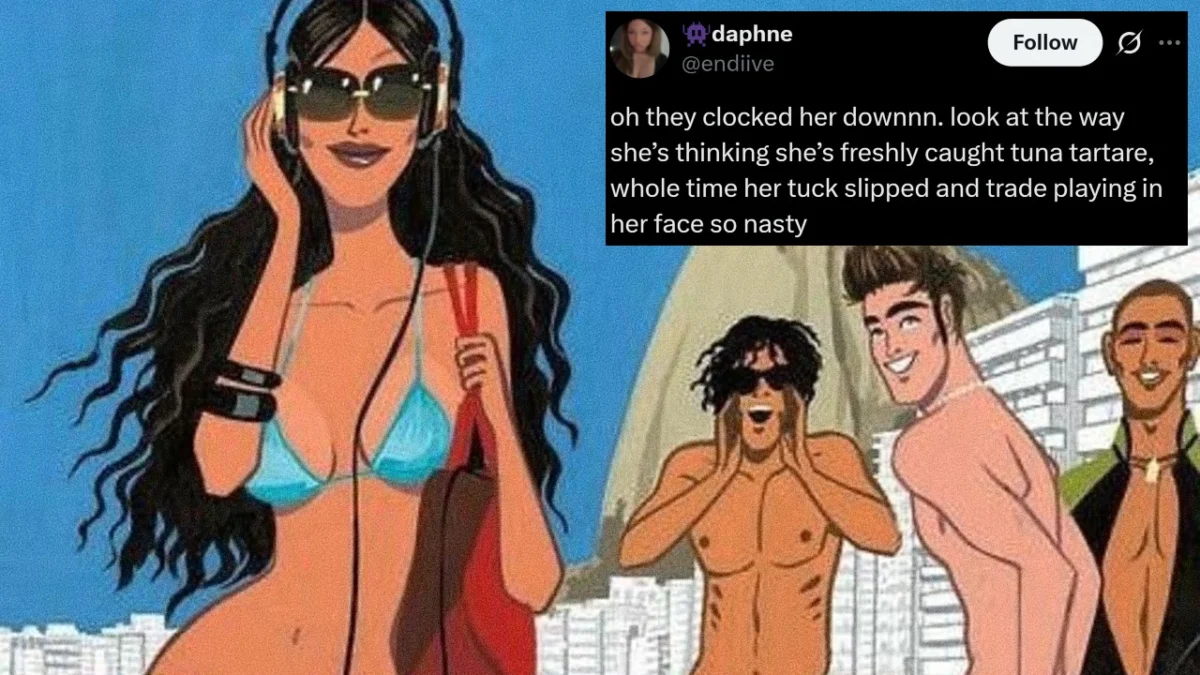
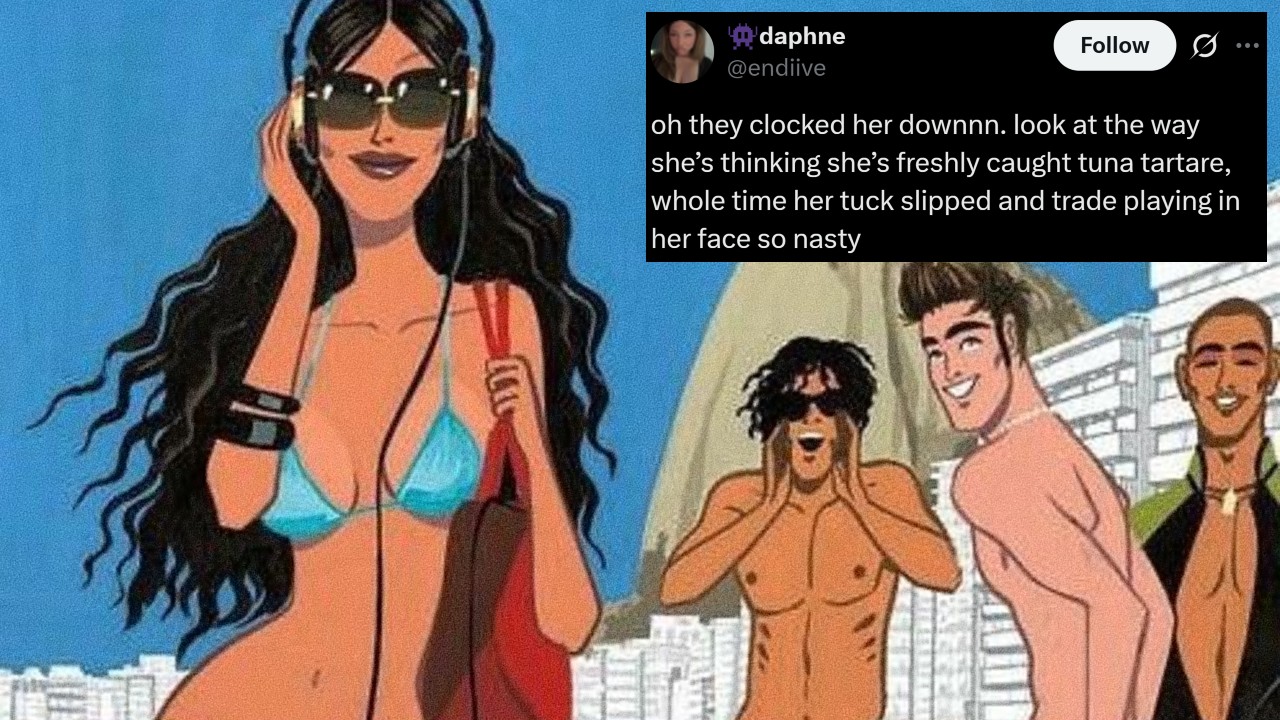
The origin of the meme can be traced precisely to November 16, 2023, when an X user known as @endiive shared a piece of artwork by the renowned British illustrator Jason Brooks. The illustration depicts a woman in a vibrant bikini, wearing headphones and a confident smirk, walking along a beach. In the background, three men in wetsuits are positioned as if they are observing her, with one man appearing to shout or gesture toward her. The artwork itself is characteristic of Brooks’ polished, lifestyle-oriented style, which often evokes themes of luxury, travel, and fashion.
The accompanying caption provided by @endiive read: "oh they clocked her downnn. look at the way she’s thinking she’s freshly caught tuna tartare, whole time her tuck slipped and trade playing in her face so nasty." This specific combination of imagery and text struck a chord with the audience, garnering over 12 million views, 49,000 likes, and 7,200 reposts within a relatively short timeframe. The post’s success was not merely due to its humor but also its dense use of subcultural slang, which required a level of cultural literacy to fully parse, thereby creating an "in-group" dynamic that encouraged sharing and explanation.
Artistic Origins and the Jason Brooks Aesthetic
To understand the meme’s impact, one must consider the source of the imagery. Jason Brooks is a highly influential figure in the world of fashion illustration, credited with pioneering the use of computer-generated imagery in the field during the 1990s. His work has appeared in prestigious publications such as British Vogue, Elle, and Cosmopolitan, and he is well-known for his "Hed Kandi" album covers, which defined a specific era of glamorous, jet-set club culture.
The choice of a Brooks illustration for this meme was particularly effective because his art portrays a world of effortless perfection and high-end aspiration. By overlaying this "perfect" image with a caption about a "tuck slipping"—a reference to a wardrobe malfunction specifically associated with the trans and drag communities—the user created a sharp, comedic contrast between the idealized world of the illustration and the messy, often embarrassing reality of social performance. This juxtaposition is a hallmark of internet humor, where high-culture artifacts are often recontextualized through a low-culture or subcultural lens.
Deciphering the Vernacular: A Linguistic Breakdown
The longevity of the "Oh They Clocked Her Downnn" meme is largely attributed to its linguistic density. The caption utilizes several terms rooted in AAVE and the LGBTQ+ Ballroom scene, each carrying specific connotations:
- Clocked: In this context, to "clock" someone means to see through a facade or to notice something that was intended to be hidden. It is frequently used in trans communities to describe someone being recognized as trans when they are attempting to "pass."
- Tuna Tartare: This metaphor serves as a descriptor for someone who views themselves as high-class, expensive, and refined. Like the dish itself, the person is "freshly caught" and presented as a delicacy.
- Tuck Slipped: A "tuck" refers to the practice of concealing male genitalia to create a flat appearance in tight clothing, common in drag and among trans women. A "slipped" tuck implies a public and embarrassing failure of this concealment.
- Trade: In Ballroom culture, "trade" traditionally refers to a masculine man, often one who identifies as heterosexual, who engages in sexual activity with queer men or trans women.
- Playing in her face: This phrase is used to describe a situation where someone is being openly disrespected, lied to, or mocked to their face, often while they remain unaware or choose to ignore the disrespect.
By weaving these terms together, the original poster created a vivid, if fictional, narrative of a woman who believes she is the height of glamour while those around her are witnessing a humiliating failure and actively mocking her for it.
Chronology of Viral Dissemination
Following the initial post in late 2023, the meme underwent a period of rapid evolution. By early 2024, the text had been decoupled from the original Jason Brooks image and was being applied to various other scenarios, a process known in internet culture as becoming a "copypasta."
In August 2024, the meme began to see cultural adaptations. User @samirakins posted a version that adapted the slang to a Middle Eastern context, replacing "tuna tartare" with "samak kan3ad" and "tuck" with "hijab." This showcased the meme’s flexibility and its ability to be translated across different cultural identities while maintaining its core comedic structure.
By late 2024 and into 2025, the meme had reached "legacy" status. Influencers and celebrities began to engage with the content directly. In October 2024, Ve’ondre Mitchell, a prominent trans influencer and musical artist, posted a high-production recreation of the Jason Brooks illustration on Instagram. This recreation was significant as it brought the meme full circle, with a member of the community from which the slang originated reclaiming the imagery. The post received over 173,000 likes, indicating the meme’s successful transition from a niche Twitter joke to a broader social media phenomenon.
Mainstream Adoption and Celebrity Recreations
The meme’s peak as a tool for celebrity commentary occurred in mid-2026. On June 16, 2026, social media users applied the caption to a real-world event: the 2023 Met Gala. A photo emerged showing singer Kim Petras standing near Anitta and Maluma. In the photograph, Anitta and Maluma appear to be sharing a private laugh while Petras stands nearby. The "Clocked Her Down" caption was applied to this image, suggesting a narrative of exclusion and mockery that mirrored the original Jason Brooks illustration. The post garnered over 11,000 likes and sparked a renewed wave of interest in the meme’s application to celebrity "feuds" and red-carpet dynamics.
Furthering its status as "digital scripture," other users began to document their obsession with the post. On November 29, 2025, user @dirty_dan____ noted that they had "given seminars" on the tweet, a hyperbolic statement that underscores how deeply analyzed and revered the post had become within certain online circles. This sentiment was echoed by others who claimed the tweet was "cemented into the Twitter hall of fame" within just a week of its release.
Broad Impact and Sociological Implications
The "Oh They Clocked Her Downnn" phenomenon offers several insights into modern digital communication. First, it highlights the speed at which subcultural language can be adopted by the mainstream. Terms like "clocked" and "playing in my face" have seen a marked increase in general usage since the meme’s peak, often losing their specific original contexts in favor of a general sense of "calling someone out."
Second, the meme demonstrates the power of "visual-textual synergy." The Jason Brooks image provided a specific "vibe"—one of sun-drenched, early-2000s commercial glamour—that perfectly complemented the sharp, modern wit of the caption. This synergy is what allowed the meme to survive multiple cycles of internet trends.
Finally, the meme serves as an example of how digital communities archive their own history. The frequent references to the post as "scripture" or a "classic" suggest that social media users are increasingly aware of the ephemeral nature of their platforms and are making conscious efforts to canonize specific moments that they feel define the "spirit" of the community.
Conclusion: The Legacy of Tuna Tartare
As of late 2026, "Oh They Clocked Her Downnn" remains a frequently cited reference point in online discourse. It has transcended its origins as a simple joke about a beach illustration to become a versatile linguistic tool used to describe any situation involving perceived delusion, public failure, or social disrespect. Through the lens of this meme, we can observe the ongoing dialogue between art, identity, and the evolving English language in the digital age. Whether used to mock a celebrity’s fashion choice or to narrate a personal mishap, the "tuna tartare" framework continues to provide a rhythmic and cutting way for users to navigate the complexities of social visibility.

