
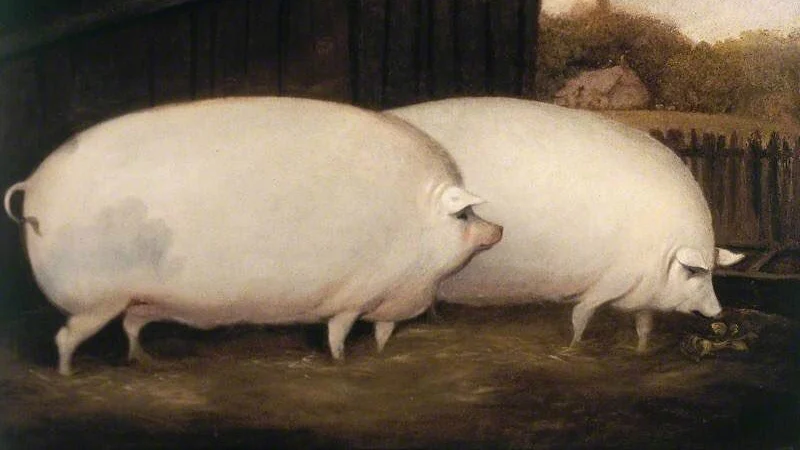
The intersection of 19th-century British agrarian art and 21st-century digital subculture has produced one of the most enduring and surreal examples of internet folklore: the "Brother, May I Have Some Oats" phenomenon. Known colloquially within online communities as "oatposting," this movement centers on a specific oil painting of two domestic pigs, accompanied by a polite yet unsettling plea for sustenance. What began as a singular social media post in late 2016 rapidly evolved into a complex ecosystem of copypasta, video remixes, and linguistic variations that challenge traditional understandings of how historical artifacts are repurposed in the age of the meme.
The Artistic Genesis: A Pair of Pigs (1850)
To understand the cultural resonance of the meme, one must first examine its visual foundation. The image at the heart of the "oatposting" trend is an oil-on-canvas painting titled "A Pair of Pigs," executed in 1850 by an unknown artist. The work is currently housed in the permanent collection of the Compton Verney Art Gallery and Park in Warwickshire, England.
The painting belongs to a specific genre of 19th-century British art known as "livestock portraiture" or "fat stock" paintings. During the Industrial Revolution and the height of the British Agricultural Revolution, wealthy landowners and farmers commissioned artists to depict their livestock. These portraits were rarely intended to be anatomically accurate; instead, they were exercises in hyperbole. Animals were depicted as impossibly large, often rectangular or oval in shape, with tiny legs and heads, to signify the success of the owner’s breeding programs and the quality of their feed.
In "A Pair of Pigs," the two subjects are rendered with a grotesque, almost monumental corpulence. The pig in the foreground appears to be looking toward the viewer (or its companion) with a heavy-lidded, pleading expression, while the pig in the background remains focused on its trough. It is this specific juxtaposition—the perceived emotional depth of the starving or pleading animal against the backdrop of Victorian agricultural pride—that provided the fertile ground for modern reinterpretation.
Chronology of Digital Proliferation
The transition from a gallery wall to digital ubiquity began on October 10, 2016. A Twitter user operating under the handle @markyannna shared the image with the caption "brother may I have some oats." The post struck an immediate chord with the platform’s audience, garnering over 12,400 retweets and 18,000 likes within three months. The humor was derived from the contrast between the formal, archaic address of "brother" and the absurdly large, primitive appearance of the swine.
By October 30, 2016, the meme migrated to Tumblr via user nanalie, whose screenshot of the original tweet generated over 68,000 notes. However, it was the migration to 4chan that transformed the image from a simple "image-macro" into a participatory subculture. On December 31, 2016, an anonymous user on the /s4s/ (Shit 4chan Says) board posted the painting with the refined caption, "Brother dear, would you please pas the oats?"
The meme reached its peak of creativity on the /r9k/ (Robot 9000) board in early January 2017. The /r9k/ board is notable for its "originality script," which prevents users from posting exact duplicates of existing text. This technical constraint forced users to innovate, leading to a linguistic explosion of variations. Users began to experiment with increasingly formal, desperate, or archaic syntax, such as:
- "Brother, I require the oats for my sustenance."
- "Sibling, might I partake in the grain?"
- "I beseech thee, brother, grant me access to the trough."
This period of "oatposting" solidified the meme’s status as a "copypasta"—a block of text that is copied and spread across the internet, often evolving with each iteration.
Multimedia Expansion and Mainstream Recognition
The evolution of "Brother, May I Have Some Oats" continued as it moved into the realm of video and audio-visual media. On January 4, 2017, YouTuber Joe Capo released a video titled "Brother May Have Any Oats." While the original video was eventually removed from the platform, its impact was immediate. The video utilized voice-over work and rudimentary animation to give the pigs a narrative, often depicting the larger pig as a hoarding, cruel sibling who denies the smaller pig any nourishment.

The video was mirrored on the "Difficulty II" Facebook page, where it achieved viral status, amassing nearly 200,000 views and thousands of shares in less than 24 hours. This mainstream exposure moved the meme beyond the insular boards of 4chan and into the broader social media landscape. By January 5, 2017, the meme had been "canonized" on Reddit’s /r/4chan subreddit, where users archived the most creative threads and linguistic variations.
Linguistic and Sociological Analysis
The popularity of "oatposting" can be attributed to several factors that define modern internet humor. First is the concept of "recontextualization." By taking a 166-year-old painting intended to show off agricultural prowess and applying a narrative of sibling rivalry and desperation, internet users created a surrealist comedy that operates on multiple levels.
Linguistically, the meme relies on "Victorian Formalism." The use of "Brother" as a prefix creates a mock-epic tone. This is a common trope in digital humor, where low-brow or absurd subjects are discussed with high-brow vocabulary. The "oats" themselves become a "MacGuffin"—an object of desire that drives the plot, despite its inherent mundanity.
Furthermore, the meme taps into the "grotesque aesthetic." The physical proportions of the pigs in the 1850 painting are inherently unsettling to a modern eye. In the 19th century, these pigs represented wealth; in the 21st century, they represent a kind of body horror or "absolute unit" (a slang term for large objects or animals). The desperation in the phrase "May I have some oats" suggests a power dynamic that resonated with users who often use memes to express feelings of inadequacy or being "left out" of societal benefits.
Institutional and Cultural Impact
The "Brother, May I Have Some Oats" phenomenon represents a unique challenge and opportunity for art institutions. For the Compton Verney Art Gallery, the viral success of "A Pair of Pigs" brought unprecedented digital foot traffic to an otherwise obscure piece of Victorian livestock art. While some traditionalists might view the "meme-ification" of art as a trivialization of history, digital curators argue that it provides a vital link between younger generations and historical archives.
The meme has also sparked a minor resurgence in interest in the "fat stock" genre of painting. Art historians have noted that the "oatposting" trend inadvertently educated thousands of people about the history of British agriculture and the stylistic conventions of the 1850s. It serves as a case study in how digital communities act as amateur archivists, pulling forgotten artifacts from obscurity and giving them a second life in a completely different cultural context.
Broader Implications for Internet Culture
The trajectory of "Brother, May I Have Some Oats" follows a classic pattern of "deep-web" to "mainstream" migration.
- The Discovery Phase: An obscure image is found and posted on a high-velocity platform like Twitter.
- The Refinement Phase: Subcultures (like 4chan) add layers of lore, linguistic rules, and internal logic.
- The Multimedia Phase: The meme is translated into video, music, or 3D animation.
- The Saturation Phase: The meme reaches major platforms like Facebook and Reddit, eventually entering the lexicon of the general public.
Unlike many memes that have a lifespan of only a few weeks, "oatposting" has shown remarkable longevity. This is likely due to the inherent quality of the source image—a painting that remains visually arresting regardless of the text attached to it.
In conclusion, "Brother, May I Have Some Oats" is more than a fleeting joke; it is a testament to the transformative power of the internet. It demonstrates how a nameless artist from 1850 can reach a global audience in 2017 and beyond, unified by a shared sense of the absurd. As long as the digital world continues to find humor in the intersection of the formal and the grotesque, the pigs of Compton Verney will continue to beg for their oats in the hallowed halls of internet history.

