
Once the cornerstone of organic search snippet optimization, meta descriptions are experiencing a significant shift in their influence, prompting a re-evaluation of their necessity for website owners and search engine optimizers. While Google has historically relied on these concise summaries to entice users into clicking search results, the search giant’s algorithms are increasingly prioritizing page content to dynamically generate snippets, leaving many to question the continued value of meticulously crafted meta descriptions.
A Shift in Google’s Snippet Strategy
For years, the meta description tag served as a direct conduit for website owners to influence how their pages appeared in search engine results pages (SERPs). The prevailing wisdom was that a well-written meta description, infused with relevant keywords and compelling calls to action, would significantly impact click-through rates (CTR). This approach was predicated on the idea that search engines would faithfully reproduce these descriptions as the primary text accompanying a search result.
However, this paradigm began to erode as Google’s sophisticated algorithms evolved. The introduction of more advanced natural language processing (NLP) and machine learning capabilities allowed Google to develop a deeper understanding of page content and user search queries. Consequently, Google started to dynamically extract snippet text directly from the body of web pages, aiming to provide the most relevant and contextually accurate information in response to specific user searches. This shift meant that a meta description, even if perfectly optimized, could be bypassed entirely if Google determined that other parts of the page offered a more pertinent answer to the query.
This evolution was not an overnight change but rather a gradual recalibration of Google’s approach to presenting search results. Early indications of this shift could be observed in the late 2010s and early 2020s as search results began to feature more diverse snippet formats, including featured snippets, answer boxes, and dynamically generated descriptions that often bore little resemblance to the page’s meta description. The underlying principle driving this change was Google’s commitment to user experience, aiming to deliver the most direct and helpful answers possible, even if it meant deviating from author-provided summaries.
Official Stance: A Lingering Relevance
Despite the observable trend of Google prioritizing on-page content, the company has maintained that meta descriptions are not entirely obsolete. In official communications, such as Google’s Search Central blog, the company acknowledges their continued, albeit nuanced, role. A statement from Google’s Search Central clarifies: "Google primarily uses the content on the page to automatically determine the appropriate snippet. We may also use descriptive information in the meta description element when it describes the page better than other parts of the content."
This statement underscores a critical point: meta descriptions still hold potential value, particularly when they accurately and compellingly encapsulate the essence of a page’s content. The implication is that a well-crafted meta description can still serve as a strong signal to Google, especially for pages where the core message might be difficult to extract dynamically from the broader content. Google’s guidance further suggests a practical application: "at the very least, create a description for the critical URLs like your home page and popular pages." This recommendation implies a tiered approach to meta description optimization, prioritizing key pages that represent a website’s brand or offer significant user value.
Adding further weight to the continued utility of meta descriptions, Google’s John Mueller, a prominent figure in Google’s Search team, recently offered his perspective. In a discussion on Reddit, Mueller commented on the necessity of meta descriptions, stating, "sometimes it [a meta description] helps you to figure out a clear focus for a page. Overall, I think it’s still worthwhile to do so for individual pages that you care about, but it’s definitely not a requirement." This perspective reinforces the idea that meta descriptions can serve a dual purpose: providing a valuable summary for search engines and aiding website owners in defining and maintaining a clear content strategy for their pages. Mueller’s assertion that it’s "not a requirement" signals a departure from the past, where meta descriptions were a fundamental SEO element, but his endorsement of their value for "pages that you care about" offers a pragmatic roadmap for current SEO efforts.
The Enduring Benefits of Meta Descriptions
The prevailing consensus among many SEO professionals, and supported by the statements from Google itself, is that there is no inherent downside to including meta descriptions. The effort invested in crafting them can yield benefits that extend beyond direct snippet generation. For critical pages—such as homepages, category pages, and product pages—these descriptions can serve as valuable navigational aids for both search engine crawlers and emerging Generative AI (GenAI) platforms.

These high-intent pages often contain complex and multifaceted information, including detailed product specifications, service descriptions, customer reviews, and testimonials. Such rich content can be challenging for automated systems to condense effectively into a concise snippet. In these scenarios, a well-written meta description acts as a clear, author-defined summary, ensuring that the most important aspects of the page are communicated.
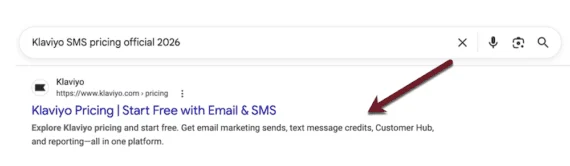
A practical illustration of this can be seen with Klaviyo’s SMS pricing page. The meta description for this page reads: "Explore Klaviyo pricing and start free. Get email marketing sends, text message credits, Customer Hub, and reporting — all in one platform." When a search query like "Klaviyo SMS pricing official 2026" was performed, both Google and ChatGPT utilized this meta description to generate their respective snippets. This example demonstrates that when a meta description is precise, informative, and directly relevant to a user’s search intent, search engines and AI models are likely to leverage it. The accompanying visual evidence from the original article further supports this, showing a Google search result snippet that directly mirrors the meta description text, with an arrow explicitly pointing to it.
Strategic Approaches to Writing Effective Meta Descriptions
The era of keyword stuffing in meta descriptions is long past. Today, the emphasis has shifted towards creating descriptions that are not only informative for search engines but also persuasive and engaging for potential visitors. For product-detail pages and other high-intent pages, a strategic approach to meta description writing is crucial.
While the original article did not specify bullet points for writing meta descriptions, a comprehensive approach would encompass the following key principles:
- Clarity and Conciseness: Aim for descriptions that are between 150-160 characters. This length ensures that the entire description is visible in most SERPs, preventing truncation.
- Relevance to Page Content: The description must accurately reflect the content of the page. Misleading descriptions can lead to high bounce rates and negatively impact user experience signals.
- Inclusion of Primary Keywords: While keyword stuffing is discouraged, incorporating primary keywords naturally within the description can help search engines understand the page’s topic and match it with relevant queries.
- Compelling Call to Action (CTA): Where appropriate, include a subtle CTA that encourages users to click, such as "Learn more," "Shop now," or "Discover."
- Unique Value Proposition: Highlight what makes the page or offering unique. What problem does it solve? What benefit does it offer?
- Audience-Centric Language: Write in a tone and language that resonates with the target audience.
For large-scale websites, particularly those with thousands of products or dynamically generated content, manual creation of every meta description is impractical. In such cases, Google recommends programmatic generation. This can be achieved using advanced GenAI platforms like ChatGPT and Claude, or specialized applications that leverage these technologies. However, the caveat is crucial: "careful prompting" is essential to ensure the quality and accuracy of AI-generated descriptions. Furthermore, a mandatory human review process is indispensable for important pages, those experiencing high traffic, featuring popular products, or contributing significantly to conversions. This human oversight ensures that the AI-generated content meets quality standards and aligns with brand messaging.
Broader Implications in the Age of AI
The ongoing evolution of search engine algorithms and the rise of Generative AI have profound implications for how websites are presented online. Search engines and AI platforms are increasingly focused on delivering snippets and answers that directly assist users. This user-centric approach means that meta descriptions, when they effectively fulfill this purpose, will continue to be utilized.
The example of Klaviyo’s pricing page serves as a microcosm of this trend. The meta description’s effectiveness in being adopted by both Google and ChatGPT highlights the enduring principle: if a meta description accurately and concisely summarizes relevant information, it will likely be used. This suggests that the value of meta descriptions is not diminishing but rather being redefined. They are becoming less of a mandatory SEO checkbox and more of a strategic tool for communication, providing a clear, author-defined narrative for search engines and AI models to leverage when crafting user-facing snippets.
In essence, the landscape of SEO is in constant flux. While the direct control exerted by meta descriptions may have lessened, their role as a descriptive tool and a strategic element in defining a page’s focus remains significant. For website owners aiming to optimize their online presence, understanding this evolving dynamic and strategically employing meta descriptions for critical pages is a worthwhile endeavor, ensuring that their content is accurately represented and effectively communicated to a growing array of search and AI-powered information systems. The ability to influence snippets is now less about dictating them and more about providing clear, compelling information that search and AI can readily utilize to serve user needs.

