
The European Union has finalized the implementation roadmap for its landmark AI Act, establishing a definitive timeline for transparency requirements that will reshape how artificial intelligence is integrated into digital products globally. While recent industry discourse has been marked by concerns regarding "sweeping" regulations and "drastic" penalties, the actual guidelines focus on a specific, pragmatic goal: ensuring that users can distinguish between human-generated and machine-generated content. Starting August 2, 2026, any company operating within the EU or providing services to EU citizens must adhere to strict AI labelling protocols. These rules represent the first comprehensive legal framework of its kind, moving beyond voluntary industry standards to a mandatory compliance model that carries significant financial and operational implications for the technology sector.
The Scope and Mandate of Article 50
The core of the new transparency regime is found in Article 50 of the EU AI Act, which dictates that AI systems must be designed and developed in a way that ensures their outputs are clearly identified as being artificially generated or manipulated. This mandate is not limited to companies headquartered within the European Union. Following the precedent set by the General Data Protection Regulation (GDPR) and the European Accessibility Act (EAA), the AI Act applies to any entity worldwide whose AI-generated output is utilized by people within the EU.
The legal obligations are divided between "providers"—those who develop or supply the AI technology—and "deployers"—the organizations that implement these tools within their own products or services. Licensing an external LLM (Large Language Model) or image generator does not absolve a company of its responsibilities; if the end-user interacts with AI-generated content through a third-party interface, the owner of that interface is legally responsible for the disclosure.

The regulation identifies three primary categories of content that require explicit labelling:
- AI-Generated Media: Any image, audio, or video content that significantly resembles existing persons, objects, places, or events and would falsely appear to a person to be authentic (commonly referred to as deepfakes).
- Public Interest Text: AI-generated text published with the intent to inform the public on matters of public interest, such as political discourse, health, or financial news.
- Interaction Transparency: Systems where users interact with an AI (such as chatbots or virtual assistants) must be identified as such, unless it is obvious from the context.
Chronology of the EU AI Act and Implementation
The path to the 2026 enforcement date has been a multi-year legislative journey, reflecting the rapid evolution of generative AI technologies.

- April 2021: The European Commission proposes the initial framework for the AI Act, focusing primarily on high-risk applications like biometric identification and critical infrastructure.
- June 2023: The European Parliament adopts its negotiating position, introducing new amendments to address the sudden rise of "General Purpose AI" (GPAI) following the public release of ChatGPT.
- December 2023: After intense "trilogue" negotiations, EU member states and the Parliament reach a political agreement on the final text.
- August 1, 2024: The AI Act officially enters into force. This marks the beginning of a staggered implementation period.
- February 2, 2025: Prohibitions on "unacceptable risk" AI (such as social scoring systems) take effect.
- August 2, 2025: Rules for General Purpose AI models and governance requirements become applicable.
- August 2, 2026: The full suite of transparency obligations, including AI labelling for content generators, becomes legally enforceable across all member states.
This timeline provides a two-year "grace period" for designers, developers, and legal teams to audit their current AI implementations and integrate the necessary disclosure mechanisms.
The Technical Challenge: Beyond the Sparkle Icon
One of the most significant shifts introduced by the EU guidelines is the rejection of ambiguous visual signals. For several years, the "sparkle" icon (✨) has served as the de facto industry standard for AI-powered features. However, research from organizations such as the Nielsen Norman Group suggests that these icons are often too vague for the average user, who may interpret them as "new features," "formatting tools," or "premium content" rather than an indication of machine generation.

The European Commission has released a specific set of "EU AI icons" to standardize the visual language of disclosure. These include distinct marks for "Basic AI," "Fully AI-Generated," and "Partially AI-Modified" content. The guidelines emphasize that an icon alone is insufficient for legal compliance. To meet the "clear and distinguishable" standard, disclosures must:
- Be persistent and survive if the content is reshared or downloaded.
- Use plain language labels (e.g., "AI-generated" or "Manually edited with AI").
- Be accessible to assistive technologies, including screen readers.
- Avoid being "buried" in footers, terms of service, or fleeting pop-ups.
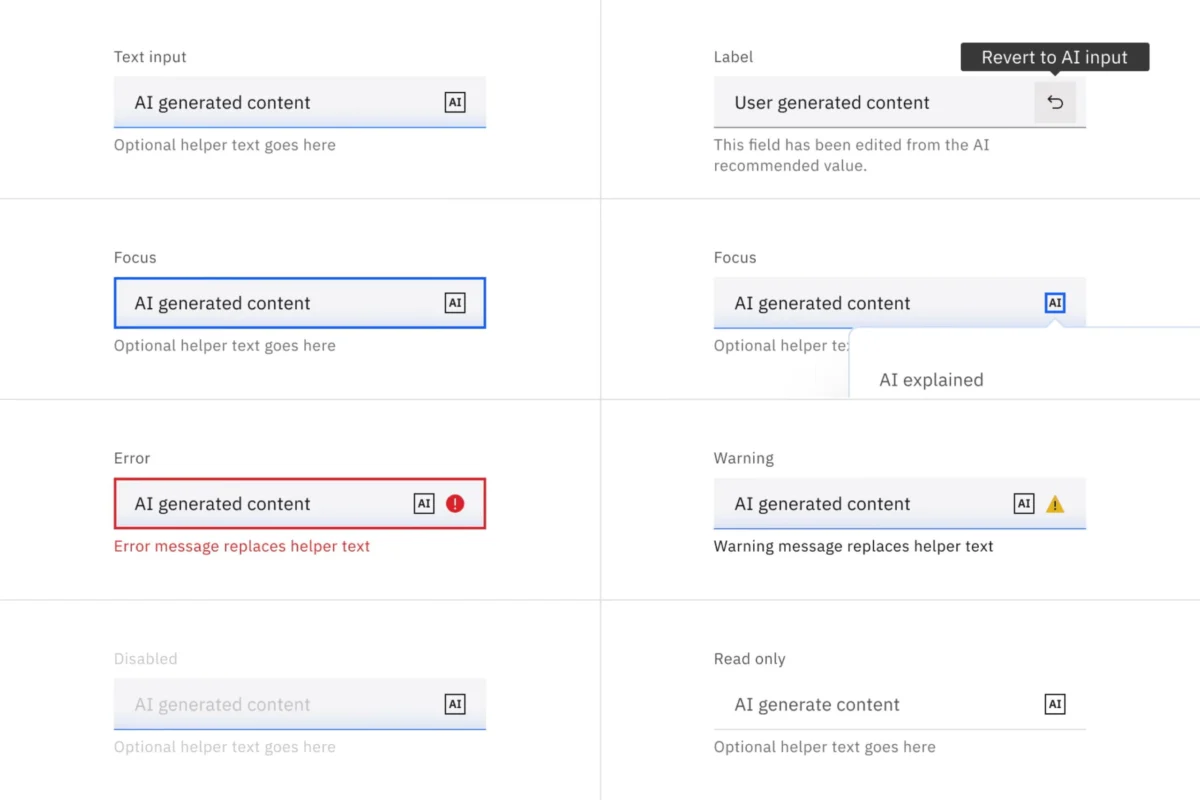
Design systems like IBM’s Carbon have already begun integrating these requirements, offering a blueprint for how complex data dashboards and creative tools can embed AI labels directly into the UI components where the data is displayed.

Defining the "Editorial Responsibility" Exception
A critical nuance in the regulation is the distinction between AI-generated content and AI-assisted content. The EU Commission has clarified that the disclosure obligation does not apply when a human has performed a "substantive" review and taken editorial responsibility for the output.
However, the definition of "substantive" is strict. Minor assistive edits—such as spellchecking, basic grammar correction, formatting, or simple photo cropping—do not remove the requirement for an AI label. Conversely, if a human uses AI to generate a draft but then significantly rewrites the text, alters the narrative structure, and verifies the facts, the resulting work may be considered human-authored for the purposes of the Act.

The Commission is explicit that "skimming" a document before clicking "publish" does not constitute an editorial review. There must be a named person or entity who stands behind the content’s accuracy and intent. This creates a significant operational hurdle for companies using high-volume automated content generation, as the lack of a human-in-the-loop will necessitate permanent AI labelling.
Supporting Data and Economic Impact
The stakes for non-compliance are high, mirroring the aggressive penalty structure of the GDPR. Organizations found in violation of the transparency rules could face:

- Fines of up to €35 million or 7% of the company’s total worldwide annual turnover (whichever is higher) for the most severe violations.
- Fines of up to €15 million or 3% for general non-compliance with the Act’s obligations.
- Fines of up to €7.5 million or 1.5% for providing incorrect or misleading information to regulatory bodies.
Beyond fines, the economic impact includes the "cost of compliance." Industry analysts suggest that large enterprises may need to invest millions in updating their metadata architectures to ensure that AI-generated assets carry persistent watermarks. The C2PA (Coalition for Content Provenance and Authenticity) standard, backed by companies like Adobe and Microsoft, is expected to become the technical backbone for this effort, allowing metadata to be baked into the file headers of images and videos.
Global Context and International Reactions
The EU is not alone in its pursuit of AI transparency, though its approach is currently the most legally rigorous. In the United States, the Biden-Harris Administration’s Executive Order 14110 on Safe, Secure, and Trustworthy AI directed the Department of Commerce to develop guidance for content authentication and watermarking. At the state level, California has moved faster, with bills such as SB 1047 and AB 2839 targeting deepfakes in elections and requiring "provenance data" for high-compute AI models.

China has also implemented its own "Administrative Provisions on Deep Synthesis," which require providers to apply conspicuous labels to any service that can "substantially edit" video or audio content. The emergence of these various regional laws suggests a global convergence toward a "transparency-first" AI economy.
Tech industry reactions have been mixed. While some developers argue that excessive labelling could lead to "transparency fatigue"—where users ignore labels due to overexposure—others, such as the Center for Humane Technology, argue that these rules are essential for maintaining the "information integrity" of the internet. They suggest that without clear labelling, the web will be flooded with "AI slop," making it impossible for citizens to participate in informed democratic processes.

Implications for Design and Development
For product teams, the 2026 deadline necessitates a shift in the design process. AI is no longer a hidden "magic" layer; it must be a visible part of the user interface. This requires:
- Provenance Audits: Mapping out every point in a product where AI is used to generate text, images, or data.
- UI Integration: Designing labels that are informative without being intrusive, ensuring they don’t break the user experience while remaining legally compliant.
- Metadata Strategy: Implementing technical solutions like digital watermarking that remain attached to the content even when it is copied to other platforms.
- Legal and Editorial Workflows: Establishing clear chains of command for human-in-the-loop reviews to determine when a label can be legally omitted.
The EU AI Act’s transparency rules are not merely a hurdle for legal departments; they are a fundamental shift in the social contract between technology providers and users. By mandating that machine-generated content be identifiable, the EU is betting that transparency will foster greater trust in AI systems. As the 2026 deadline approaches, the global tech industry will likely look to the "Brussels Effect" once again, as European standards become the default setting for the digital world. The transition from the ambiguous "sparkle" to the clear "AI-generated" label marks the end of AI’s "wild west" era and the beginning of a more regulated, accountable synthetic media landscape.

