
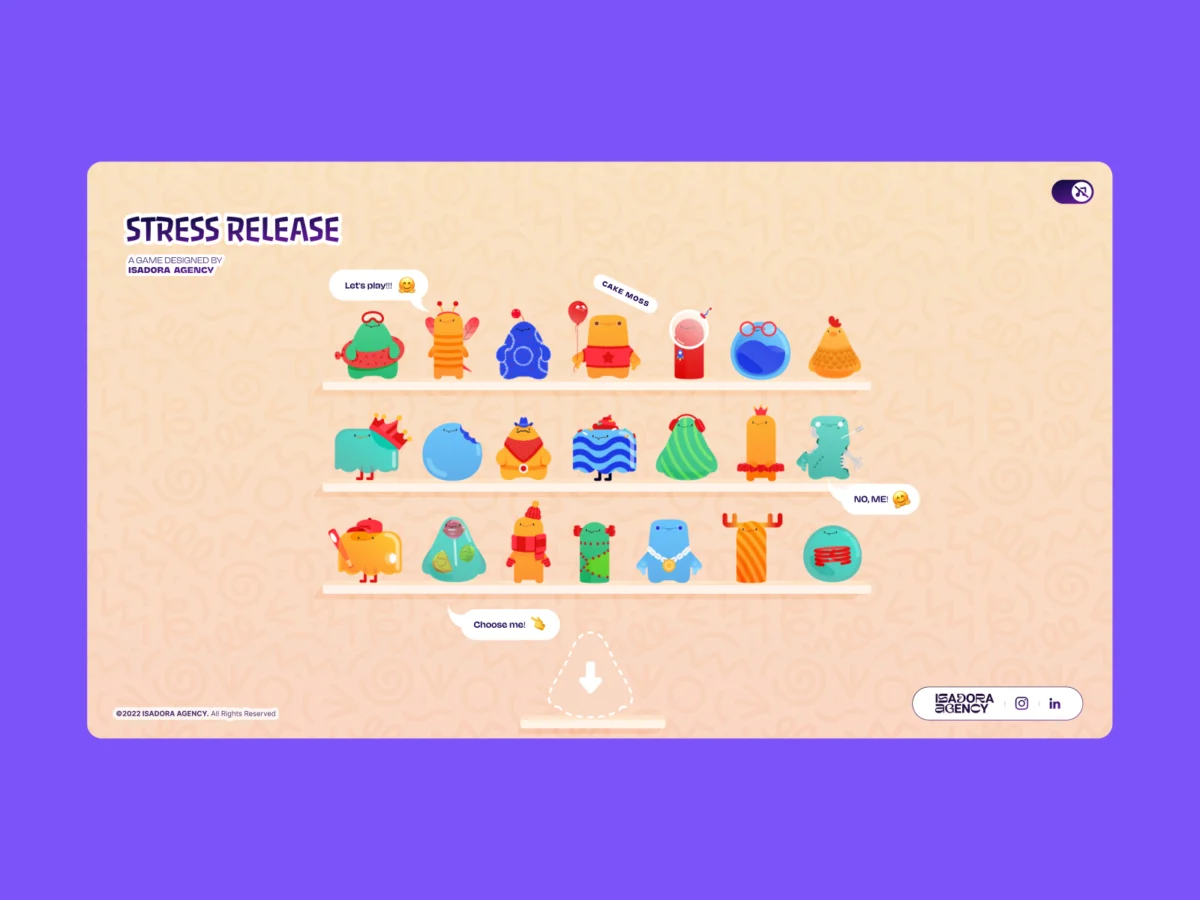
The landscape of interactive web design is currently undergoing a shift from generic physics-based simulations to highly curated, "intentional" motion. When the creative team at Isadora Agency was tasked with developing Stress Release—a digital stress-relief application featuring a cast of squishable, stretchable characters—they faced a fundamental architectural crossroads. While the industry standard for tactile web experiences typically involves physics engines like Matter.js or Cannon.js, the agency’s lead front-end developer, Alexey Kopytin, determined that these tools were insufficient for capturing the bespoke, frame-perfect artistry required for the project. By bypassing traditional physics engines in favor of programmatic Lottie state controls, DOM manipulation, and distance-based mathematics, the team has established a new blueprint for design-led engineering.
The Evolution of Tactile Web Interfaces
In recent years, the demand for "squishy" or "tactile" user interfaces has grown, driven by a desire to make digital experiences feel more human and less clinical. For years, frameworks such as WebGL and physics libraries like Matter.js have been the gold standard. These engines allow developers to assign properties like mass, friction, and restitution to objects, allowing them to bounce and collide in a way that mimics the real world. However, as Kopytin explains, physics engines produce "plausible motion," which is often at odds with "intentional motion."
In the case of Stress Release, the goal was not to create a realistic simulation of rubber balls. Instead, the team needed to bring to life characters with distinct personalities and specific, designer-mandated reactions. A physics engine calculates movement on the fly, leading to unpredictable results that can occasionally break the visual "character" of an animation. By utilizing Lottie—a mobile library for Web and iOS that parses Adobe After Effects animations exported as JSON with Bodymovin—the developers were able to ensure that every squish and every bounce was exactly as the animators intended, frame by frame.
The Chronology of Development: From Physics to Programmatic Control
The development of Stress Release followed a rigorous timeline that began with a search for the most efficient way to handle complex vector interactions.
- Phase One: Prototyping with Physics Engines. Initially, the team explored Matter.js. While the library provided immediate "bounciness," it lacked the granular control required for the complex, multi-stage reactions of the characters. The motion felt too "procedural" and lacked the charm of the hand-crafted animations.
- Phase Two: The Pivot to Lottie. The team decided to move all character logic into Lottie. This required a paradigm shift: instead of letting an engine decide how a character should react to a click, the developers would map user input directly to specific frame ranges within a pre-rendered JSON file.
- Phase Three: Implementing Radial Input Mapping. To make the characters feel responsive, the team developed a mathematical layer to handle hit detection. By using the Pythagorean theorem to calculate the distance between a click and the center of the character, they created a "concentric zone" scoring and reaction system.
- Phase Four: Optimization and Mobile Refinement. The final stage involved optimizing the heavy Lottie files for mobile performance, ensuring that dozens of animations could run simultaneously on the "Character Shelf" without causing frame rate drops.
Technical Mechanics: The Mathematics of the "Squeeze"
The core of the Stress Release experience lies in its hit-detection logic. Unlike traditional game development, which might use complex hitboxes or raycasting, Kopytin’s team utilized simple, elegant geometry. By treating each character as a circular target, they were able to use the character’s local coordinate space to determine the intensity of a user’s interaction.

The process begins by capturing the (X, Y) coordinates of a click or tap relative to the character’s top-left corner. This is then translated into a vector from the character’s center point. Using the formula Math.hypot(a, b), the system calculates the straight-line distance from the center. This single integer then drives three critical components of the UX:
- Scoring: Clicks closer to the center (the "bullseye") yield higher point rewards.
- Visual Feedback: The coordinates (a, b) are used to reposition a secondary "explosion" Lottie animation, ensuring the visual impact occurs exactly where the user touched the screen.
- State Selection: The distance determines which animation segment is triggered, allowing for "light," "medium," or "heavy" reactions.
This architectural choice highlights a significant benefit: the visual complexity of the character does not impact the performance of the hit detection. Whether the character is a simple circle or a complex, multi-limbed creature, the math remains the same, providing a consistent and performant experience across all devices.
Performance Data and Mobile Optimization Strategies
One of the primary challenges of using Lottie in a high-intensity interactive environment is the potential impact on CPU and memory. Lottie files are essentially massive JSON objects that the browser must parse and render as SVGs in real-time. In the Stress Release application, the "Character Shelf" displays 21 different animated characters simultaneously, which presented a significant performance hurdle.

To maintain a fluid 60 frames-per-second (FPS) experience, the team implemented several aggressive optimization techniques. First, they utilized lottie.setQuality() to manage the interpolation calculations. On the shelf screen, where animations are smaller and less central, the quality was reduced to 50%. Additionally, the playback speed was lowered to 60% to reduce the number of frame calculations required per second.
Conversely, on the "Play Screen"—where the user interacts with a single, focused character—the quality was set to 100%. This dynamic resource allocation ensured that the most critical part of the user experience received the most processing power, while background elements were throttled to save battery and memory on mobile devices.
Official Responses and Industry Implications
Industry experts have noted that the approach taken by Isadora Agency reflects a growing trend toward "Design-Driven Engineering." By prioritizing the animator’s vision over the engine’s simulation, the agency has demonstrated that high-fidelity UX does not always require the most complex technology stack.

"When building a web interface that needs to feel tactile, the instinct is to reach for a physics engine," says Alexey Kopytin. "But we realized that physics engines produce plausible motion, whereas our animators produced intentional motion. We didn’t need realistic rubber balls; we needed characters that reacted in specific, highly designed ways."
This sentiment is echoed by UX researchers who argue that "deterministic" interactions—where a specific action always leads to a specific, high-quality visual result—are often more satisfying for users than "emergent" interactions, which can sometimes feel glitchy or unpolished. The success of Stress Release suggests that for branded experiences and gamified marketing, the control offered by Lottie and DOM-based math may be superior to the randomness of physics simulations.
Broader Impact: The Future of SVG and Lottie in Web Development
The architectural rationale behind Stress Release has broader implications for the future of front-end development. As browsers become more capable of handling complex SVG manipulations, the need for heavy WebGL wrappers may decrease for certain types of interactive content.

Furthermore, the use of CSS variables for responsive scaling—as seen in this project—provides a much simpler path to cross-device compatibility. By recalculating CSS custom properties on every window resize, the Isadora Agency team ensured that their animations scaled naturally without the need for complex bounding-box recalculations. This "DOM-first" approach allows for a more seamless integration of interactive elements with traditional web layouts, making it easier for developers to build "gamified" components into standard websites.
In conclusion, the development of Stress Release serves as a case study in the importance of aligning technology with art direction. By rejecting the "gold standard" of physics engines in favor of a math-driven Lottie implementation, the team at Isadora Agency was able to honor the intentional design of their animators while delivering a high-performance, tactile experience. This methodology provides a compelling alternative for developers looking to create immersive web interfaces that prioritize visual storytelling and deterministic control over algorithmic simulation. As the industry continues to evolve, the lessons learned from this project will likely influence a new generation of interactive web experiences that value the "hand-crafted" feel of intentional motion.

