
To address this persistent challenge, a new category of "autonomous websites" is emerging, driven by agentic artificial intelligence. These systems are designed to go beyond simple content management; they are built to continuously optimize, repair, and update themselves without constant human intervention. However, as industry veterans like Pierre Burgy, co-founder of the autonomous website platform Fimo, have discovered, the transition to full autonomy is hindered less by technical limitations and more by a fundamental human desire for control over brand identity and creative judgment.
The Chronology of Web Infrastructure: From Static Files to Agentic Systems
The evolution of the web has been defined by the shifting balance between ease of use and technical flexibility. To understand the current move toward autonomous sites, it is necessary to examine the timeline of web infrastructure:
- The Static Era (1990s–Early 2000s): Websites were collections of manually coded HTML files. Updates required direct file manipulation, leading to high barriers to entry for non-technical users.
- The CMS Revolution (2003–2010s): The rise of platforms like WordPress and Drupal democratized the web. Content could be updated via a graphical user interface (GUI), but the underlying theme and technical maintenance remained manual and prone to "plugin bloat."
- The Headless and Decoupled Era (2015–Present): Developers separated the front-end presentation from the back-end data, using tools like Strapi or Contentful. This allowed for better performance but increased the complexity of maintaining consistency across multiple platforms.
- The Agentic Era (2024–Future): Autonomous websites use specialized AI agents to monitor the site’s health, performance, and compliance in real-time, making changes based on predefined rules or learned behaviors.
While the Headless era solved many scalability issues, it did not solve the problem of human bandwidth. Even with the best tools, a website remains a "frozen" entity until a human developer or editor decides to change it. Autonomous agents represent the first attempt to make the website a living organism that reacts to its environment.
Data-Driven Analysis of Website Decay
The necessity for autonomy is underscored by the quantifiable rate at which websites degrade. Industry data suggests that the average lifespan of a website’s design is between two and three years. However, the technical decay happens much faster:
- Link Rot: Research indicates that approximately 25% of deep-link URLs disappear or break within the first two years of a site’s life.
- Performance Degradation: Without regular optimization, page load speeds typically decrease by 5–10% annually as unoptimized images are uploaded and scripts accumulate.
- Accessibility Compliance: As the Web Content Accessibility Guidelines (WCAG) are updated, older sites frequently fall out of compliance. A 2023 study of the top 1 million homepages found that 96.3% had detectable WCAG 2 failures.
- Security Vulnerabilities: In manual systems, the average time to patch a known vulnerability in a website plugin is often measured in weeks, leaving a window of exposure.
Autonomous agents target these specific data points. By automating the "chores" of web maintenance—compressing images, fixing broken links, and ensuring ARIA labels are present—an autonomous system can maintain a site at 100% of its launch-day performance indefinitely.
The Conflict of Autonomy: The Human-Agent Boundary
The primary obstacle to the adoption of autonomous websites is a psychological and organizational one. In testing the Fimo platform, developers observed a recurring pattern: when presented with a system capable of managing a site entirely on its own, stakeholders hesitated. This hesitation was not rooted in a lack of trust in the AI’s technical capability, but in the realization that a website is a multi-stakeholder asset with no single "owner."
The work required to maintain a website can be categorized into three distinct layers, each requiring a different level of human oversight:
1. Rule-Bound Maintenance (The "No-Brainer" Layer)
This layer accounts for approximately 80% of the total maintenance workload. It includes tasks defined by objective rules: fixing 404 errors, optimizing metadata, ensuring mobile responsiveness, and maintaining technical SEO. Agents excel in this area because there is a "correct" answer that does not rely on subjective taste. For development teams, delegating these tasks is viewed as a relief rather than a loss of control.
2. Strategic Brand Identity (The "Untouchable" Layer)
At the opposite end of the spectrum are tasks involving high-level creative judgment. An AI agent may be able to write a grammatically correct headline, but it cannot determine if that headline captures the specific "voice" or "soul" of a brand. This layer represents the core value of human designers and copywriters. Industry sentiment suggests that professionals are unwilling to delegate this work at any price, as it defines the company’s unique market position.
3. The Subjective Middle (The Negotiation Layer)
The most significant challenge in autonomous design lies in the middle ground, where the line between a "chore" and a "decision" varies by role. For example, changing a site’s default theme to "dark mode" based on user behavior might be seen by a developer as a simple technical optimization. However, a brand designer might see it as a fundamental change to the site’s aesthetic identity. This "Subjective Middle" is where autonomous systems must provide the most granular control, allowing different team members to draw their own boundaries of trust.
Industry Responses and Stakeholder Perspectives
The shift toward agentic web management has drawn varied reactions from across the tech sector.
Web Developers and DevOps: Most technical teams welcome the move. "The goal of modern DevOps is to automate away the mundane," says one senior engineer. "If an agent can handle the CSS regression testing and image optimization, it frees our team to focus on building new features rather than fixing old ones."
Designers and Creative Directors: The reaction here is more cautious. Creative professionals express concern that total autonomy could lead to "design drift," where a site slowly loses its visual coherence as an AI makes incremental changes. The consensus among this group is that agents must act as "assistants" who flag issues for approval rather than "autonomous actors" who publish changes without a human-in-the-loop.
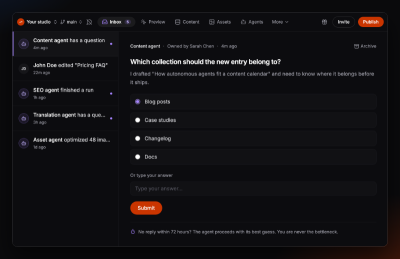
Business Owners and CMOs: From a business perspective, the primary concern is ROI and risk management. A "frozen" site that fails to convert is a liability, but an autonomous site that accidentally publishes an off-brand message is a PR risk. Business leaders are looking for systems that offer "earned autonomy"—where agents gain more permissions as they demonstrate reliability over time.
Implications for the Future of Digital Presence
The move toward autonomous websites signals a broader shift in how digital products are perceived. Instead of being "built" and then "maintained," websites are becoming "trained" and "evolved."
One significant implication is the democratization of high-performance web standards. Smaller companies that cannot afford a full-time web team can use autonomous agents to maintain the same technical standards as a Fortune 500 company. Furthermore, as search engines like Google place more weight on "Core Web Vitals" and user experience, the ability of a site to optimize itself in real-time could become a decisive factor in SEO rankings.
However, this transition also necessitates a new set of skills for web professionals. The role of the web designer may shift from "creator of static layouts" to "curator of agentic behaviors." Understanding how to set the parameters for an AI agent—determining what it can touch and what it must leave alone—will become a core competency in the next decade of web development.
Conclusion: Overcoming the Risk of Stagnation
The ultimate goal of an autonomous website is not to replace the human element, but to protect it. By automating the decay, these systems ensure that the creative work of the launch day remains relevant and functional. The "frozen site" is no longer a safe option in a digital economy that moves at the speed of AI.
As platforms like Fimo continue to refine the balance between automation and control, the industry is moving toward a model where "trust is the new configuration." By allowing agents to earn their autonomy through transparent logs, history tracking, and gradual delegation, organizations can finally break the cycle of launch-day peaks and long-term decay. The future of the web is not a site that is built once, but a site that never stops being built.

