
A landmark European Union regulation, the E.U. AI Act (Regulation (EU) 2024/1689), intended to foster transparency in artificial intelligence by making AI-generated content identifiable, is raising significant concerns among marketing professionals. While the Act aims to distinguish between human and synthetic content, its implementation could inadvertently create a framework for surveillance-like consequences, potentially leading to the segregation and censorship of marketing materials based on their origin rather than their intrinsic quality. This development follows closely on the heels of AI developers beginning to embed detectable watermarks into their generative models, a move that, while addressing the EU’s transparency mandate, also presents new challenges for content creators and digital marketers.
The E.U. AI Act, formally adopted in March 2024 and set to be fully implemented over the next two years, represents one of the most comprehensive legislative attempts globally to govern artificial intelligence. Its core objective is to ensure that AI systems used within the Union are safe, transparent, traceable, non-discriminatory, and environmentally friendly. A key component of this transparency mandate is the requirement for AI-generated content, particularly deepfakes and other synthetic media, to be clearly labeled. This stipulation is designed to combat misinformation and manipulation by allowing individuals to discern between authentic and AI-produced information. However, the mechanism for achieving this identification, specifically the requirement for "machine-detectable" synthetic content, has drawn scrutiny. Critics argue that this could pave the way for sophisticated detection systems that might be leveraged by governments or digital platforms to filter or suppress content, not on the basis of its factual accuracy or societal impact, but on the technical means of its creation.
In anticipation of and in response to these regulatory shifts, leading AI developers are already taking steps to comply. Anthropic, a prominent AI safety and research company, announced in early 2024 that all future iterations of its Claude large language models (LLMs) will incorporate an identifiable, text-based "watermark." This watermarking technology is designed to embed subtle, statistically detectable signals within the generated text, allowing for its origin to be identified without altering the readability or perceived quality of the content itself. The move by Anthropic is widely expected to set a precedent, with other major AI companies likely to follow suit in implementing similar watermarking solutions to meet evolving regulatory demands and industry expectations.
The Quest for Identifiable Content
The fundamental challenge lies in reliably identifying AI-generated text. While some observers might point to stylistic quirks, such as the use of em dashes or colons, as telltale signs of AI authorship, these are superficial and easily mimicked. Such punctuation marks have been staples of human writing for centuries, predating modern AI by a significant margin. More sophisticated attempts to discern AI authorship based on grammatical patterns or word choice are also becoming increasingly difficult. Generative AI models are constantly evolving, with each iteration designed to produce more nuanced, human-like prose. The very nature of AI development means that any database of AI writing "affinities and proclivities" is likely to become outdated rapidly. This rapid evolution makes subjective analysis an unreliable method for identification, leaving the E.U.’s mandate for machine-detectability paramount.
To address this, Anthropic is adopting a Google-developed approach known as SynthID-Text. This method embeds a hidden watermark directly into the text as it is being generated by the AI model. The key advantage of SynthID-Text is its ability to be detected without needing to re-query the original language model, access an external database, or expend significant computational resources. This efficiency is crucial for widespread application, especially in environments where large volumes of content are processed.

Unpacking the "Token" and the "Tournament"
Understanding how SynthID-Text operates requires a basic grasp of AI’s generative process. In the realm of AI, a "token" refers to a fundamental unit of data, which can be a part of a word, an entire word, a number, or even punctuation. When an LLM is tasked with generating content – be it a blog post, a product description, or a marketing email – it begins with an initial token and then predicts the most probable next token, and so on, to construct coherent sentences and paragraphs.
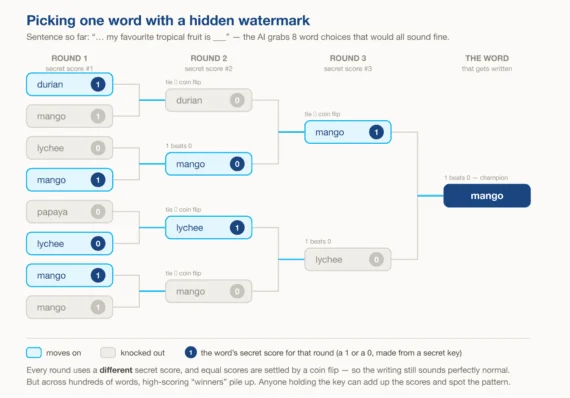
For instance, if a model like Google Gemini is prompted to write a sentence beginning with "My favorite tropical fruit is…", it will then statistically determine the most likely subsequent token. The choice isn’t always deterministic; the model might have several plausible options, such as "mango," "durian," or "papaya." It is precisely these alternative, statistically probable choices that SynthID leverages.
The SynthID system employs a method akin to a sports tournament to embed its watermark. For each new token the AI model is about to generate, SynthID presents a set of statistically plausible "competitor" tokens. These tokens then undergo a series of "contests," where a hidden scoring mechanism, influenced by the watermark’s seed, determines which token "wins" and is ultimately selected. This process is not about consistently choosing a specific word, like "mango," across all contexts. Instead, it’s about subtly biasing the probability distribution of token selection in a way that is statistically discernible over a larger body of text. A particular token might win a "tournament" in one sentence, and a different, equally plausible token might win in another.
Crucially, a single "tournament" or a few winning tokens offer little definitive proof of watermarking. However, when hundreds or thousands of these contests occur within a longer piece of text, a discernible statistical pattern emerges. The choices made by the AI model, when analyzed through the lens of the watermarking algorithm, will deviate from purely random chance in a predictable, seed-influenced manner. This aggregate statistical pattern forms the hidden watermark.
The Mechanics of Detection
The ability to detect this watermark relies on a sophisticated "detector" algorithm. This algorithm, equipped with the secret key associated with the watermarking process, can deconstruct a given passage of text into its constituent tokens. It then reconstructs the "tournament scores" for each token generation. By comparing these reconstructed scores against the expected statistical distribution influenced by the watermark, the detector can ascertain whether the token choices within the passage exhibit a strong enough correlation with the watermark to exceed a predefined detection threshold.
The reliability of this detection mechanism increases with the length of the text. A single instance of a statistically improbable token choice could be coincidental. However, hundreds of such instances within a single document provide robust evidence that the SynthID watermarking process influenced the AI’s generation. Conversely, factual content or passages where the AI model has a limited number of highly probable token choices (due to strict adherence to facts or extensive user feedback during composition) may produce less statistical evidence of watermarking. Nonetheless, any text that scores above the established detection threshold would be flagged as either fully AI-generated or, at the very least, significantly AI-assisted.

The Marketing Predicament
The implications of this newfound ability to identify AI-generated content with a degree of confidence are profound for the marketing industry, particularly for e-commerce. Search engines, social media platforms, LLMs themselves, and email clients could all leverage this technology to isolate and potentially filter or suppress content deemed to be AI-generated. This capability poses a direct challenge to one of the key advantages that generative AI has offered to marketers: the ability for smaller teams to produce and repurpose a high volume of content at a significantly reduced cost.
The introduction of watermarking could effectively become a proxy for quality or, at least, for human authorship. Major search engines, for instance, might choose to de-prioritize or discount pages that are heavily AI-aided. LLMs could be programmed to avoid citing or referencing AI-generated content as sources, limiting its reach and utility. Social media platforms, which are already experimenting with content moderation policies for AI-generated material, might further reduce the distribution of such content. Pinterest, for example, has already begun to implement policies that can affect the visibility of AI-generated posts. Email clients could start routing AI-generated marketing messages to spam folders or to a separate "likely AI" category, diminishing their chances of being seen by recipients.
Furthermore, the system is not without its inherent imperfections. Detection, being statistical in nature, is not infallible. There is a tangible risk of false positives, particularly if the detection threshold is set too low in an effort to capture all AI-generated content. This could lead to legitimate, human-authored content being mistakenly flagged and penalized. The nuance of AI assistance versus pure AI generation also presents a challenge; content that is lightly edited or uses AI for brainstorming might be indistinguishable from fully AI-generated text, leading to unintended consequences.
The E.U. AI Act’s emphasis on transparency, while laudable in its intent to protect citizens from manipulative AI applications, introduces a complex regulatory landscape for digital marketers. The infrastructure built to identify AI content could, intentionally or unintentionally, become a tool for content segregation and control, fundamentally altering how marketing content is created, distributed, and consumed across the digital sphere. The industry now faces the task of navigating these new regulations, understanding the capabilities and limitations of watermarking technologies, and adapting their content strategies to remain effective in an increasingly regulated AI environment. The coming years will likely see a significant evolution in how AI is integrated into marketing workflows, with a greater emphasis on demonstrating the value and authenticity of content, regardless of its origin.

