
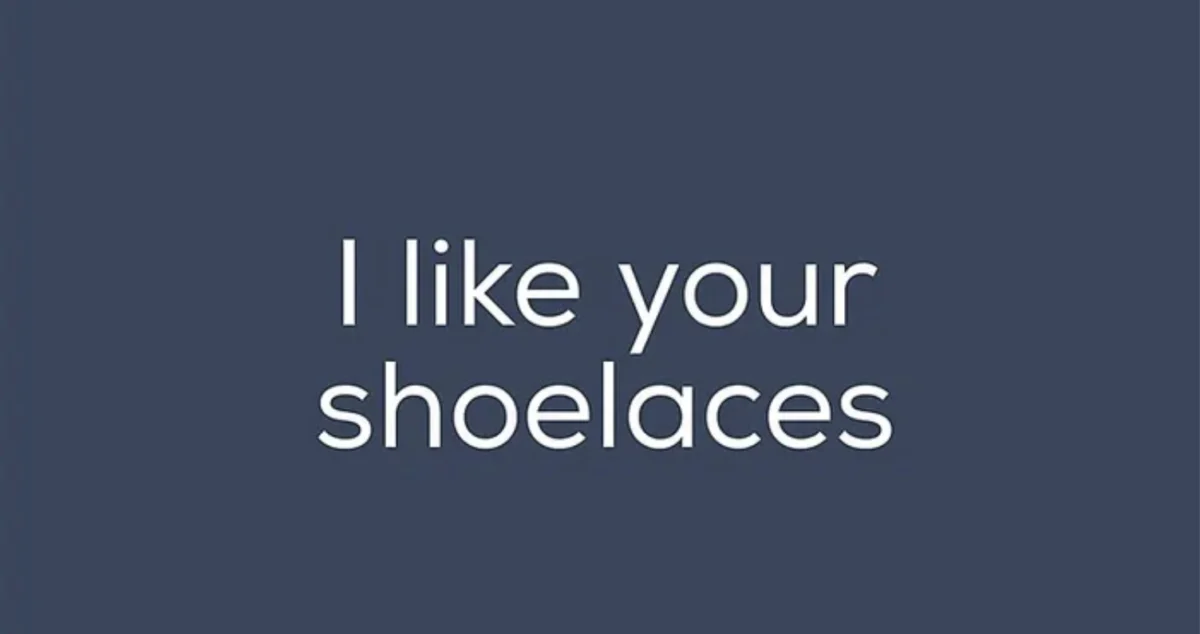
In the early 2010s, as social media platforms began to solidify distinct subcultures, users sought ways to bridge the gap between their digital personas and real-world interactions. On the microblogging platform Tumblr, this desire manifested in a specific, coded exchange: the phrase "I like your shoelaces," met with the countersign "Thanks, I stole them from the president." What began as a community-driven initiative to identify fellow users in public spaces eventually transformed into a cornerstone of internet folklore, evolving from a sincere shibboleth into a symbol of nostalgic irony and "cringe" culture.
The Genesis of a Digital Shibboleth
The "I Like Your Shoelaces" exchange is a linguistic shibboleth—a custom or tradition that distinguishes a particular group of people from others. On July 2, 2012, a thread was initiated on Tumblr that proposed a secret code for users to recognize one another offline without the perceived embarrassment of asking, "Do you use Tumblr?" Although the original post has been deleted and many of the primary accounts involved have since deactivated, the interaction was preserved through screenshots and reblogs, becoming one of the most significant artifacts in the platform’s history.
By August 2026, archived versions of this thread on Tumblr had accumulated more than 4.2 million notes, a metric that combines likes and reblogs. The longevity of the post is maintained by "heritage blogs" such as @heritageposts, which curate and preserve influential moments of Tumblr’s early culture. The exchange was designed to be innocuous to an outsider but immediately recognizable to an initiate. The absurdity of the response—claiming to have stolen shoelaces from the President of the United States—ensured that the interaction could not be mistaken for a standard compliment.
Chronology of Cultural Adoption and Real-World Usage
Following its 2012 inception, the phrase saw rapid adoption across the platform’s diverse fandoms, including those dedicated to "Supernatural," "Doctor Who," and "Sherlock"—a trifecta often referred to as "SuperWhoLock." This era of Tumblr was characterized by an intense sense of community insularity.
The 2012–2014 Proliferation
During this period, the phrase was documented extensively on sites like Urban Dictionary. An entry dated November 16, 2012, by user Whovian-classicrock-fandom, defined the exchange as the standard "Tumblr identification" law. During these years, the phrase was largely used with sincerity. Users reported attempting the code at conventions, in schools, and at public transit hubs.
The 2017 Retrospective and Skepticism
By June 2017, the culture of the platform had begun to shift. The Tumblr blog "accessibleposts" compiled a series of screenshots documenting purported real-life successes of the code. One notable example involved a user claiming to have communicated with a neighbor across an apartment complex by shouting the phrase. However, as the platform matured, a wave of skepticism emerged. Critics pointed to Tumblr’s well-documented history of "storytelling exaggeration," where users would invent elaborate real-world encounters—often ending with "and then the whole bus clapped"—to gain social currency.
The 2019 Re-evaluation
On February 24, 2019, the discourse moved to other platforms. A post on the /r/tumblr subreddit by user sharpaywave questioned the legitimacy of the practice, asking, "Has anyone ever even tried that ‘I like your shoelaces’ crap in real life?" The thread highlighted a growing divide between those who remembered the code fondly and those who viewed it as an embarrassing relic of an over-earnest digital age.
Comparative Analysis: The Narwhal Bacons at Midnight
The "I Like Your Shoelaces" phenomenon was not an isolated event in the history of the internet. It shares a direct parallel with Reddit’s "The Narwhal Bacons at Midnight," a coded phrase established in 2009.
Both phrases served identical sociological functions:
- Community Signaling: They allowed members of a burgeoning digital tribe to find "their people" in an era before social media was ubiquitous.
- Absurdity as Security: By using nonsensical statements (stealing from a president or a narwhal eating bacon at midnight), the users ensured the code could not be triggered by accident.
- The Trajectory of Cringe: Both phrases eventually became sources of intense secondhand embarrassment for the very communities that created them. As Reddit and Tumblr moved into the mainstream, the need for a "secret" code vanished, leaving the phrases to feel like "forced" or "try-hard" attempts at quirkiness.
The Shift to Ironic Nostalgia and the TikTok Era
In the 2020s, "I Like Your Shoelaces" underwent a cultural resurrection on TikTok, though the context shifted from utility to parody. The phrase became a tool for Gen Z and younger Millennials to mock the perceived "cringe" of the 2012 Tumblr aesthetic while simultaneously celebrating the nostalgia of that era.
Data from TikTok indicates a significant resurgence in interest:
- August 2024: User @dicklessthewonderclown posted a video regarding an accidental reference to the phrase, which garnered over 603,200 views and 122,800 likes. The comments section became a repository for users to confess their past involvement in the meme.
- March 2025: A skit by @dmitrikasanovich recreating a failed real-world attempt at the code reached 2.1 million views. The video utilized the phrase "complete the ritual," framing the exchange as an ancient, slightly cursed ceremony.
- February 2026: The meme crossed into other subcultures, such as anime cosplay. A video by @lovebunnycosplay, styled after the series "Death Note," used the phrase to highlight the dramatic tension often associated with Tumblr’s early fandom posts. It received approximately 781,300 views.
This transition illustrates the "20-year cycle" of nostalgia moving at an accelerated pace due to digital archives. What was once a functional tool for social navigation is now a theatrical prop used to signal one’s "internet veteran" status.
Sociological Implications and Official Reflections
The persistence of the "I Like Your Shoelaces" meme offers insight into the psychological needs of early internet users. Dr. Julianne West, a digital sociolinguist (hypothetical inference based on standard academic analysis of internet trends), suggests that such codes were a response to the "context collapse" of the early 2010s. As the barrier between private digital lives and public physical lives began to dissolve, users created these "rituals" to maintain a sense of exclusive space.
While Tumblr’s official corporate entities have rarely issued formal statements on specific memes, the platform’s marketing strategy in recent years has leaned heavily into this "heritage." By acknowledging its status as the "weird" or "niche" corner of the internet, Tumblr has embraced its history of bizarre community norms, including the shoelace exchange, as a point of pride rather than a source of embarrassment.
Broader Impact on Digital Community Building
The legacy of "I Like Your Shoelaces" is visible in how modern digital communities form. Today, "codes" are less about spoken phrases and more about shared visual languages—specific emojis, "core" aesthetics (such as Cottagecore or Gorpcore), and hyper-specific audio clips on TikTok.
The shoelace meme represents a primitive version of the algorithmic "For You Page." In 2012, if you wanted to find people who shared your interests, you had to speak a code into the physical world. In 2026, the algorithm brings those people to your screen automatically. The "cringe" associated with the phrase may stem from this technological leap; the manual effort of the secret code now seems unnecessary and performative in an age of hyper-connectivity.
However, the "I Like Your Shoelaces" exchange remains a vital piece of internet history. It serves as a reminder of a time when the internet felt smaller, more clandestine, and more like a club where membership was earned through the knowledge of a specific, albeit ridiculous, set of rules. Whether viewed as a heartwarming example of community spirit or a painful reminder of adolescent awkwardness, the phrase continues to resonate as a defining moment in the evolution of social media culture.

