
A landmark European Union regulation, formally known as Regulation (EU) 2024/1689 and informally dubbed the E.U. AI Act, is poised to usher in an era of transparency for artificial intelligence-generated content. However, the mechanisms designed to make AI output identifiable are sparking significant concern among marketers, with potential implications that extend beyond mere content labeling into the realm of digital surveillance and censorship. The core of the regulation mandates that "synthetic" content be machine-detectable, a requirement that, while aiming for clarity, simultaneously constructs an infrastructure capable of segregating and potentially censoring text based on its origin rather than its inherent quality or factual accuracy.
This regulatory push has already prompted proactive measures from leading AI developers. Anthropic, a prominent AI research company, has publicly announced that all future iterations of its Claude models will incorporate identifiable, text-based "watermarks." This move by Anthropic is expected to set a precedent, with other major AI companies likely to follow suit in order to comply with the forthcoming EU directives and maintain access to the European market.
The Genesis of AI Identification: A Regulatory Imperative
The European Union’s impetus for identifying AI-generated content stems from a growing desire for accountability and transparency in the digital sphere. As AI models become increasingly sophisticated, their ability to produce human-quality text, images, and other media blurs the lines between authentic human creation and machine-generated output. This ambiguity presents challenges across various sectors, from the spread of misinformation and deepfakes to intellectual property concerns and the erosion of trust in digital information.
While some observers might point to stylistic quirks, such as the use of em dashes or colons, as indicators of AI authorship, these are often superficial and rapidly evolving. AI writing systems are designed to mimic human linguistic patterns, meaning that what might be a telltale sign today could be obsolete tomorrow. The very nature of AI development is geared towards increasing its human-likeness, rendering any static identification method inherently transient. This inherent fluidity makes manual or heuristic-based detection unreliable and ultimately unsatisfying for regulatory bodies seeking definitive markers.
SynthID-Text: A Technical Solution for Identification
In response to the EU’s mandate, Anthropic’s adoption of a Google-developed watermarking technique, known as SynthID-Text, highlights a significant technological advancement in this area. This approach embeds a hidden watermark directly into the text as the AI model generates it. Crucially, this watermark is designed to be detectable without needing to re-access the original language model, consult an external database, or expend significant computational resources. This efficiency is key to its potential widespread adoption and real-time application.
The underlying principle of generative AI, particularly large language models (LLMs), involves processing information in discrete units called "tokens." These tokens can represent anything from parts of words and whole words to numbers and punctuation. When an AI is tasked with generating content, such as a marketing email or a blog post, it begins with an initial token and then probabilistically predicts the subsequent token, building the text piece by piece. For example, if prompted with "My favorite tropical fruit is," an LLM like Google Gemini might statistically evaluate a range of plausible next tokens, such as "mango," "banana," or "papaya." The selection process is not deterministic; different runs can yield different token choices, even for the same prompt.

The "Tournament" Mechanism: Weaving a Statistical Watermark
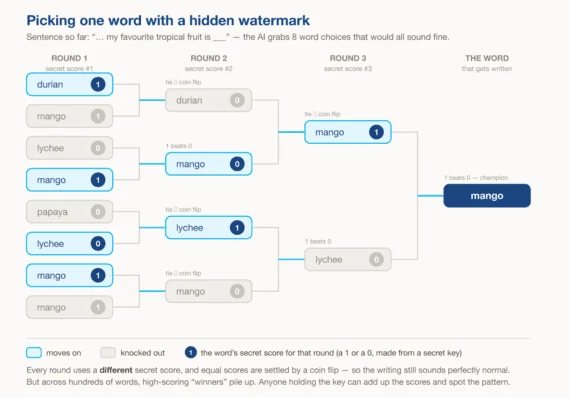
SynthID-Text leverages this probabilistic nature of token generation to create its watermark. The system operates akin to a sophisticated tournament for each potential token. When an AI model is generating text, SynthID essentially sets up a series of "competitions" among plausible next tokens. These competitions are not based on subjective preference but on a proprietary scoring system tied to the watermarking algorithm.
Imagine the sentence fragment "My favorite tropical fruit is." The system might present several candidate tokens, such as "durian," "mango," "lychee," and "papaya," as potential continuations. Through a series of secret scoring rounds, similar to a sports bracket, these candidates are narrowed down. For instance, in the first round, "mango" might "win" against "lychee," and "papaya" might "win" against "durian." This process continues until a single token is selected as the most probable and statistically favorable continuation according to the watermark’s design.
This "tournament" occurs for every token generated. While any single token’s selection might appear random or coincidental, the cumulative effect of hundreds or thousands of these statistically influenced "wins" creates a discernible pattern. This pattern, embedded within the sequence of tokens, constitutes the watermark. It’s not that specific words are consistently chosen; rather, the tendency for certain tokens to be selected under specific algorithmic conditions is what marks the text. The watermark is therefore a statistical signature, a deviation from purely random chance that is detectable by a specialized algorithm.
The Detection Process: Unveiling the Statistical Signature
The effectiveness of SynthID-Text hinges on its detection mechanism. A "detector" algorithm, equipped with the necessary secret key (which essentially comprises the rules of the token tournaments), can analyze a given passage of text. This detector deconstructs the passage back into its constituent tokens. It then reconstructs the hypothetical tournament scores for each token selection based on the watermark’s rules. By comparing these reconstructed scores with the actual token choices made by the AI, the detector can determine if the sequence of token selections exhibits a statistically significant correlation with the watermark.
The strength of the evidence increases with the length of the text. A single or a few token selections might occur by chance and not trigger a detection. However, when hundreds or thousands of token choices consistently align with the watermark’s statistical bias, the evidence becomes compelling. The system establishes a "detection threshold"; passages scoring above this threshold are flagged as either fully AI-generated or at least significantly AI-aided.
It is important to note that factual content or instances where user feedback heavily influences the composition process can produce text that scores lower on the detection scale. This is because such inputs might limit the AI’s range of plausible token choices, making the statistical pattern less pronounced. Nevertheless, the system is designed to identify the subtle statistical fingerprints left by the watermarking process.
Marketing’s Peril: From Content Creation to Content Control
The ability to identify AI-generated content with a high degree of confidence presents a significant challenge for marketers who have increasingly come to rely on generative AI for efficiency and cost-effectiveness. The primary concern is the potential for AI content segregation, which could lead to censorship or de-prioritization by major digital platforms.

Search engines, social media networks, LLMs themselves, and even email clients could leverage this identification capability to filter or suppress AI-generated content. For e-commerce marketers, who often operate with lean teams and limited budgets, generative AI has been a powerful tool for scaling content creation and repurposing existing material across various channels. The prospect of this content being systematically disadvantaged could undermine a key advantage of AI adoption.
The implications are far-reaching:
- Search Engine Visibility: Search engines could begin to discount or penalize pages heavily reliant on AI-generated content, impacting organic search rankings and traffic. This would necessitate a more human-centric approach to SEO or a careful integration of AI that remains undetectable or passes quality checks.
- LLM as a Source: LLMs, which are increasingly used to summarize information and provide answers, might be programmed to avoid citing or referencing AI-generated text as a source, limiting its reach and influence.
- Social Media Distribution: Platforms like Pinterest are already experimenting with reducing the distribution of AI-generated content. This trend could expand, with other social networks potentially limiting the reach of AI-produced posts, affecting engagement and brand visibility.
- Email Deliverability: Email clients could route AI-generated marketing messages to spam folders or a dedicated "likely AI" folder, drastically reducing open rates and conversion opportunities.
Furthermore, there is a potential for watermarking to become a de facto proxy for content quality, irrespective of the actual merit of the material. A human-written article, even if poorly crafted, might be favored over a superior AI-generated piece simply because of its origin.
The Specter of Surveillance and Censorship
Beyond the direct impact on marketing strategies, the broader implications of the E.U. AI Act’s identification mechanism raise serious concerns about digital surveillance and censorship. The infrastructure built to detect AI-generated content could be repurposed or expanded for more invasive monitoring.
If governments or platforms can reliably identify content based on its origin, they gain the power to:
- Segregate and Filter: Content can be systematically separated from human-generated content, allowing for its easy isolation and potential removal from public view or specific platforms.
- Censor Based on Origin: The regulation, in its current form, could inadvertently create a framework where content is censored not because of its falsity, factual inaccuracies, or harmful nature, but simply because it was produced by an AI. This raises questions about freedom of expression and the potential for AI-generated creative works or informative content to be suppressed.
- Monitor Discourse: A comprehensive system for identifying AI-generated text could, in theory, be used to monitor online discourse, distinguishing between human and machine-generated contributions. This could have implications for political discourse, academic research, and public debate.
The statistical nature of detection also introduces the risk of false positives. If the detection threshold is set too low, legitimate human-written content that coincidentally exhibits certain token patterns could be misidentified as AI-generated, leading to unfair penalties or suppression. Conversely, sophisticated AI models might eventually learn to circumvent these watermarking techniques, leading to an ongoing technological arms race.
Looking Ahead: Navigating the Evolving Landscape
The E.U. AI Act represents a significant step in the global effort to govern artificial intelligence. While its intentions are to foster transparency and build trust, the practical implementation of content identification raises complex ethical and operational challenges, particularly for the marketing industry. The development of technologies like SynthID-Text is a testament to the ingenuity of AI developers in meeting regulatory demands. However, the potential for these tools to be used for broader forms of content control warrants careful consideration and ongoing dialogue. As AI continues to evolve, so too must the regulatory frameworks, ensuring that they promote innovation and transparency without stifling creativity or enabling undue surveillance. The coming years will likely see a continuous adaptation of both AI generation techniques and detection methods, as well as a robust debate about the appropriate boundaries for AI content regulation.

