
A new European Union regulation designed to identify artificial intelligence (AI) generated content, while aiming for transparency, is raising significant concerns among marketers about potential surveillance-like consequences and the risk of content censorship. Regulation (EU) 2024/1689, informally known as the E.U. AI Act, mandates that "synthetic" content be machine-detectable. Critics argue this requirement could inadvertently create an infrastructure that allows governments or platforms to segregate and censor text based on its origin rather than its inherent quality or accuracy. In response to this evolving regulatory landscape, AI developers are beginning to implement sophisticated watermarking techniques to comply with the spirit, if not the letter, of the new rules.
Anthropic, a prominent AI research company, has already announced that all future iterations of its Claude models will embed identifiable, text-based "watermarks." This proactive step is expected to be followed by other major AI companies as they navigate the implications of the E.U. AI Act. The core of the regulation hinges on the ability to reliably distinguish AI-produced content from human-created material, a challenge that is becoming increasingly complex as AI models advance in their ability to mimic human writing styles.
The Quest for Identification: Beyond Punctuation
The European Union’s objective is clear: to establish a verifiable method for identifying content generated by AI. While some observers might point to stylistic quirks like the use of em dashes or colons as indicators of AI authorship, such assumptions are increasingly unreliable. These punctuation marks have been standard in written language for centuries, predating modern AI language models by a significant margin. Moreover, the rapid evolution of AI writing capabilities means that any attempts to build a database of AI writing "affinities" and "proclivities" would quickly become obsolete. AI models are continuously being refined to produce text that is virtually indistinguishable from human writing.
This inherent difficulty in distinguishing AI-generated text through simple stylistic analysis underscores the need for more robust identification methods. The E.U.’s demand for detectability, therefore, pushes the industry towards more technical solutions. Anthropic’s adoption of a Google-developed approach, known as SynthID-Text, exemplifies this shift. This method embeds a hidden watermark directly into the text as it is being generated by the AI model. Crucially, this watermark is designed to be detectable without requiring a return to the original Large Language Model (LLM), the consultation of an external database, or significant computational resources for analysis.
Decoding the "Token" and the "Tournament" of Text Generation
To understand SynthID-Text, it is essential to grasp the fundamental concept of a "token" in the context of AI. A token represents a small unit of data, which can be a fragment of a word, a whole word, a number, or even punctuation. When a generative AI model is tasked with producing content, such as a blog post, product description, or email marketing message, it operates by predicting the most probable "next token" in a sequence.

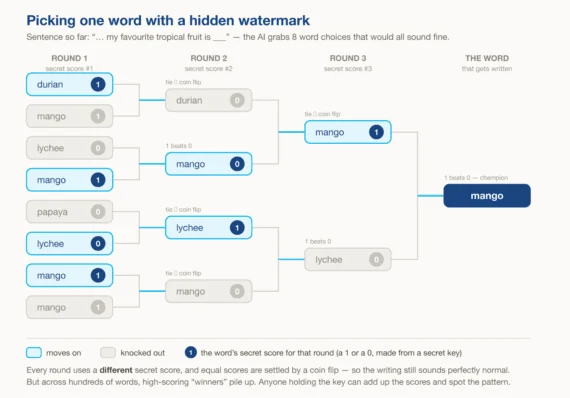
For instance, if an AI model is prompted to complete the sentence "My favorite tropical fruit is…", it will use statistical probabilities to select the subsequent token. The choice is not deterministic; a model like Google Gemini might select "mango," while another instance of the same model, or even the same model at a different time, might choose "durian" or "papaya," all of which are statistically plausible options. This inherent variability in token selection is precisely what SynthID-Text leverages.
The SynthID-Text Mechanism: A Statistical Watermark
SynthID-Text employs a process akin to a sports tournament to embed its watermark. For each new token that the AI model is about to generate, SynthID identifies a set of reasonable alternative tokens that could logically follow. These candidate tokens then enter a "tournament," where a hidden scoring mechanism, influenced by a cryptographic seed, determines the "winner." This winning token is then subtly nudged towards being selected by the AI model.
Consider the example of generating the phrase "My favorite tropical fruit is __." If the AI model considers "mango," "durian," "lychee," and "papaya" as plausible next tokens, SynthID might run a tournament among these options. The outcome of this tournament is not a fixed word but a statistical bias. For example, "mango" might win the tournament in one instance, while in another, depending on the cryptographic seed and the model’s internal state, "lychee" might emerge as the statistically favored token.
This tournament process is repeated for every token generated. While a single token’s selection might not reveal much, the cumulative effect over hundreds or thousands of tokens creates a statistically significant pattern. The watermark is not a specific word or phrase, but rather the discernible bias in token selection that deviates from what would be expected by pure chance. This statistical anomaly, built up over a substantial piece of text, serves as the digital fingerprint of AI generation.
Detection: Unraveling the Statistical Pattern
The detection of this watermark relies on a specialized "detector" algorithm. This algorithm, armed with the same secret key and understanding of the scoring mechanism used during generation, can deconstruct a given passage of text. It splits the text into its constituent tokens and then, using the secret key, reconstructs the "tournament scores" for each token. By analyzing how strongly the token choices correlate with the watermark’s statistical bias, the detector can determine if the passage crosses a predefined detection threshold.
The strength of the evidence for AI generation increases with the length of the text. A single or a few "winning" tokens in a tournament could plausibly occur by chance. However, when hundreds or thousands of tokens exhibit a consistent bias towards watermark-influenced selections, the statistical evidence becomes compelling. Conversely, passages that are heavily influenced by factual constraints or extensive user feedback during their composition may produce less evidence for the watermark. This is because these factors limit the AI model’s available choices, reducing the number of opportunities for the watermark’s statistical influence to manifest. Nevertheless, any text that scores above the detection threshold would be classified as either fully AI-generated or, at the very least, significantly AI-assisted.

The Marketing Conundrum: Segregation and Censorship Concerns
The ability to identify AI-generated text with a high degree of confidence presents a double-edged sword for content marketers. While transparency is a stated goal, the practical implications could lead to the segregation and potential censorship of AI-assisted content across various digital platforms. Search engines, social media networks, LLMs, and even email clients could leverage this identification capability to isolate and filter content based on its generative origin.
For e-commerce marketers, this presents a significant challenge. A key advantage of generative AI has been its ability to empower smaller teams to create and repurpose vast amounts of content at a reduced cost. If AI-generated content is systematically de-prioritized or flagged, it could undermine this cost-efficiency and the competitive edge it provides.
The watermarking system could inadvertently become a proxy for content quality in the eyes of platforms and users. Search engines might choose to downrank pages that are heavily AI-aided, LLMs might avoid them as authoritative sources, and social media platforms could reduce their distribution. Pinterest, for instance, has already begun implementing policies to limit the visibility of AI-generated content. Email clients might route such content to spam folders or label it as "likely AI," potentially diminishing its reach and impact.
Navigating Imperfect Systems and Future Implications
It is crucial to acknowledge that the detection system is not infallible. Statistical detection inherently carries the risk of false positives, especially if the detection threshold is set too low. This could lead to legitimate human-created content being mistakenly flagged as AI-generated, creating further complications for creators.
The E.U. AI Act, enacted in its final form in May 2024 and scheduled to be fully applicable by mid-2026, represents a significant regulatory intervention in the rapidly evolving field of artificial intelligence. Its provisions for transparency and detectability are intended to foster trust and safety in AI systems. However, the implementation of these measures, particularly through technologies like SynthID-Text, opens a complex debate about the balance between regulation, innovation, and the freedom of expression in the digital age.
As AI models continue to advance, the methods for their detection will also need to evolve. The industry faces the ongoing challenge of developing identification techniques that are both robust and fair, ensuring that the pursuit of transparency does not inadvertently stifle creativity or lead to undue censorship. The long-term implications for content creation, digital marketing, and the dissemination of information will likely be profound, necessitating continuous dialogue between regulators, developers, and content creators to shape a future where AI serves as a tool for enhancement rather than a source of division. The journey from identifying AI-generated text to potentially controlling its visibility is a delicate one, with significant ramifications for how information is produced, consumed, and valued in the years to come.

