
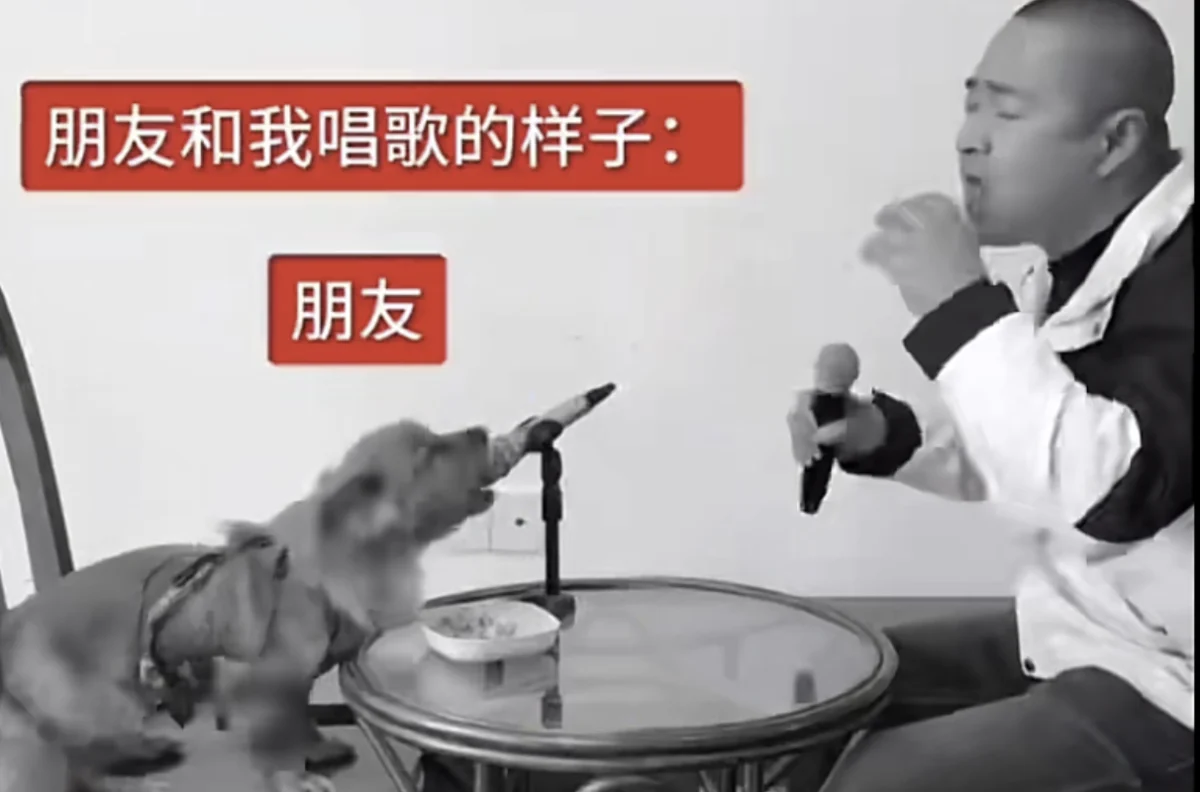
Chinese Dog Singing, also recognized in digital circles as Chinese Man Singing With Dog, has emerged as a significant cross-cultural internet phenomenon, bridging the gap between traditional Chinese folk expression and contemporary global "brainrot" meme culture. The viral series of videos features an unidentified Chinese man performing various traditional songs and popular tunes alongside his Corgi, a dog frequently identified by followers as Tangyuan. What distinguishes these clips from standard pet videos is the Corgi’s uncanny ability to howl and bark in rhythmic synchronization with the owner’s vocalizations, creating the auditory illusion of a practiced musical duet. While the original footage was celebrated for its wholesome and impressive display of animal training and companionship, its subsequent migration to Western platforms like TikTok in mid-2026 saw the content transformed through aggressive editing, speed manipulation, and absurdist recontextualization.
Origins and Cultural Context on Douyin
The phenomenon began on Douyin, the mainland Chinese counterpart to TikTok, where pet-centric content occupies a massive share of the daily domestic viewership. In the original high-definition uploads, the man and his Corgi are seen in a domestic setting, often with the man holding a microphone or singing directly to the camera. The Corgi, Tangyuan, responds to specific melodic cues with high-pitched, sustained howls that mimic the pitch and cadence of the traditional Chinese scales being sung.
Cultural analysts note that the songs performed often fall into the category of "Minzu" (ethnic folk) or "Guofeng" (national style) music, which emphasizes vocal agility and emotional resonance. The dog’s participation, while likely a conditioned response to the man’s volume or specific tonal shifts, appears remarkably intentional to the casual observer. This "singing dog" trope has a long history in digital media, but the specific rhythmic precision of the Chinese Corgi provided a unique foundation for the viral explosion that would follow in the summer of 2026.
The transition from a domestic Chinese hit to a global meme began through "aggregator" accounts—users who specialize in scouring Douyin for compelling content to repost on YouTube and TikTok. One of the primary drivers of this early exposure was the YouTube channel Corgi Croon (@CorgiCroon). This channel, which operates as a licensed curator for mainland Chinese pet creators, introduced the pair to an English-speaking audience, framing the videos as heartwarming examples of animal intelligence.
The July 2026 Pivot: From Wholesome to Brainrot
The trajectory of Chinese Dog Singing shifted dramatically in July 2026. On July 8th, TikTok user @morayayalex uploaded a version of the duet that had been significantly altered. The playback speed was increased by approximately 1.5x, and the audio was sharpened to emphasize the dog’s high-pitched yapping. This edit stripped the video of its original "heartwarming" context, repositioning it within the "brainrot" genre—a subculture of internet humor characterized by over-stimulation, repetitive audio loops, and a rejection of traditional narrative logic.
This specific edit resonated with a younger demographic (Gen Alpha and late Gen Z), for whom the distorted, rapid-fire barking of the Corgi served as a comedic "stimulant." The video by @morayayalex quickly amassed over 2.1 million views and nearly 180,000 likes within seven weeks, signaling a new phase in the meme’s lifecycle. Following this success, on July 15th, user @unknwn_xin posted a "Top 5" style compilation of the man and dog, utilizing even more aggressive editing techniques. This version gained 1.1 million views, further cementing the "sped-up" audio as the definitive version for Western social media users.
Evolution Into the Redraw and Fan Art Movement
By late July and early August 2026, the Chinese Dog Singing meme moved beyond simple video re-shares and entered the "creative template" phase. The high-pitched, rhythmic barking provided a perfect audio backdrop for "redraw" memes and fan animations. In this stage of a meme’s evolution, artists use a popular audio clip as a "script" for their own fictional characters.
On July 30th, 2026, a pivotal moment occurred when user @bethany_420 posted an animation featuring characters from the indie game The Binding of Isaac. The animation depicted the protagonist singing while his feline companion, Guppy, performed the Corgi’s barking parts. The success of this video—gaining 1.2 million views—validated the audio as a versatile tool for character-based storytelling.
This trend proliferated across various fandoms. Digital artists on TikTok and X (formerly Twitter) began rotoscoping the original man’s movements or creating entirely new scenarios. Notable examples included:
- The Legend of Zelda: Animations featuring Midna and Wolf Link performing the duet.
- Jujutsu Kaisen: A popular edit by @lpxht_vale depicting the character Megumi Fushiguro and his "Divine Dogs" using the audio as emotional support.
- Haikyuu!!: A labor-intensive 86-frame rotoscoped animation by @paintsnacc featuring the characters Oikawa and Kyotani, which highlighted the technical dedication the meme was now inspiring.
Statistical Analysis and Platform Reach
The data from August 2026 illustrates the massive scale of the "Chinese Dog Singing" trend. A comparative analysis of various uploads shows a consistent engagement-to-view ratio of approximately 10-15%, which is exceptionally high for non-celebrity content.
- TikTok @martin.arg8: A late-August upload (Aug 22) reached 3.2 million views in just five days, indicating that the meme had not yet reached its saturation point even after two months of circulation.
- YouTube @bugori: A comparison video uploaded on August 13th, which placed the original footage side-by-side with the "brainrot" version, garnered 1.3 million views. This suggests a secondary interest from the audience in understanding the "lore" or the origin of the distorted audio.
- Global Distribution: While the origin is Chinese, search interest data indicates that the primary drivers of the "brainrot" version of the meme are located in North America, Western Europe, and Southeast Asia (specifically Indonesia and the Philippines).
The Psychology of the "Brainrot" Aesthetic
The transition of the Chinese Dog Singing video into the "brainrot" category offers a case study in modern digital consumption. "Brainrot" content often relies on "low-poly" or "low-fidelity" aesthetics combined with high-frequency audio. The Corgi’s bark, when sped up, loses its canine quality and becomes a rhythmic, percussive instrument.
Psychologically, these videos provide a form of "micro-entertainment" that fits the shrinking attention spans of users accustomed to vertical scrolling. The repetition of the man’s singing—often a single melodic phrase—acts as a "hook," while the dog’s response provides the "drop" or the comedic payoff. The fact that the lyrics are in Chinese, a language many of the Western viewers do not understand, adds a layer of "semantic satiation" where the voice becomes purely melodic and phonetic, stripped of its literal meaning and repurposed as a raw comedic tool.
Official Responses and Creator Impact
While the original creator on Douyin has not issued a formal statement to Western media, the proliferation of "authorized" clips on YouTube via @CorgiCroon suggests an awareness of the global audience. In the Chinese digital ecosystem, "KOLs" (Key Opinion Leaders) or pet influencers often view international virality as a mark of prestige, even if the context of the fame is shifted toward the absurd.
However, the "brainrot" community’s tendency to deconstruct and distort original works has raised minor discussions regarding copyright and the "sanctity" of original content. In this instance, the consensus among digital culture critics is that the meme has provided a net benefit to the original creator by driving curiosity toward the source material. Many users who first encountered the "screaming sped-up dog" eventually sought out the original, wholesome videos of Tangyuan, leading to a surge in followers for the original Douyin accounts.
Broader Implications for Digital Culture
The Chinese Dog Singing phenomenon represents the "globalization of the absurd." It demonstrates how a local cultural artifact—a man singing folk songs to his pet in China—can be stripped of its geography and language to become a universal digital building block.
Furthermore, the meme highlights the power of "Sound" on platforms like TikTok. In the current social media landscape, the visual component of a video is often secondary to the audio. Once a sound becomes a "template," it takes on a life of its own, independent of the person who filmed it. The "Chinese Dog Singing" audio has become a shorthand for a specific type of chaotic, high-energy interaction between two parties, a theme that resonates across language barriers.
As of late 2026, the meme continues to evolve, with VR (Virtual Reality) creators and 3D animators beginning to experiment with the audio. Whether the "Chinese Dog Singing" remains a permanent fixture of the internet’s library of sounds or eventually fades into the background of digital history, its peak in the summer of 2026 remains a definitive example of how modern audiences consume, distort, and ultimately celebrate cross-cultural content.

