
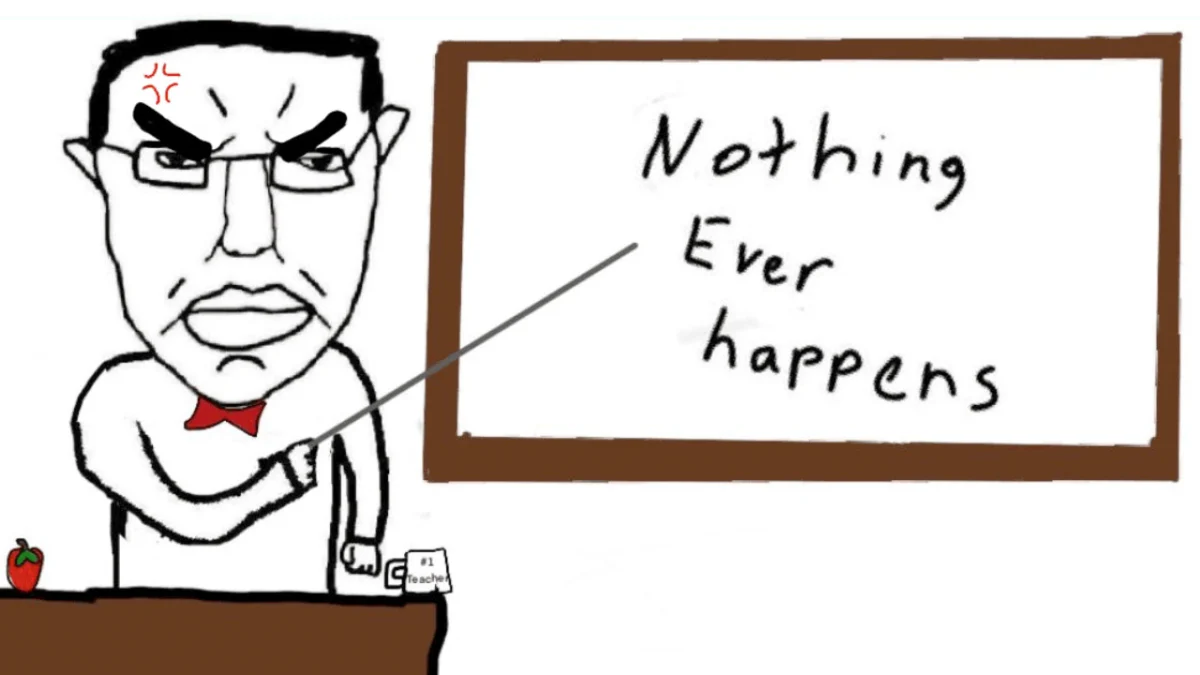
The digital age is characterized by an unprecedented velocity of information, where global events are broadcast, analyzed, and memeticized in real-time. Within this high-intensity information ecosystem, a specific counter-narrative has emerged from the subcultures of the internet, most notably on the imageboard 4chan. The phrase "Nothing Ever Happens" has transitioned from a simple expression of boredom to a complex cultural mantra and a lens through which a segment of the digital population views global geopolitics, social movements, and historical milestones. By asserting that major global events are either insignificant, staged, or ultimately inconsequential, the "Nothing Ever Happens" phenomenon represents a profound shift in how digital natives process the concept of historical change.
Conceptual Origins and the Culture of the Happening
To understand the rise of "Nothing Ever Happens," one must first examine its predecessor: the "It’s Happening" meme. Historically associated with the "Doom Paul" imagery of former Congressman Ron Paul, "It’s Happening" was used to signal the arrival of a long-anticipated systemic collapse, a revolutionary political shift, or a major geopolitical upheaval. In the early 2010s, users on 4chan’s political board, /pol/, lived in a state of constant anticipation, waiting for a "happening"—a definitive break in the status quo.
By 2014, a sense of "happening fatigue" began to settle in. Despite the constant stream of breaking news, many users felt that the fundamental structures of power and daily life remained stubbornly unchanged. The earliest recorded instances of the phrase "Nothing Ever Happens" appeared in July 2014. On July 26, 2014, an anonymous user expressed a visceral sense of frustration, stating, "Nothing ever happens in this shit, I can’t take it anymore, please god make something happen this world is boring as fuck." This initial sentiment was not yet a political theory but rather a cry of existential boredom from a generation that felt they were living in the "end of history."
The Chronological Solidification of Cynicism
As the decade progressed, "Nothing Ever Happens" evolved from an expression of boredom into a defensive psychological posture. Between 2015 and 2017, the phrase began to appear as a standard rebuttal to any thread attempting to hype a current event. When users posted about potential wars, economic collapses, or political scandals, skeptics would respond with the mantra to signal their refusal to be emotionally invested in what they perceived as another "nothingburger."
A significant turning point occurred in the early 2020s. The period between 2019 and 2021 saw an extraordinary density of global crises, including the death of Jeffrey Epstein, the COVID-19 pandemic, and the 2020 George Floyd protests. For the proponents of the "Nothing Ever Happens" philosophy, these events served as the ultimate proof of their worldview. An influential post on April 22, 2021, titled "Every single happening has been CANCELLED," argued that despite the apparent magnitude of these events, they failed to result in the radical systemic changes that "happening" enthusiasts expected. The user lamented that even events with "civil war potential" or "global conspiracy" implications eventually fizzled out, leaving the world essentially as it was before.
Linguistic Variants and the Nothingburger Phenomenon
The "Nothing Ever Happens" mantra is closely linked to the term "Nothingburger." While "Nothing Ever Happens" describes a temporal state of the world, a "nothingburger" describes a specific event that is hyped by the media or social groups but lacks substantive impact or evidence. The term gained mainstream political prominence in 2017 during various congressional investigations in the United States, but on imageboards, it was adopted as a classification for failed "happenings."
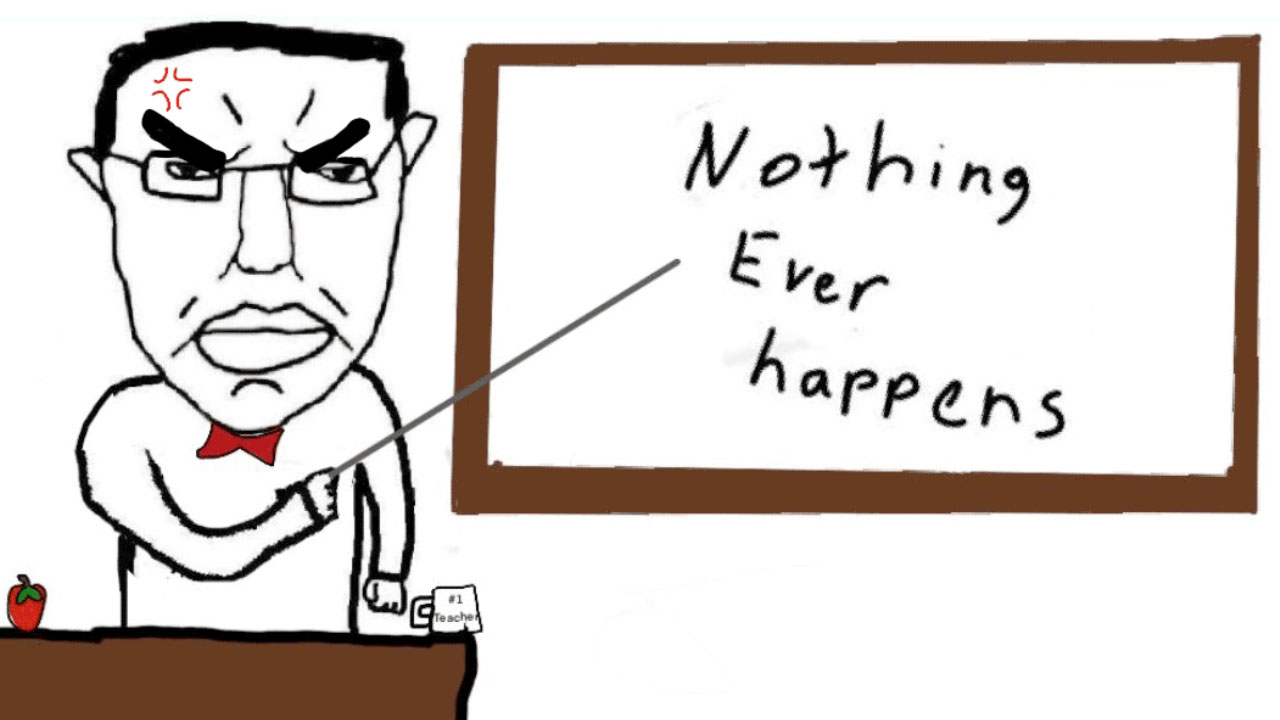
The visual language of the meme further solidified its presence. The "Chudjak" variant—a stylized, often bespectacled caricature—became the face of the "Nothing Ever Happens" advocate. These reaction images typically depict a character looking unimpressed or smugly dismissive of a major news headline. This imagery serves to signal a perceived intellectual superiority; the "Nothing Ever Happens" proponent views themselves as someone who has seen through the "spectacle" of the news cycle and refuses to be manipulated by the "hype machine."
Case Study: The Wagner Group Rebellion
The most prominent modern application of the "Nothing Ever Happens" mantra occurred on June 24, 2023, during the Wagner Group mutiny led by Yevgeny Prigozhin. As the private military company seized control of military sites in Rostov-on-Don and began a "March of Justice" toward Moscow, the internet was flooded with "It’s Happening" sentiment. For several hours, it appeared that a fundamental shift in the Russian state was imminent.
However, when a deal was struck and the rebellion was abruptly called off, the "Nothing Ever Happens" camp claimed a total symbolic victory. Twitter user @AltHistCody noted that the "’Nothing Ever Happens’ Chad absolutely obliterated the ‘Happening’ Virgin today." This event served as a perfect data point for the movement: a high-stakes, dramatic event that captured global attention but ultimately resulted in a return to a version of the status quo. To the skeptics, the Wagner rebellion was the ultimate proof that even the most dramatic "happenings" are often transitory and lack lasting structural impact.
Sociological Analysis: The Crisis of Significance
The "Nothing Ever Happens" phenomenon can be analyzed as a symptom of "information overload" and "crisis fatigue." In a world where every news cycle is framed in apocalyptic terms—"existential threats," "unprecedented crises," and "historic shifts"—the human capacity for alarm becomes exhausted. When the predicted apocalypse fails to materialize repeatedly, the individual develops a skeptical filter.
From a sociological perspective, this represents a "crisis of significance." The mantra suggests that the individual no longer believes that the events reported in the news have any bearing on their actual life or the trajectory of the world. It is a form of digital nihilism that rejects the narrative of progress or even the narrative of decline, opting instead for a narrative of stasis.
Furthermore, the meme often intersects with "Simulation Theory" or "Dead Internet Theory." Some users suggest that nothing happens because the world is a controlled simulation where "system-breaking" events are programmed to be resolved before they can cause actual change. While often said in jest, this reflects a deeper feeling of powerlessness among the youth in the face of massive, impersonal global systems.
Implications for News Consumption and Political Engagement
The prevalence of the "Nothing Ever Happens" mindset has tangible implications for how information is consumed and how political engagement is formed.
- Desensitization: As users adopt this mantra, they become increasingly desensitized to genuine crises. This creates a high barrier for entry for any social or political movement seeking to mobilize the public.
- Erosion of Trust: The mantra is rooted in a deep distrust of both mainstream media (which is seen as overhyping events for clicks) and alternative media (which is seen as creating false hope for revolution).
- Political Apathy: If "nothing ever happens," then political action is perceived as futile. This can lead to a withdrawal from civic life, as the individual concludes that the "script" of history is already written and unchangeable.
Conclusion
"Nothing Ever Happens" is more than a 4chan catchphrase; it is a cultural artifact that captures the disillusionment of the early 21st century. It stands as a cynical monument to the "End of History" theory, suggesting that we have reached a state where the complexity of global systems prevents any single event from causing a true rupture in the status quo.
While the mantra is often used for humor or to "troll" those who get excited by breaking news, its underlying sentiment is one of profound alienation. As the gap between the perceived drama of the news cycle and the lived reality of the individual continues to widen, the "Nothing Ever Happens" philosophy is likely to remain a dominant strain of digital thought, serving as a shield against the exhaustion of a world that is always "happening" but never changing.

