
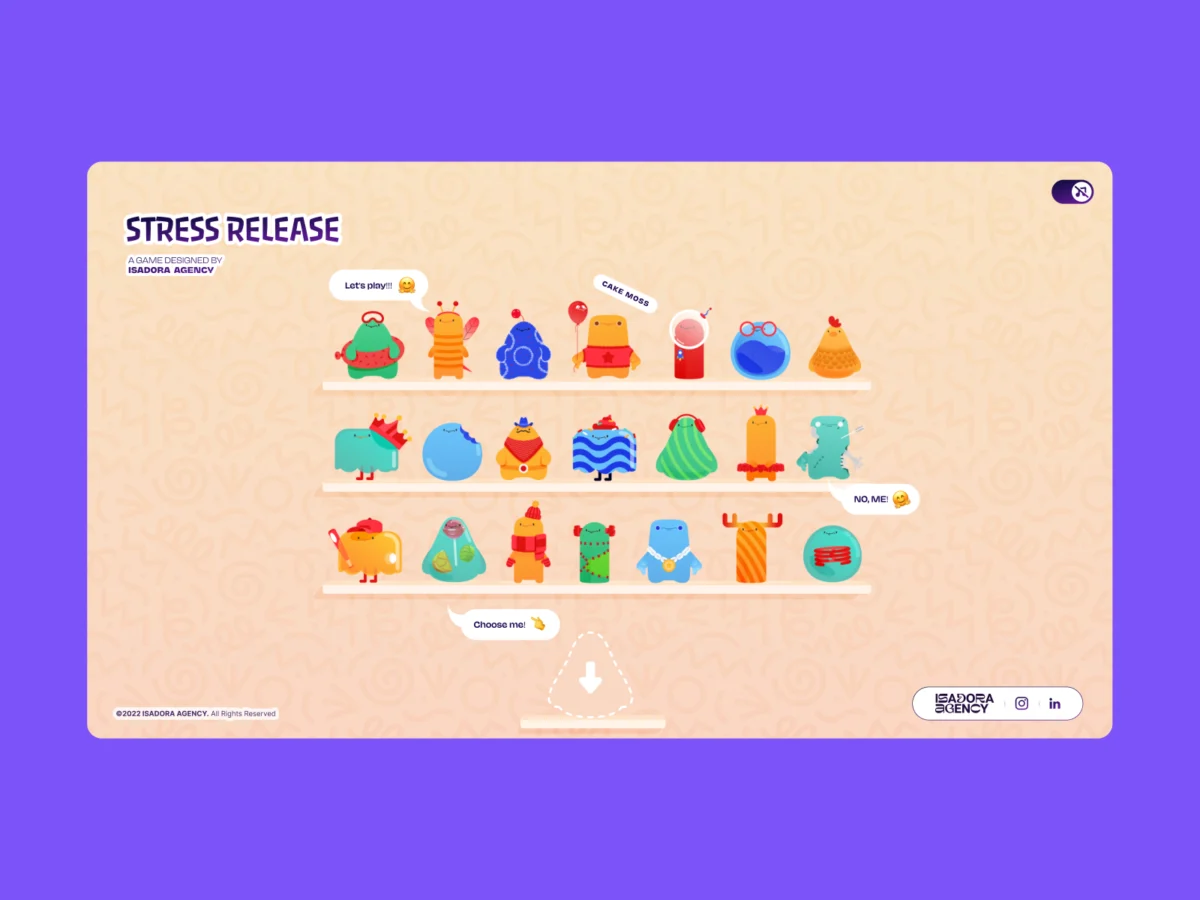
In an era where digital interfaces are increasingly judged by their "feel" and responsiveness, the web development community has reached a critical crossroads between algorithmic simulation and designer-led precision. When Isadora Agency, a prominent digital firm, set out to develop its "Stress Release" project—a digital stress-relief tool designed for burnt-out creative professionals—they faced a fundamental architectural choice. The project required a highly interactive environment where users could smash, stretch, and distort a cast of 21 unique animated characters. While the industry standard for such tactile experiences typically involves complex physics engines like Matter.js, Cannon.js, or custom WebGL solutions, the development team, led by Alexey Kopytin, ultimately rejected these established norms in favor of a more deterministic, math-based approach utilizing Lottie animations and DOM manipulation.
The Conflict Between Plausible and Intentional Motion
The decision to bypass traditional physics engines was rooted in a fundamental realization regarding the nature of the project. Physics engines excel at "plausible motion"—motion that follows the laws of gravity, friction, and inertia to create a realistic simulation. However, for a gamified experience like Stress Release, the creative team required "intentional motion." In this context, intentionality refers to specific, handcrafted animation sequences where every frame of a character’s "squish" or "bounce" is curated by an artist to convey a specific personality or emotional response.
When developers use a physics engine, they relinquish a degree of control to the algorithm. A character might bounce realistically, but it may not bounce in a way that feels satisfying or "correct" according to the art director’s vision. By choosing to build without a physics engine, Isadora Agency prioritized the integrity of the animators’ work, ensuring that the interaction layer served as a trigger for bespoke Lottie animations rather than a simulation that might overwrite carefully crafted keyframes.
The Architecture of Tactile Feedback: A Mathematical Framework
The technical backbone of the Stress Release project rests on radial input mapping and distance-based mathematics. Without the collision detection built into a physics engine, the team had to create a custom "hitbox" system that translated user clicks into meaningful game data.
The process begins with converting a user’s click coordinates from the global page space into the local coordinate space of the character. By identifying the center point of a character (the $x_center$ and $y_center$) and comparing it to the coordinates of the click ($X, Y$), the system calculates the vector from the center to the point of impact. Using the Pythagorean theorem ($a^2 + b^2 = c^2$), the developers derived the straight-line distance from the center.

This single numerical value—the distance—becomes the primary driver for the entire user experience. It determines three critical outputs:
- Scoring Accuracy: A concentric zone system assigns points based on proximity to the center, ranging from 100 points for a "bullseye" (distance < 10) to zero for a complete miss.
- Feedback Intensity: The distance determines which specific animation segment is triggered, allowing for "light," "medium," or "heavy" reactions.
- Visual Alignment: The system repositions an "explosion" Lottie animation to the exact (a, b) vector of the click, ensuring that the visual feedback is spatially accurate.
This mathematical approach provides a level of deterministic control that physics engines often lack. Because the hitbox is a clean, calculated circle, the visual complexity of the character—no matter how distorted it becomes—does not interfere with the reliability of the hit detection.
Chronology of Development and Prototyping
The development of Stress Release followed a structured timeline that reflects the iterative nature of high-end web design:

- Phase 1: Conceptualization and Art Direction. The creative team at Isadora Agency designed 21 distinct characters, each with a unique personality. Animators created bespoke
.jsonLottie files in Adobe After Effects, mapping out specific frame ranges for idle states, reactions, and "mega squeeze" sequences. - Phase 2: Physics Engine Prototyping. The initial development phase explored the use of Matter.js to handle the tactile interactions. However, the team quickly found that the engine’s approximations often conflicted with the specific timing and easing curves designed by the animators.
- Phase 3: The Pivot to Programmatic Control. Recognizing the need for absolute control, the team scrapped the physics engine. They shifted to using the Lottie native API to control the timeline of the animations programmatically.
- Phase 4: Implementation of State Management. Developers built a state machine to handle the transition between different animation segments. This ensured that if a user clicked a character multiple times in rapid succession, the animation would skip to the next logical "squeeze" state rather than resetting awkwardly.
- Phase 5: Mobile Optimization and Launch. The final phase involved stress-testing the application on mobile devices, leading to the implementation of tiered rendering quality to manage the performance cost of multiple simultaneous SVG animations.
Performance Optimization: Managing the Weight of Lottie
While the Lottie-based architecture solved the problem of intentional motion, it introduced a significant challenge regarding performance and file size. Lottie JSON files, while more efficient than traditional video, can become heavy when 21 different characters and multiple explosion variants are loaded simultaneously.
To maintain a fluid experience, particularly on mobile hardware, the team implemented a "context-aware" rendering strategy. On the "Character Shelf" screen, where all 21 characters are visible at once, the animations are set to 50% quality. This reduces the interpolation calculations required by the browser. Additionally, the speed of these background animations is reduced to 60% of their original rate, further lowering the frame-per-second (FPS) burden on the CPU.
Conversely, when a user selects a single character to interact with on the "Play Screen," the system shifts resources. The selected animation is rendered at 100% quality, as the browser only needs to manage one active Lottie instance and the associated click-event mathematics. This tiered approach allows the application to feel premium and high-fidelity without crashing lower-end mobile browsers.

The Role of CSS Variables in Responsive Design
Another advantage of the DOM-based architecture was the ease of creating a truly responsive experience. Traditional game engines often require complex scaling of bounding boxes and collision vectors when a window is resized. By staying within the standard DOM, Isadora Agency was able to leverage CSS custom properties (variables) to handle resizing.
The team implemented a script that recalculates the viewport height and width on every resize event, updating CSS variables like --doc-height. Because the Lottie animations are contained within standard SVG elements, they scale naturally according to CSS rules. This ensures that the interaction math remains consistent regardless of the device’s aspect ratio, as the "local coordinate space" of the character scales proportionally with its container.
Implications for the Future of Web UX
The success of the Stress Release project offers a compelling case study for the "less is more" philosophy in web architecture. It demonstrates that for many interactive experiences, the overhead of a full physics simulation is not only unnecessary but can be counterproductive to the goals of the design team.

Industry analysts suggest that this "intentional motion" approach is likely to gain traction as brands seek to create more branded, character-driven digital experiences. By using Lottie as a state machine rather than just a playback tool, developers can create "tactile" interfaces that feel physically present without the unpredictability of a physics engine. This bridge between the designer’s timeline and the developer’s code allows for a more harmonious collaboration, ensuring that the final product is an exact reflection of the artistic vision.
Furthermore, this methodology highlights a shift toward "math-first" interaction design. By relying on fundamental geometry and trigonometry rather than third-party libraries, developers can build lighter, faster, and more maintainable codebases. As mobile performance continues to be a primary concern for global audiences, the ability to deliver rich, interactive content through optimized SVG and DOM manipulation will remain a vital skill set for front-end engineers.
In conclusion, Isadora Agency’s Stress Release project serves as a blueprint for honoring intentional design in a digital medium. By mapping Lottie’s native timeline capabilities to the DOM and using precise mathematical triggers, the team delivered a tactile experience that is both technologically efficient and artistically uncompromising. The project stands as a reminder that the best technology for a job is the one that serves the art, not the one that dictates it.

