
The global technology sector has reached a critical inflection point in user experience (UX) design, currently characterized by what industry experts describe as conversational tunnel vision. As Large Language Models (LLMs) have become the primary engine for digital innovation, a default design pattern has emerged: the ubiquitous chat bubble. While these dialogue-based interfaces are a natural byproduct of models trained on human conversation, a growing movement of design practitioners argues that the industry’s over-reliance on chat-based interaction is creating significant barriers to efficiency, accessibility, and user safety. The challenge facing modern product teams is no longer just the intelligence of the underlying AI, but the modality through which that intelligence is delivered.
The Rise of the Universal Chat Interface
The current dominance of the chatbot can be traced to the rapid proliferation of generative AI tools following the public release of ChatGPT in late 2022. Because these models are fundamentally built on "next-token prediction" within a conversational framework, the chat interface appeared to be the most intuitive delivery mechanism. However, this "blank slate" approach often ignores the fundamental principles of human-computer interaction (HCI).
In a traditional graphical user interface (GUI), menus and buttons serve as "affordances"—visual cues that signal what an application is capable of doing. By contrast, a blank chat box forces the user into a state of "choice paralysis." Users are required to not only understand their own goals but also to possess the linguistic precision to describe those goals in a way the machine understands. This shift represents a significant transfer of effort from the system to the user, effectively imposing a "psychological tax" on every interaction.
The Linguistic and Cognitive Barriers of Chat
The limitations of conversational AI are most visible when evaluated through the lens of input and output modalities. Modality, defined as the sensory channel through which a human interacts with a system—seeing, hearing, touching, or speaking—must be matched to the user’s immediate environment and intent.
On the input side, the text box acts as a linguistic barrier. For many professionals, translating a visual or spatial thought into a written prompt is an unnecessary creative burden. For example, a designer seeking to adjust the lighting of an image finds more utility in a slider than in a descriptive sentence. A manager attempting to reorganize a complex team schedule finds drag-and-drop calendar blocks more intuitive than explaining those shifts in a paragraph.
On the output side, the "cognitive tax" of reading long blocks of text is often overlooked. Text is a serial medium; the human brain must process it word by word to extract meaning. This is highly inefficient for data-rich environments where visual formats—such as charts, maps, or color-coded dashboards—allow for "parallel processing." In high-stakes environments like medicine or finance, forcing a professional to read a narrative summary of vital signs or stock movements instead of providing a glanceable visual can lead to fatigue and increased error rates.
Chronology of Modality Evolution
To understand the current friction, it is helpful to look at the timeline of interface evolution:

- 2022–Early 2023: The Chat-First Era. Following the success of OpenAI’s early models, almost every enterprise software suite integrated a "Copilot" or "Assistant" in a side-rail chat window.
- Late 2023: The Multimodal Shift. Models began to support image and audio inputs (e.g., GPT-4V, Gemini 1.5). Despite this, the primary interaction container remained the chat thread.
- 2024: The Contextual Realization. UX researchers began documenting "AI fatigue." Data indicated that while users appreciated AI’s power, they were frustrated by the "prompt engineering" required to use it and the "wall of text" responses they received.
- Present: The Push for Adaptive Modality. The industry is moving toward "invisible AI," where the capability is integrated directly into existing workflows—buttons that predict the next action, sliders that control generative outputs, and ambient voice alerts.
Supporting Data: The Cost of Inefficiency
Recent studies in cognitive load theory suggest that "adaptation load"—the effort required for a human to accommodate a machine’s communication style—is a leading cause of software abandonment. In enterprise settings, a 2023 survey of knowledge workers found that 42% felt that "conversing" with AI tools often took longer than performing the task manually using traditional software shortcuts.
Furthermore, accessibility data highlights the risks of a chat-only approach. While visual dashboards are efficient for many, they can be exclusionary for users with visual impairments. Conversely, voice-only interfaces are useless in loud industrial environments or private office settings. The consensus among accessibility advocates is that AI must offer "modality multiplication"—providing multiple pathways to the same information to accommodate different physical and cognitive needs.
The Task Audit: A Framework for Design Selection
To move beyond conversational tunnel vision, design teams are adopting the "Task Audit" framework. This evidence-based approach requires researchers to observe work in its natural setting before deciding on an interface. The audit focuses on four critical dimensions:
- Input Constraints: Are the user’s hands occupied? Are they wearing protective gear like gloves? Are they in a mobile or stationary environment?
- Output Constraints: Is the user "eyes-busy"? Is there high ambient noise? Is the screen subject to glare?
- Cognitive Load: Is the user performing a high-stakes task where verification speed is critical? Is the information density high or low?
- Social and Environmental Context: Is the user in a sterile environment (like an operating room) where they cannot touch surfaces? Are they in a public space where voice input would be a privacy risk?
By answering these questions, teams can map user intent to an "Input/Output Alignment Matrix." For instance, a "Quick Status Check" might best be served by a voice query and a push notification, whereas "Complex Analysis" requires a GUI with filters and a visual dashboard.

Case Study: High-Voltage Utility Maintenance
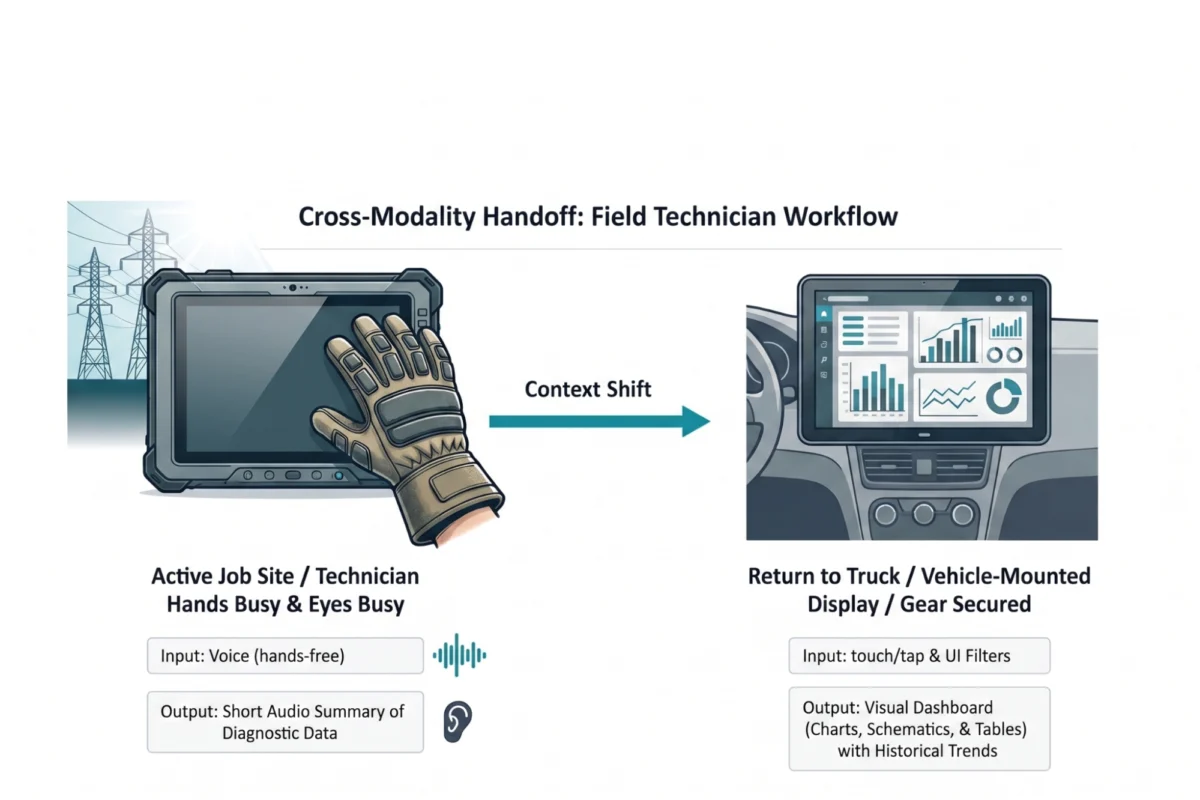
A primary example of the failure of standard AI interfaces occurred in the utility sector. Field technicians servicing high-voltage electrical grids were initially provided with ruggedized tablets featuring a chat-based AI assistant to help diagnose faults. In practice, the tool was nearly unusable.
Technicians, often suspended in bucket trucks and wearing thick, insulated gloves, found it impossible to type booking numbers or diagnostic queries into a chat box. Furthermore, reading dense text summaries of system health while under direct sunlight—which caused significant screen glare—created a dangerous distraction from the high-voltage equipment they were handling.
The solution was a pivot to adaptive modality. Researchers implemented a "voice-first" input system that allowed technicians to query the system hands-free. The AI was programmed to respond with short audio summaries for immediate "glance verification." Once the technician returned to the safety of their vehicle, the system automatically handed off the data to a large, high-resolution dashboard for deeper analytical work. This transition from "chat-default" to "context-aware" design reportedly reduced diagnostic time by 20% and significantly improved safety compliance.
Industry Reactions and Expert Analysis
UX practitioners are increasingly vocal about the need for this shift. "We have fallen into a trap where we treat the LLM as the product, rather than the engine," says one lead designer at a major Silicon Valley firm. "A brilliant model packaged in a lazy text interface is a failure of design. We owe it to the user to make the AI fit their world, not the other way around."

Analysts suggest that the next generation of successful AI products will not look like chatbots at all. Instead, they will be "intent-aware" interfaces that change their modality based on the user’s device, location, and even the time of day. This "ambient AI" would provide haptic feedback during a workout, voice summaries during a commute, and complex data visualizations when the user is at a desk.
Broader Implications and the Future of Interaction
The implications of this shift extend beyond simple convenience. As AI is integrated into more critical infrastructure—from air traffic control to emergency surgery—the ability to match modality to cognitive load becomes a matter of public safety.
The future of AI interface design is likely to be a diverse ecosystem of visual, vocal, haptic, and ambient channels. The chat window will remain a valuable tool for exploratory research and creative brainstorming, but it will lose its status as the default interface for every task. By grounding design decisions in the physical and social realities of the user’s environment, the industry can finally move past the novelty of "talking to a machine" and toward the reality of a machine that truly understands and assists the human.
In conclusion, the path forward requires a departure from the screen-centric thinking of the last decade. Product teams must embrace the Task Audit, utilize the Alignment Matrix, and, most importantly, leave the office to observe how their tools are used in the "wild." Only then can the true potential of artificial intelligence be realized—not as a box to be chatted with, but as a seamless, natural extension of human capability.

