
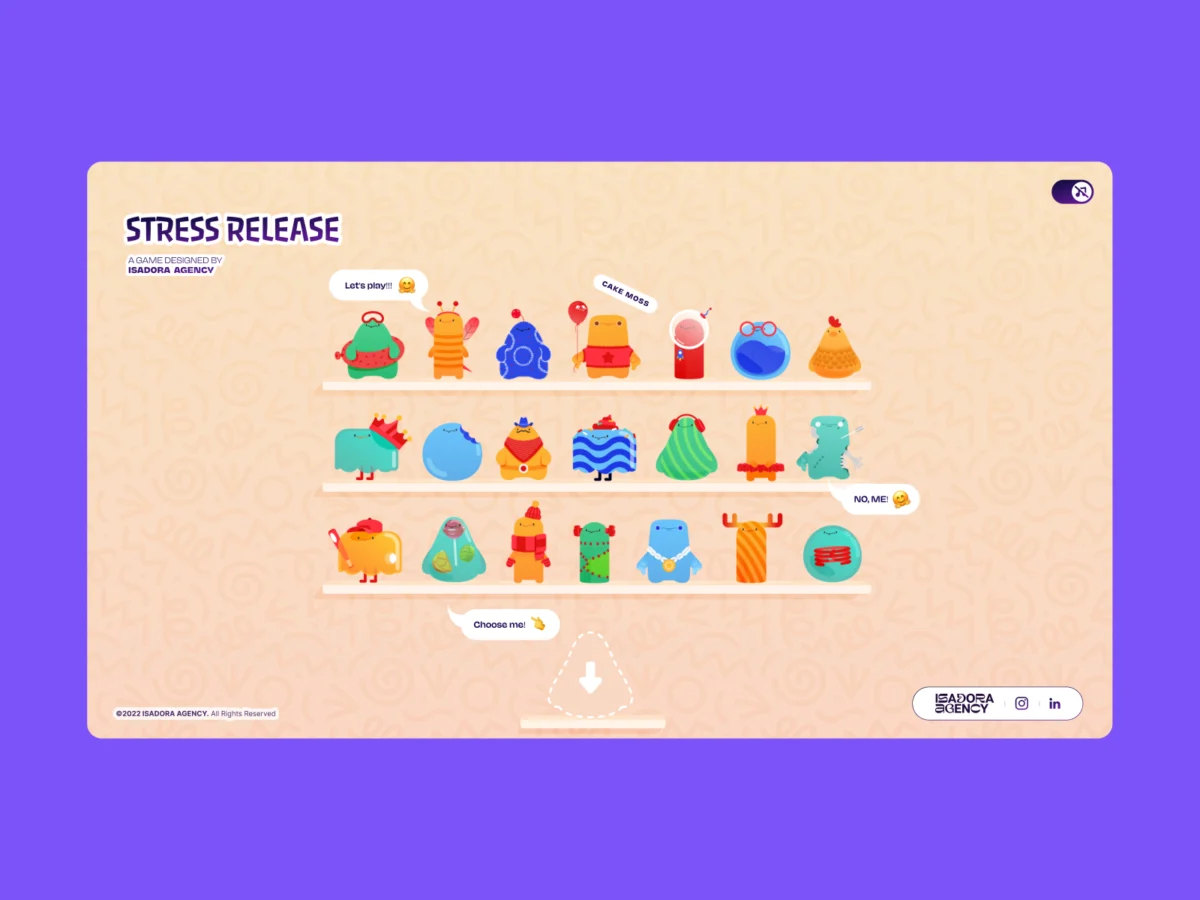
In an era where web interfaces are increasingly expected to mimic the physical world, the technical approach to achieving "tactility" has become a central point of contention among front-end architects and UX engineers. Isadora Agency, a prominent digital design firm, recently challenged the industry-standard reliance on physics engines during the development of "Stress Release," a digital stress-relief application. While frameworks like Matter.js, Cannon.js, and custom WebGL solutions have long been the gold standard for creating immersive, gamified websites, the team at Isadora Agency discovered that these tools often prioritize algorithmic plausibility over artistic intent. By pivoting away from emergent physics and toward a system of programmatic Lottie state controls, the agency has demonstrated a new methodology for maintaining absolute control over motion design in high-stakes interactive environments.
The Architectural Pivot: From Simulation to Intentionality
The development of "Stress Release" began with a seemingly simple objective: to create a digital squeeze toy that allows users—specifically burnt-out creatives—to smash, stretch, and distort animated characters. The project required a high degree of "squishiness," a tactile quality that suggests physical mass and resistance. Initially, the development team explored the implementation of a 2D physics engine. The rationale was that a physics-based system would naturally handle the collisions and deformations required for a satisfying user experience.
However, during the prototyping phase, a significant friction point emerged between the creative vision and the technical execution. Physics engines operate on the principle of emergent behavior; they calculate motion based on forces, gravity, and friction. While this produces realistic results, it often lacks the "personality" required for character-driven narratives. The agency’s animators had crafted bespoke sequences that required exact, frame-by-frame sequencing to convey specific emotions and reactions.
Alexey Kopytin, a lead developer on the project, noted that physics engines produce motion that is merely plausible, whereas the designers required motion that was intentional. This realization led to the decision to scrap the physics engine entirely. Instead, the team opted for an architecture built on the Lottie framework, utilizing JSON-based vector animations rendered as SVGs, controlled through DOM events and distance-based mathematics.
The Technical Framework: Radial Input Mapping and Geometry
To achieve a tactile feel without a physics engine, Isadora Agency implemented a "radial input mapping" system. This approach relies on the Pythagorean theorem to translate user interactions into specific animation triggers and scoring rewards. The core of the interaction layer is the conversion of a click or tap from global page coordinates into the local coordinate space of the animated character.

The process begins by identifying the center point of the character element within the browser’s viewport. When a user clicks, the script calculates the distance between the click coordinates and the center of the character. By using the formula Math.hypot(a, b), where ‘a’ and ‘b’ represent the horizontal and vertical offsets from the center, the system generates a single numerical value representing the distance.
This distance value serves as the primary driver for the game’s logic. The agency established a concentric zone system, effectively creating a "bullseye" hitbox around each character. A click closer to the center yields higher points and a more intense visual reaction, while clicks further away trigger lighter "squish" animations. This deterministic approach ensures that the visual feedback is always perfectly aligned with the user’s input, creating a sense of spatial accuracy that mimics physical contact.
Chronology of Development and Optimization
The transition from a physics-based model to a Lottie-based model followed a structured timeline that prioritized performance and cross-platform compatibility.

- Conceptualization and Asset Creation: Animators developed 21 unique characters, each with a distinct personality. These were exported as Lottie JSON files, containing various states including idle loops, light reactions, medium reactions, and "mega-squeeze" sequences.
- The Physics Engine Prototype: Early builds used Matter.js for collision detection. The team found that the "bounce" felt generic and often obscured the nuanced work of the animators.
- The Pivot to Programmatic Control: The architecture was rewritten to use the Lottie native API. This allowed developers to jump to specific frame ranges (e.g., frames 41-80 for a "light squeeze") with millisecond precision.
- Responsive Integration: Rather than using complex scaling algorithms common in WebGL, the team utilized CSS custom properties (variables) to handle responsive resizing. By recalculating the viewport height and width on every resize event, the Lottie SVGs remained perfectly scaled within their DOM containers.
- Performance Optimization: Recognizing that 21 simultaneous Lottie animations could tax mobile processors, the team implemented a dual-quality rendering system. On the "character shelf" screen, where multiple animations play, quality was reduced to 50% and playback speed to 60%. On the active "play" screen, where only one character is visible, the engine was set to 100% quality.
Supporting Data: The Cost of Visual Fidelity
The decision to use Lottie over a physics engine involves a trade-off between CPU overhead and network payload. Physics engines are generally light on initial download but heavy on real-time CPU calculations due to the continuous solving of mathematical constraints. In contrast, Lottie files can be substantial in size.
In the "Stress Release" project, the cumulative size of the 21 character JSON files and their associated explosion variants posed a challenge for mobile performance. According to industry benchmarks, a complex Lottie animation can range from 100KB to over 1MB. By optimizing the JSON structures and implementing "lazy loading" for characters not currently in view, Isadora Agency maintained a fluid 60 frames-per-second (FPS) experience across most modern devices.
The use of SVGs within the DOM also provided a distinct advantage in terms of accessibility and SEO. Unlike a Canvas-based WebGL experience, which is essentially a "black box" to screen readers and search engines, the Lottie-rendered SVGs remain part of the document object model, allowing for better integration with standard web technologies.

Official Responses and Industry Implications
The methodology employed by Isadora Agency reflects a broader trend in high-end web development: the return to "bespoke" motion. While the "no-code" and "engine-first" movements have dominated the last decade, there is a growing realization that these tools can lead to a homogenization of digital experiences.
Industry analysts suggest that the "intentional motion" approach is particularly valuable for brand-centric projects where the "feel" of an interaction is as important as its function. By bypassing the "uncanny valley" of physics simulations—where objects move almost, but not quite, like their real-world counterparts—developers can create experiences that feel more like interactive cartoons or high-end motion graphics.
"By mapping Lottie’s native timeline capabilities to the DOM," the agency stated in their technical retrospective, "you can deliver incredibly rich, tactile user experiences while maintaining absolute control over the art direction." This sentiment is echoed by UX designers who argue that the future of the web lies in "deterministic interactivity," where every user action results in a handcrafted, rather than calculated, response.

Broader Impact on Front-End Architecture
The success of "Stress Release" offers several key takeaways for the developer community. First, it validates the use of the DOM for complex interactive games, provided the math is handled efficiently. Second, it highlights the importance of the Lottie API as a bridge between motion design and functional code.
Furthermore, this approach simplifies the developer-designer handoff. In a physics-based workflow, a designer might provide a video reference, and the developer must then attempt to recreate that motion using variables like "mass" and "restitution." In the Lottie-based workflow, the designer provides the actual motion in the form of a JSON file, and the developer simply triggers the appropriate segments. This ensures that the final product is an exact replica of the designer’s vision.
As web browsers continue to improve their handling of SVG and vector data, the barriers to high-fidelity, tactile UX are falling. The "Stress Release" project serves as a blueprint for how agencies can leverage existing web standards—HTML, CSS, and JavaScript—alongside specialized animation tools to create experiences that are both technically robust and artistically uncompromising. In the evolving landscape of digital design, the move toward intentionality over simulation may well define the next generation of interactive storytelling.

