
The reintroduction of the Patient Matching and Transparency in Certified Health IT (MATCH IT) Act in March 2025 marks a pivotal moment in the ongoing effort to modernize the United States’ fragmented healthcare infrastructure. Sponsored by Representatives Mike Kelly (R-PA) and Bill Foster (D-IL), the bipartisan legislation aims to confront a systemic failure that has plagued the American medical system for decades: the inability to consistently and accurately link patients to their medical records across different healthcare providers. While the bill has garnered significant support from prominent industry groups—including the American Health Information Management Association (AHIMA), the Healthcare Information and Management Systems Society (HIMSS), the College of Healthcare Information Management Executives (CHIME), the American Medical Informatics Association (AMIA), and the American College of Physicians (ACP)—it also arrives amid a technical debate regarding whether its provisions go far enough to solve the root causes of patient mismatching.
The Magnitude of the Patient Matching Crisis
Patient matching is the process of linking a patient’s data across various health information technology systems to ensure that a provider has a complete and accurate picture of a person’s medical history. In the current decentralized landscape, where patients frequently move between different primary care physicians, specialists, hospitals, and pharmacies, the lack of a unified identification system has led to staggering inefficiencies.
Data from Black Book Research highlights the severity of the economic impact, revealing that approximately one in three healthcare claim denials is the direct result of inaccurate patient matching. For the average hospital, these errors translate to an annual loss of $2.5 million. On an industry-wide scale, the financial burden is estimated at $6.7 billion per year. Beyond the financial drain, the clinical risks are profound. Research from the Pew Charitable Trusts has shown that match rates between disparate healthcare organizations can be as low as 50% in certain interoperability scenarios. This means that in half of all cases where data is exchanged between systems, the receiving clinician may not be able to confidently associate the incoming records with the correct patient, leading to a fragmented and potentially dangerous view of the patient’s health.
A Chronology of Fragmentation and Legislative Efforts
The struggle for patient data integrity is not a new phenomenon. Its origins can be traced back to the Health Insurance Portability and Accountability Act (HIPAA) of 1996. While HIPAA originally called for the creation of a unique individual health identifier (UPI), a subsequent 1998 legislative ban—driven by privacy concerns—prevented the Department of Health and Human Services (HHS) from using federal funds to develop or finalize such a standard. This ban, often renewed through the annual appropriations process, forced the healthcare industry to rely on "probabilistic matching," which uses varying combinations of demographic data like names, birthdates, and addresses to guess a patient’s identity.
Over the last decade, as the adoption of Electronic Health Records (EHRs) reached near-ubiquity, the limitations of these demographic-based methods became undeniable. In 2019, the RAND Corporation found that even within a single organization, patient-to-record mismatches occurred roughly 8% of the time. The Office of the National Coordinator for Health Information Technology (ONC) further reported that when records are exchanged across different health systems, error rates frequently climb to 50% or 60%.
The MATCH IT Act was first introduced in previous sessions of Congress as a response to this growing data crisis. Its 2025 reintroduction follows years of advocacy by health IT experts who argue that while a national identifier remains politically sensitive, the government must at least standardize how matching is performed and measured to reduce the prevalence of duplicate records and "overlays"—where one patient’s information is incorrectly merged into another’s file.
Technical Provisions and Objectives of the MATCH IT Act
The MATCH IT Act of 2025 focuses on transparency and the standardization of performance metrics rather than mandating a single technological solution. The primary objectives of the legislation include:
- Standardizing Performance Measurement: The bill requires the ONC to establish a uniform set of metrics for measuring the effectiveness of patient matching within certified health IT. This ensures that vendors and providers are using the same "yardstick" to evaluate how often their systems successfully or unsuccessfully match records.
- Mandatory Reporting: Certified health IT developers would be required to report on their systems’ matching performance. This data would provide the federal government and healthcare purchasers with a clearer picture of which technologies are failing and which are succeeding.
- Transparency in Methodology: The Act encourages vendors to be more transparent about the algorithms they use. By understanding the underlying logic of a matching engine, providers can better configure their systems to minimize errors.
However, the bill has faced criticism from some technical experts who argue that it stops short of prescribing a specific matching methodology. By leaving the choice of technology to the vendors and hospitals, critics suggest the bill may only document the problem rather than solve it, allowing high error rates to persist under the guise of standardized reporting.
The Technical Divide: Probabilistic vs. Hybrid Matching
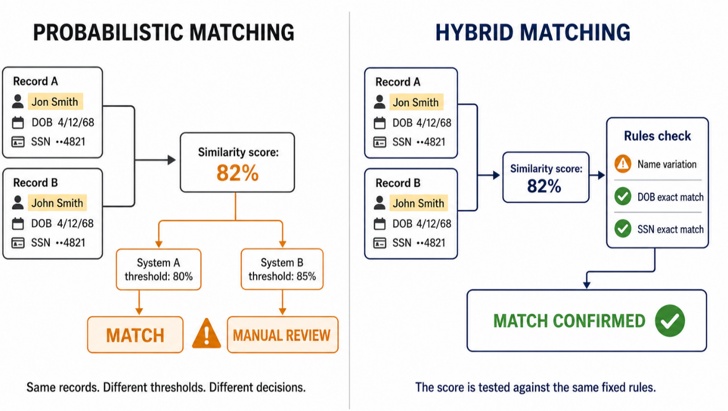
Most current EHR systems utilize "probabilistic scoring" to identify matches. This method assigns weights to various demographic fields—such as first name, last name, date of birth, and Social Security Number (SSN)—and calculates a confidence score. If the score exceeds a threshold set by the hospital, the records are merged. If it falls into a "gray area," the record is sent for manual review by a health information management professional.
A study published in the Journal of the American Medical Informatics Association (JAMIA) noted that because every health system sets its own confidence thresholds, the same pair of records can be treated differently by two different hospitals. This inconsistency is a primary driver of interoperability failures.
In contrast, many experts are now advocating for "hybrid deterministic-probabilistic strategies." A deterministic match requires an exact character-for-character match on specific identifiers (like an SSN or a state-issued ID number). A hybrid approach uses deterministic rules for high-certainty fields while applying probabilistic logic to others, such as name variants (e.g., "Robert" vs. "Bob") or address changes.
Proponents of the hybrid model argue it is significantly more robust. By tracking a wider array of data points—including legal name, date of death, record ownership status, and place-of-birth codes—hybrid systems can resolve matches that traditional EHR systems would flag for manual review or, worse, fail to match entirely.
Lessons from the Social Security Administration and Vital Records
The risks of faulty patient matching were underscored in early 2025 by a high-profile failure within the Social Security Administration (SSA). The agency mistakenly declared two living men dead due to demographic mismatches in their database. The error resulted in the immediate termination of their benefits, and the fallout took months of administrative labor to resolve.
This incident serves as a cautionary tale for the healthcare industry. While the SSA deals with financial benefits, healthcare systems deal with life-and-death information. A "false positive" match in a hospital—merging a healthy patient’s record with one containing a severe drug allergy or a different blood type—can lead to fatal clinical errors.
State vital records systems, which manage approximately 2.8 million death registrations annually, have pioneered the use of hybrid matching to mitigate these risks. These systems feed data to Medicare, insurers, and pension boards. To prevent fraudulent claims or the accidental termination of benefits, many states now use hybrid strategies that combine deterministic SSN checks with probabilistic name-variant analysis. This methodology has proven highly effective in catch-all scenarios that narrower EHR-style matching would miss.
Industry Support and Implementation Challenges
Despite the technical debates, the MATCH IT Act has received broad support from the healthcare community. Organizations like AHIMA and HIMSS view the bill as a necessary first step toward accountability. In a joint statement, supporters emphasized that without federal standards for transparency, the industry remains in the dark about the true extent of the matching problem.
"Accurate patient matching is the cornerstone of a safe and efficient healthcare system," stated a representative from a leading health IT association. "The MATCH IT Act provides the framework for transparency that we have lacked for decades. While it may not prescribe the final technical solution, it forces the industry to confront its failures with hard data."
However, implementing more advanced matching strategies, such as the hybrid model, is not without challenges. The ONC has previously noted that hybrid systems require complex configuration, rigorous governance, and constant monitoring. For smaller hospitals with limited IT staff, moving away from the "out-of-the-box" probabilistic settings of their EHR vendor can be a daunting and expensive task. Furthermore, even with a hybrid model, the lack of a universal identifier means that some degree of error is mathematically inevitable.
Broader Implications for the Future of Healthcare
The outcome of the MATCH IT Act will have long-term implications for the trajectory of American healthcare. As the industry moves toward value-based care models—which reward providers for patient outcomes rather than the volume of services—the need for a longitudinal, accurate patient record becomes essential. Fragmented data leads to redundant testing, which inflates costs and frustrates patients.
Moreover, the rise of artificial intelligence (AI) in medicine relies heavily on data quality. If the underlying data used to train clinical AI models is riddled with duplicate records or mismatched histories, the resulting "insights" could be fundamentally flawed. Ensuring data integrity at the point of entry is therefore a prerequisite for the next generation of medical innovation.
As the MATCH IT Act moves through the legislative process, health IT leaders are encouraged to evaluate their own internal systems. While federal legislation may provide a standardized framework for the future, the immediate reduction of the $6.7 billion annual loss depends on individual organizations adopting more rigorous matching methodologies today. Whether through the adoption of hybrid models or more stringent data governance, the goal remains the same: ensuring that every patient is correctly identified, every time, across the entire continuum of care.

