
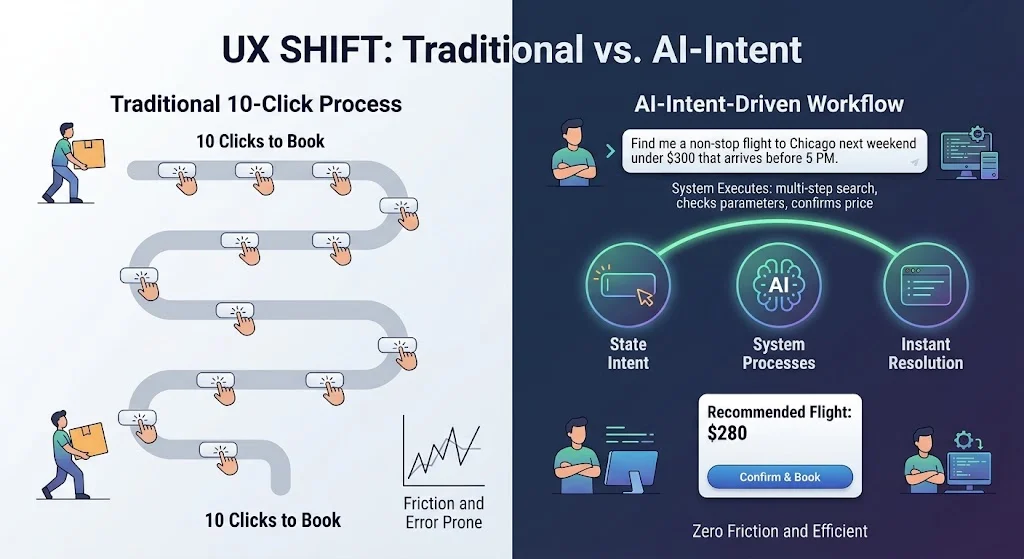
The digital landscape is currently undergoing its most significant architectural shift since the introduction of the mouse. For nearly four decades, the primary contract between humans and computers has been defined by the Graphical User Interface (GUI), a system of visual metaphors including menus, windows, and buttons. However, this paradigm is rapidly being superseded by a new philosophy known as Intent-Driven Design. Driven by breakthroughs in large language models (LLMs) and autonomous agentic systems, the modern web is evolving from a collection of interactive pages into a transparent layer of intelligence that prioritizes human goals over software navigation.
This transition marks the end of the "point-and-click" era. In the legacy model, users were required to act as the primary orchestrators of data, navigating complex funnels and interpreting mechanical outputs to achieve simple results. The emerging model flips this relationship: the software becomes the orchestrator, interpreting high-level human intent and executing the necessary background labor to provide a final resolution. For the global user experience (UX) design community, this represents a fundamental re-evaluation of their professional utility, moving from the creation of visible layouts to the management of invisible, intent-driven experiences.
The Evolution of Interaction: A Chronology of User Interfaces
To understand the magnitude of the current shift, one must view the history of computing through the lens of friction reduction. Each major era of technology has been defined by how it lowered the barrier between human thought and digital execution.

The first era was the Command Line Interface (CLI), dominant through the 1960s and 70s. This required users to learn specific machine languages, creating a high barrier to entry. The second era arrived with the commercialization of the GUI, pioneered by the Xerox Star in 1981 and popularized by the Apple Macintosh in 1984. This era introduced the WIMP (Windows, Icons, Menus, Pointers) paradigm, allowing non-technical users to interact with software through visual metaphors.
By the early 2000s, the Web 2.0 movement expanded the GUI into the browser, leading to the "10-click process" that defines modern e-commerce and SaaS platforms. Users became accustomed to managing the software—filling out multi-step forms, toggling range sliders, and managing dozens of browser tabs—rather than focusing on their actual objectives.
The 2020s have ushered in the fourth era: the Linguistic or Intent-Based Interface. With the arrival of sophisticated AI, the computer can now understand natural language and environmental context. This removes the need for the user to understand the "how" of a digital task, allowing them to focus exclusively on the "what."
The Death of the 10-Click Process: Efficiency Data and Analysis
The inefficiency of current web design is most evident in high-friction tasks such as travel booking or financial planning. In a traditional GUI environment, booking a flight requires a user to navigate a linear path: inputting dates, filtering by airline, comparing prices across multiple tabs, dodging upselling pop-ups, and manually entering payment data.
Industry data suggests that the average consumer visits approximately 38 websites over a 45-day period before booking a trip. This "hyper-interactive" workflow is increasingly viewed as a design failure rather than a feature. Intent-driven design aims to collapse this 38-site, multi-click journey into a single prompt. When a user states, "Find me a non-stop flight to Chicago next weekend under $300," the AI executes the search query, compares the options, and presents a single, actionable result.
This shift is backed by emerging market trends. According to a 2023 report on AI-driven automation, companies implementing "invisible" or agentic workflows saw a 40% increase in user task completion rates compared to those using traditional multi-step forms. The data indicates that as cognitive load decreases, user satisfaction and conversion rates scale proportionally.
Market Leaders in Intent-Based Architecture
Several platforms are already demonstrating how the removal of traditional UI elements can enhance utility. These examples serve as the vanguard for the next decade of web development.
1. Perplexity AI and the Future of Search
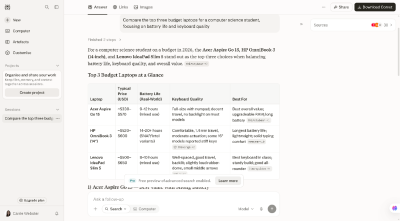
Traditional search engines like Google functioned as directories, providing a list of links that required the user to perform the manual labor of skimming and synthesizing information. Perplexity AI represents the intent-driven alternative. It bypasses the "blue link" model entirely, synthesizing a direct answer from multiple sources. This removes the need for "tab-clutter," as the interface provides the resolution rather than the path to the resolution.
2. Vercel v0: Generative UI in Development
In the realm of design and development, the process has long been tethered to visual builders like Figma or manual CSS coding. Vercel’s v0 platform allows users to describe a functional interface in natural language, which the system then generates in real-time. This "Generative UI" means that the interface is no longer a static asset designed months in advance; it is a dynamic response to a specific user request.
3. Goblin.tools: Cognitive Accessibility
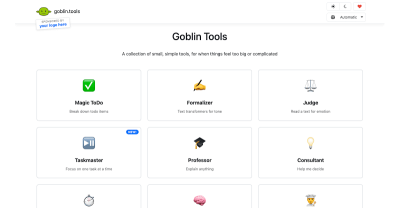
Goblin.tools uses AI to break down overwhelming tasks into manageable steps. For neurodivergent users, the traditional "productivity dashboard" with its myriad of buttons and kanban boards can be a source of anxiety. By focusing on a single input field that converts a vague goal into a checklist, the platform proves that the most powerful tool is often the one with the fewest visible controls.
The Three Pillars of Intent-Driven Design
As the industry moves away from static layouts, designers are coalescing around three core pillars that define the new UX paradigm:
Pillar 1: High-Level Goal Capture
Modern systems are moving toward "ambient design." Guided by Apple’s Human Interface Guidelines, these systems use environmental metadata—location, device state, and past habits—to anticipate needs. An intent-driven interface does not wait for a click; it leverages context to proactively offer solutions.
Pillar 2: Generative UI
The Nielsen Norman Group has identified AI as a new UX paradigm where computing shifts from command-based interaction to outcome-specification. Generative UI allows a website to render a custom layout for a specific user at a specific moment. If a user needs to calculate a mortgage, the interface generates a calculator; once the task is done, the calculator vanishes. The UI becomes "disposable," appearing only when relevant.
Pillar 3: Autonomous Execution by AI Agents
Traditional interfaces are designed for "prevention," using constant confirmation modals to stop errors. Intent-driven design shifts the focus to "reversibility." Following Jakob Nielsen’s usability heuristics, these systems prioritize frictionless "undo" mechanisms. Since an AI agent is performing the task on the user’s behalf, the design must provide transparent audit logs and easy rollback features rather than intrusive warning signs.
Industry Reactions and the Shifting Role of the Designer
The transition to invisible interfaces has sparked a debate within the design community. Prominent figures, including Golden Krishna, author of The Best Interface Is No Interface, argue that the industry has long been addicted to "screen time" as a metric of success.
"The ultimate goal of modern web design is no longer to build prettier buttons; it is to eliminate the interface entirely," Krishna has noted in various forums. This sentiment is echoed by the Center for Humane Technology, which advocates for "Time Well Spent." They argue that software should be measured by how quickly it allows a user to leave the screen, not how long it keeps them there.
However, some designers express concern regarding the "Black Box" problem. If the interface disappears, how does the user troubleshoot an error? The Google PAIR (People + AI Research) Guidebook suggests that designers must become "Intent Architects." Their role is no longer to draw rectangles but to design the feedback loops that allow users to calibrate trust in autonomous systems.
Risks, Ethics, and Technical Challenges
The move toward "no interface" is not without significant risk. When software operates on inferred intent, several ethical and technical pitfalls emerge:
- The Illusion of Control: If a system automates too much, the user may feel a loss of agency. Designers must decide which tasks are "routine" (and thus automatable) and which are "high-stakes" (requiring explicit human confirmation).
- Privacy and Data Harvesting: Intent-driven design requires massive amounts of contextual data to function effectively. This creates a tension between user convenience and data privacy.
- Algorithm Bias: If an AI interprets intent incorrectly due to biased training data, the lack of a visible interface may make it harder for the user to spot and correct the error.
The Broader Impact on the Digital Economy
The "Death of the Button" will have profound implications for the SaaS (Software as a Service) business model. For the last two decades, software value was often equated with the number of features accessible via a navigation bar. In an intent-driven world, value is equated with the speed of resolution.
We are entering an era where engagement metrics—such as page views and click-through rates—will become obsolete. They will be replaced by "Success per Session" and "Time to Resolution." For businesses, this means that the competitive advantage will no longer lie in having the most beautiful UI, but in having the most sophisticated intent-capture engine.
Conclusion
The evolution of the web toward seamless, invisible completion is an inevitability of the AI age. The graphical user interface served as a necessary bridge between the human mind and the machine’s logic for forty years, but that bridge is now being replaced by direct communication. As the digital industry moves forward, the most successful products will be those that solve problems so efficiently that the user hardly notices the software at all. The future of design is not more interaction; it is the elegant, ethical, and absolute disappearance of the interface.

