
The rapid evolution of artificial intelligence from passive chatbots to autonomous agentic systems is forcing a fundamental rethink of user interface design. For over three decades, the primary visual shorthand for system latency has been the "spinner"—a looping animation indicating that a process is underway. However, as AI agents increasingly take on complex, multi-step tasks that involve probabilistic decision-making rather than simple data retrieval, the traditional loading icon is proving insufficient. Modern interface designers are now moving toward a new paradigm of transparency, replacing vague progress indicators with detailed "thinking" patterns that reveal the system’s process, status, and logic in real-time.
The core of this shift lies in the distinction between "loading" and "thinking." Traditional software delays are typically caused by bandwidth limitations or file sizes. In contrast, an AI agent’s delay is often the result of computational reasoning—weighing options, searching for sources, and synthesizing information. When users are presented with a simple spinning wheel during a twenty-second pause, it creates a "black box" effect that breeds anxiety and distrust. Without visibility into the agent’s progress, users are unable to discern whether the system is performing a complex calculation, has stalled, or has crashed entirely.
The Evolution of Latency Indicators: A Brief Chronology
To understand the current crisis in AI transparency, one must look at the history of human-computer interaction (HCI). The first graphical loading indicators appeared in the 1980s, popularized by systems like the Macintosh "watch" and later the Windows "hourglass." These icons served a specific purpose: telling the user that the CPU was busy and the mouse cursor was temporarily disabled.

By the early 2000s, as the web became more dynamic, the "throbber" or spinning ring became the industry standard. These patterns communicated a technical reality of the era—the system was waiting for a server to return a packet of data. However, the emergence of Large Language Models (LLMs) in the early 2020s introduced a new type of latency. In 2023, as "agentic" AI—systems capable of using tools and making independent decisions—began to enter the enterprise space, the limitations of the spinner became a primary barrier to user adoption. Industry research indicates that user trust in AI drops by as much as 40% when a system takes longer than ten seconds to respond without providing a status update.
The Decision Node Audit and the Transparency Matrix
Designing for AI requires what experts call a "Decision Node Audit." This technical methodology involves mapping out the internal workflow of an AI system to identify every point where the agent makes a choice based on probability. Once these nodes are identified, designers create a "Transparency Matrix" to determine which behind-the-scenes actions require a visible status update.

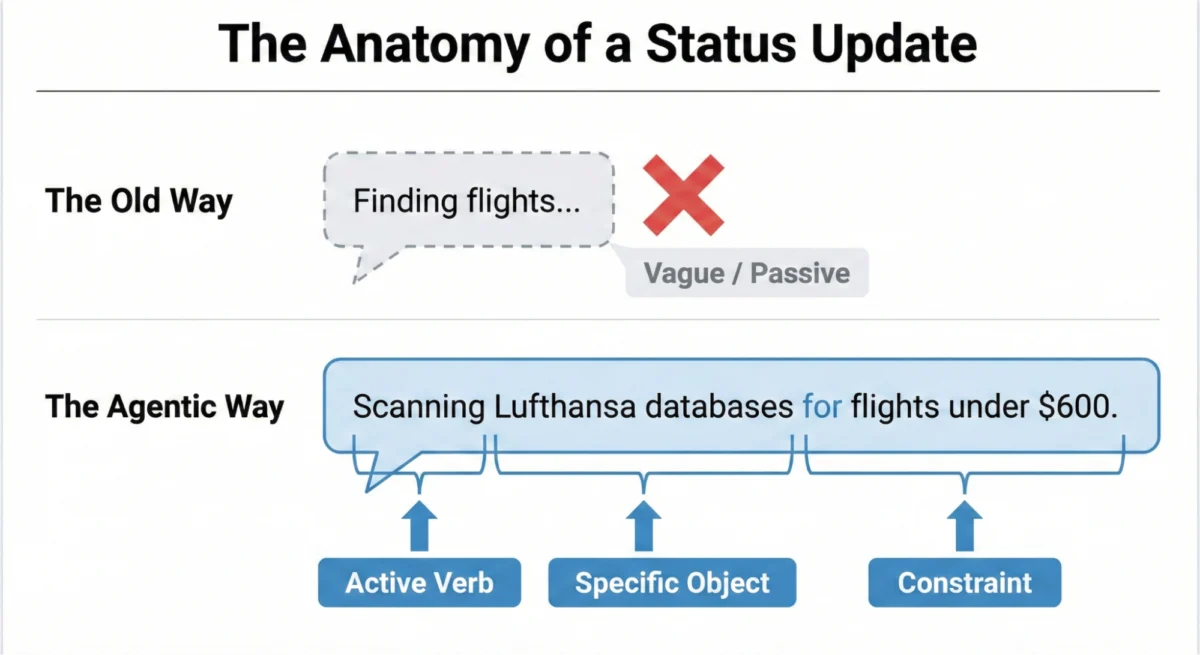
This approach moves away from generic placeholders like "Loading…" or "Working…" which are remnants of static software. Instead, a new formula for "Agentic Microcopy" has emerged. Effective status updates are now constructed using a three-part structure: a strong Action Word, a Specific Item, and defined Limits. For example, rather than "Searching for flights," a transparent agent might display: "Analyzing [Action] 50+ flight options [Specific Item] within your $600 budget [Limit]." This level of detail reassures the user that the AI has understood the constraints of the request and is working within the prescribed boundaries.
Practical Interface Patterns for AI Transparency
As the industry moves away from the spinner, four primary design patterns have emerged as the new standards for agentic transparency.

1. The Living Breadcrumb
For low-stakes, background tasks—such as an AI drafting an email or organizing a file directory—designers are utilizing "Living Breadcrumbs." These are subtle, pulsing indicators located within the application’s periphery. Unlike disruptive pop-ups, the living breadcrumb provides a quiet assurance of activity, transitioning smoothly between text updates like "Reading thread," "Drafting reply," and "Reviewing tone." This pattern addresses the user’s need for awareness without demanding constant attention.
2. The Dynamic Checklist
In high-stakes environments, such as financial services or healthcare, the "Dynamic Checklist" has become essential. This pattern replaces the progress bar with a step-by-step roadmap of the agent’s intended actions. It marks completed steps, highlights the current task, and lists pending actions.

The psychological benefit of this pattern is significant. If a specific step, such as "Verifying account routing numbers," takes an unexpected amount of time, the user remains calm because they can see exactly where the delay is occurring. Technical implementation of this pattern requires robust front-end state management and back-end webhooks to ensure the interface reflects the agent’s real-time position in the workflow.
3. The Thinking Toggle
For power users and developers, the "Thinking Toggle" provides deep transparency. This is a progressive disclosure control, often a chevron or "View Logs" button, that allows the user to expand a friendly status update into a raw terminal view. This view displays the sanitized logic logs of the AI, showing how it is interpreting data and which tools it is calling. While many users may never open this view, its presence acts as a "trust signal," suggesting that the system has nothing to conceal.

4. The Audit Trail
Perhaps the most critical pattern for long-term trust is the "Audit Trail." Because real-time transparency is fleeting, users who return to a completed task need a way to verify the work. An audit trail provides a persistent "receipt" of the agent’s logic. This allows users to spot-check the validity of the output after the fact, ensuring that the AI’s decisions align with their expectations.
Data-Driven Analysis of Tone and Risk
The "Impact/Risk Matrix" is a crucial tool for determining the appropriate "voice" of an AI during these transparency moments. Research into user psychology suggests that the effectiveness of an AI’s tone is directly tied to the level of risk involved in the task.

- Low-Risk Tasks: Conversational, friendly, and human-like tones (e.g., "I’m checking your calendar for the best time to meet") increase user engagement and comfort.
- High-Risk Tasks: Mechanical, precise, and objective tones (e.g., "Verifying 128-bit encryption for data migration") are preferred. Playful language in high-stakes scenarios, such as "I’m thinking hard about your money," can trigger panic and lead to immediate system abandonment.
User research across enterprise sectors confirms that experts—such as insurance underwriters or data analysts—judge AI systems based on "expectation alignment." If a system returns a result that falls outside of an expert’s expected range, they will immediately seek to understand the "why." If the transparency interface has disappeared or was never present, the expert is likely to revert to manual methods, rendering the AI tool a "time-waster" rather than an accelerator.
Case Study: The Transparency Gap in ChatGPT’s Memory
A notable example of the consequences of failed transparency occurred in early 2025 regarding ChatGPT’s "Memory" feature. Developers and users noted that the system was silently storing personal information—such as a user’s location or preferences—and using that data to influence future outputs without clear disclosure.

In one documented instance, a user asked the AI to generate an image of a dog in a costume; the AI spontaneously included a sign for "Half Moon Bay" in the background because it had cross-referenced the user’s location from a previous conversation. Because there was no log or "Audit Trail" explaining why the AI chose to include that specific detail, the interaction felt invasive rather than personalized. This incident underscored the necessity of persistent transparency: users must be able to see not just what the AI is doing now, but what information it is using to shape its decisions.
Broader Implications for the AI Industry
The transition from spinners to transparent agentic patterns is not merely a cosmetic change; it represents a shift in the fundamental relationship between humans and machines. By providing clear status updates, acknowledging partial successes, and disentangling tool failures from AI failures, designers are moving away from "magic tricks" and toward "colleagueship."

A "good colleague" keeps others in the loop, admits when they hit a snag, and explains their reasoning. When AI systems adopt these behaviors through intentional UI design, they cease to be mysterious black boxes. This openness allows users to understand why a certain result was achieved and, more importantly, how they can intervene or guide the system for better outcomes.
As agentic AI becomes more integrated into professional workflows, the "Audit Trail" and "Dynamic Checklist" will likely become as standard as the "Save" icon. The goal of these patterns is to ensure that predictability, reliability, and understanding are treated as the core products of the AI experience. In the burgeoning age of autonomy, transparency is the only sustainable currency for building and maintaining user trust.

