
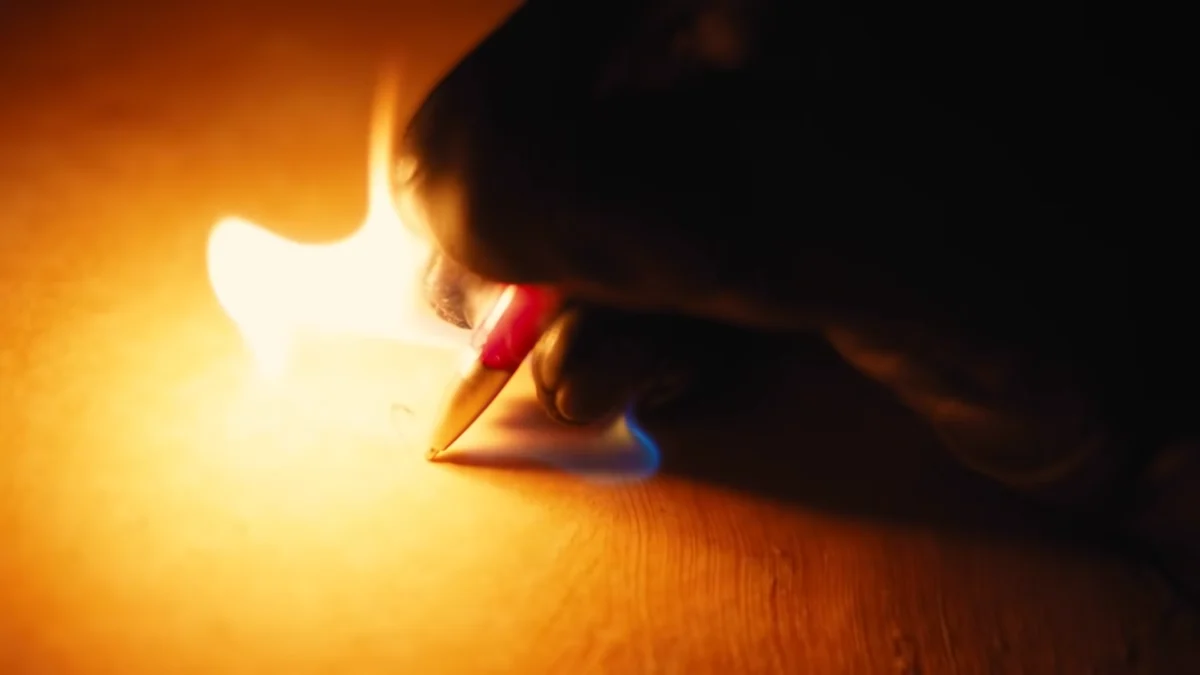
The digital landscape of the late 2010s and early 2020s has been defined by the rapid transformation of high-budget music cinematography into bite-sized, versatile internet memes. Among the most enduring of these visual artifacts is the Gunna Writing Fire clip, a brief yet potent sequence derived from the 2019 music video for Young Thug’s hit single "Hot." Featuring rapper Gunna, the visual depicts the artist seated at a wooden desk, focused intently on a piece of paper as a pen in his hand produces literal flames, eventually engulfing the surroundings. This imagery has transcended its original context to become a universal shorthand for creative excellence, particularly in the realms of screenwriting, lyricism, and comedic irony.
The origin of the visual dates back to November 1, 2019, with the premiere of the "Hot" music video, directed by frequent collaborator Be El Be. The track, which features Young Thug, Gunna, and Travis Scott, was a standout from Young Thug’s debut studio album, So Much Fun. The music video itself was a high-concept production, utilizing pyrotechnics and surrealist imagery to match the "fire" theme of the song’s title. In the specific scene that birthed the meme, Gunna is shown dressed in a vibrant yellow outfit, calmly documenting his thoughts while the table beneath him ignites. The contrast between the artist’s nonchalant demeanor and the escalating inferno provided the perfect foundation for digital reinterpretation. Within three years of its release, the music video accumulated over 183 million views on YouTube, cementing its place in the pantheon of modern hip-hop visuals.
The transition from a cinematic moment to a viral meme occurred almost instantaneously. By November 3, 2019, social media users on Twitter began isolating the clip to serve as a "reaction video." One of the earliest documented instances of this usage came from Twitter user @AyoDerik, who applied the clip to a caption regarding the high-quality writing of the manga series Gintama. This established the primary "use case" for the meme: a visual representation of a writer or creator producing work of such exceptional quality that it metaphorically "sets the world on fire."
The Evolution of the GIF Caption Format
Throughout 2020 and 2021, the Gunna Writing Fire clip evolved from a simple reaction video into a structured "GIF caption" format. This format typically features a white border at the top of the GIF containing text, a style popularized on platforms like Discord and iFunny. During this period, the meme became a staple within various online subcultures, particularly in the worlds of sports, gaming, and anime. Fans utilized the image to praise showrunners or authors during pivotal plot twists or intense story arcs. For example, in April 2020, the clip was used to describe the work of My Hero Academia creator Kohei Horikoshi, further demonstrating its utility in celebrating "peak" fiction.
While the meme saw a slight decline in frequency during 2021, it experienced a massive resurgence in 2022, driven by two distinct cultural shifts: the rise of "Slowed + Reverb" audio trends on TikTok and the emergence of the "He Didn’t Say That" irony movement.

In April 2022, the clip found a new home on TikTok. Users began pairing the visual of Gunna writing with a "Slowed + Reverb" version of Playboi Carti’s track "Rockstar Made." This specific audio-visual combination added a layer of atmospheric intensity to the meme, often used to describe students performing exceptionally well on unexpected exam questions or individuals coming up with perfect rebuttals in an argument. TikTok user @zach5454 was among the first to see massive success with this iteration, garnering over 1.5 million views and hundreds of thousands of likes.
Intersection with the He Didnt Say That Movement
The most significant evolution of the Gunna Writing Fire meme occurred in July 2022, when it merged with the "He Didn’t Say That" or "Movie Titles in Movie Lines" trend. This specific genre of irony involves creating fake quotes where a character says the name of the movie or video game they are in, usually in a forced or nonsensical manner. The Gunna clip was the perfect accompaniment for these memes, suggesting that the "writer" of the film was a genius for including such a blatant and humorous title drop.
Notable examples of this crossover include a Breaking Bad meme where Walter White supposedly tells Jesse Pinkman, "It’s alright Jesse, you can just call me Breaking," and a JoJo’s Bizarre Adventure version where a character exclaims, "It was truly a bizarre adventure." These posts received tens of thousands of upvotes on subreddits like r/shitposting and r/whenthe, indicating a shift in the meme’s usage from genuine praise to absurdist humor. The meme effectively became a satire of "peak cinema" tropes, mocking the idea of heavy-handed dialogue while simultaneously celebrating the creativity of the internet users who invented these scenarios.
Cultural Significance and Linguistic Impact
The longevity of Gunna Writing Fire can be attributed to the linguistic evolution of the word "fire" in modern slang. As a synonym for "excellent," "impressive," or "trendy," the word "fire" is deeply embedded in the lexicon of Generation Z and Millennials. By providing a literal visual representation of this metaphor, the Gunna clip bypassed the need for complex explanation. It is a visual superlative that is understood across language barriers, making it an ideal tool for global internet communication.
Furthermore, the meme highlights the symbiotic relationship between the music industry and internet culture. High-budget music videos are no longer just promotional tools for songs; they are "content mines" for social media. When directors like Be El Be create striking, meme-able imagery, they extend the "shelf life" of the artist’s work. Gunna’s appearance in the meme has kept his likeness relevant in digital spaces even during periods between album releases, proving that a single well-crafted shot can have more cultural staying power than a traditional marketing campaign.
Analytical Perspectives on Virality
From a sociological perspective, the Gunna Writing Fire meme functions as a form of "digital hyperbole." In an era of information overload, users often resort to extreme imagery to express their opinions. The image of a house burning down because someone is writing too well is the ultimate exaggeration of creative talent. It resonates because it captures the feeling of being "in the zone"—that state of flow where a person feels their output is unstoppable and world-altering.

Technologically, the meme’s success is also a testament to the accessibility of video editing tools. The transition from the original YouTube video to a cropped TikTok clip, and finally to a captioned GIF, shows how easily modern users can manipulate media to fit new contexts. Platforms like Tenor and Giphy have archived the clip under various tags (e.g., "writing," "fire," "genius," "Gunna"), ensuring that it remains easily searchable for anyone looking to emphasize a point about quality content.
Broader Implications and Legacy
As the Gunna Writing Fire meme continues to appear in various forms, it serves as a benchmark for how modern memes are recycled and refurbished. It has moved through three distinct phases: sincere reaction (2019), structured GIF captioning (2020-2021), and ironic meta-humor (2022-present). This trajectory is typical of high-tier memes that possess enough visual clarity to survive multiple shifts in internet aesthetics.
In the broader context of hip-hop’s influence on the internet, Gunna Writing Fire stands alongside other iconic moments, such as Drake’s "Hotline Bling" dances or DJ Khaled’s "Suffering from Success" album cover. It reinforces the idea that rappers are the primary architects of modern cool, providing the visual and linguistic vocabulary that the rest of the internet uses to express itself. Whether it is being used to unironically praise a brilliant piece of literature or to ironically mock a low-budget action movie, the image of Gunna at his desk remains a definitive symbol of the creative spark—quite literally.
As of late 2024, search interest in the meme remains stable, with new variations appearing in response to major cultural events, such as high-profile film releases or viral social media debates. The "Gunna Writing Fire" visual has transitioned from a mere music video scene into a permanent fixture of the digital lexicon, ensuring that as long as people are "writing fire," Gunna will be there to illustrate it.

