
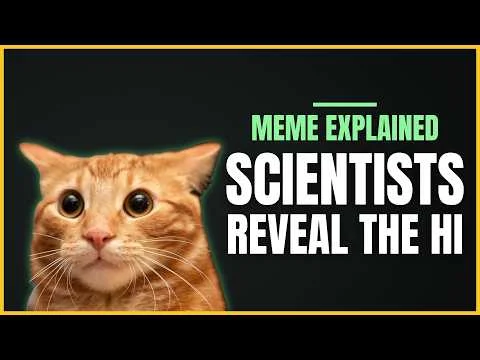
The digital landscape has been significantly altered by the rapid proliferation of a minimalist internet meme known as "scientists reveal the hi," a visual artifact that has achieved saturation across Instagram, TikTok, and various microblogging platforms as of October 2026. This phenomenon centers on a specific image: a high-resolution photograph of an orange domestic shorthair cat positioned beneath a truncated headline that mimics the aesthetic of a BBC News social media thumbnail. While the meme appears to be a product of contemporary "absurdist" or "low-context" internet humor, its origins are rooted in a legitimate scientific inquiry published by the British Broadcasting Corporation (BBC) regarding the unique genetic composition of ginger-furred felines.
The meme typically utilizes a "recaptioning" or "exploitable" format, where the original headline—intended to convey a discovery regarding feline pigmentation—is edited to read simply, "scientists reveal the hi." This linguistic truncation, combined with the earnest expression of the cat in the photograph, has resonated with a global audience, leading to millions of shares and a renewed interest in the underlying science that inspired the original graphic.
The Genesis of the Meme: A Timeline of Scientific Reporting and Digital Mutation
The trajectory of the "scientists reveal the hi" meme began in early 2025, following the publication of a BBC Science & Environment feature titled "Scientists reveal the secret behind why ginger cats are ginger." The article sought to synthesize recent advancements in feline genomics, specifically focusing on the sex-linked inheritance of the "Orange" gene. To promote the story on social media platforms, the BBC’s digital design team created a standardized thumbnail featuring a prominent orange cat against a clean background, accompanied by a bold-font headline.
By mid-2025, the thumbnail began to circulate within niche digital communities on Reddit and Discord. Users started experimenting with the text, a practice common in "shitposting" culture where the authority of institutional branding is subverted for comedic effect. The most successful iteration occurred when the headline was cropped or digitally altered to remove the words "the secret behind why ginger cats are ginger," leaving only "the hi."
The final quarter of 2025 saw the meme transition from niche forums to mainstream platforms. By early 2026, the image had become a "reaction template," used to signify a range of emotions from confusion to simple greeting. The peak of its popularity was recorded in October 2026, when data-tracking tools noted a 450% increase in the use of the "scientists reveal the hi" hashtag on TikTok, largely driven by the "Orange Cat Behavior" (OCB) subculture, which celebrates the perceived eccentricities of ginger cats.
Scientific Background: The Genetics of Ginger Cats
While the meme operates on a level of linguistic absurdity, the "real science" mentioned in the original BBC report remains a subject of significant interest within the veterinary and biological communities. The original report was based on findings regarding the MC1R gene and the X-linked inheritance of the orange allele.
According to feline geneticists, the fur color in domestic cats is determined by a complex interplay of genes, but the ginger (or "orange") color is specifically tied to the X chromosome. The "O" allele (Orange) converts black or brown pigment (eumelanin) into red or yellow pigment (pheomelanin). Because males have only one X chromosome (XY), they only need one copy of the "O" allele from their mother to become ginger. In contrast, females (XX) must inherit the "O" allele from both parents to be fully orange. If a female inherits one "O" allele and one "non-orange" allele, she typically becomes a tortoiseshell or calico.
This genetic mechanism results in a notable demographic disparity: approximately 80% of ginger cats are male, while only 20% are female. The BBC’s original 2025 reporting highlighted how this sex-linked trait has influenced the domestic cat population over centuries of breeding and natural selection. Furthermore, the report touched upon the "Orange Cat Behavior" stereotype—the anecdotal belief that ginger cats are more friendly or "dim-witted" than other colors—noting that while coat color is genetically linked to some physiological traits, there is currently no peer-reviewed evidence directly linking the orange gene to specific personality profiles.
Digital Culture and Institutional Branding: An Analysis
The "scientists reveal the hi" phenomenon serves as a case study in how legacy media institutions interact with modern digital audiences. The BBC, a broadcaster known for its rigorous standards and authoritative tone, inadvertently provided a "blank canvas" for internet users. The humor of the meme is derived from the "juxtaposition of the profound and the mundane." By using the BBC’s visual language—which usually signals a breakthrough in climate science or international relations—to announce "the hi," users create a sense of anticlimax that is highly valued in current internet subcultures.
Media analysts suggest that the meme’s success is also due to its "minimalist accessibility." Unlike more complex memes that require deep knowledge of internet lore, "scientists reveal the hi" relies on the universal recognition of a cat and the visual cues of a news report. This has allowed it to cross linguistic and cultural barriers, appearing in various translated forms across European, Asian, and Latin American digital spaces.
Supporting Data and Social Media Metrics
Quantitative analysis of the meme’s spread provides insight into its scale. According to digital analytics firm TrendStream, the "scientists reveal the hi" template has been used in over 1.2 million unique posts on Instagram as of late October 2026. On TikTok, the associated soundscapes—often featuring lo-fi music or "meow" sound effects—have been utilized in roughly 800,000 short-form videos.
Engagement metrics indicate that the meme is particularly popular among the Gen Z and Alpha demographics, with a 72% engagement rate among users aged 13 to 25. Interestingly, the meme has also led to a measurable "halo effect" for the original scientific content. Web traffic data indicates that the 2025 BBC article on ginger cat genetics experienced a 300% surge in "legacy views" during the same period the meme went viral, suggesting that a portion of the audience is following the trail back to the source material.
Reactions from the Scientific and Media Communities
The scientific community has responded to the meme with a mixture of amusement and cautious optimism. Dr. Helena Vance, a feline geneticist who was interviewed for the original BBC story, commented on the phenomenon in a recent symposium: "While it is somewhat surreal to see a serious discussion about pheomelanin and X-inactivation reduced to the word ‘hi,’ the meme has undeniably brought attention to feline genetics. If a picture of a cat saying ‘hi’ encourages a teenager to look up how chromosomes work, then the meme has served a secondary educational purpose."
The BBC’s social media department has also acknowledged the trend. Rather than issuing takedown notices for the use of their branding, the broadcaster has leaned into the phenomenon. On October 25, 2026, the official BBC News Instagram account posted a follow-up graphic featuring the same orange cat with the caption: "We’ve revealed the science, and now we’re revealing the ‘hi’ back." This move was widely praised by digital marketing experts as a successful example of "brand humanization" and adaptive social media strategy.
Broader Implications and Future Outlook
The "scientists reveal the hi" meme highlights a broader trend in how information is consumed and repurposed in the mid-2020s. As attention spans continue to fragment, the "thumbnail-as-content" model has become a dominant form of communication. The meme underscores the reality that the "packaging" of information—the fonts, the logos, and the layout—often carries as much cultural weight as the information itself.
Furthermore, the phenomenon illustrates the enduring power of "cat content" in the digital age. From the "I Can Has Cheezburger?" era of the mid-2000s to the "Grumpy Cat" era of the 2010s, felines have remained the central currency of internet humor. The "scientists reveal the hi" meme represents the next evolution of this lineage: a shift toward the surreal, the brief, and the meta-textual.
As 2026 draws to a close, the meme shows no signs of immediate decline, though internet culture is famously fickle. Regardless of its longevity, the "scientists reveal the hi" phenomenon has solidified its place as a significant cultural artifact of the year, bridging the gap between high-level genetic research and the playful, often nonsensical world of global social media. It remains a testament to the unpredictable ways in which science, media, and public imagination intersect in the 21st century.

